When AI crashes, everyone listens.
We’ve all heard of the age-old thought experiment, “If a tree falls in a forest and no one is around to hear it, does it make a sound?” But here’s a different question: if a self-driving car crashes and nobody is injured, why does it become headline news?
The above video has over 1.9M views on YouTube as of writing, and features quotes like:
Erratic driving is not completely out of the question for the Artificial Intelligence. Phil Briggs (Local interviewee) says Tuesday, he nearly got sideswiped by a Waymo on a mission – with no regard for the cars surrounding it.
Yet, in the same story, Waymo’s own narrative (Waymo, 2024) directly contradicts most of the news stories we see about the autonomous driving company, stating that:
In our first 22 million miles driven Waymo has seen 84% Fewer airbag deployment crashes, 73% Fewer injury-causing crashes, and 48% fewer police-reported crashes.
In a car-centric country like the United States, where 39,254 people died in traffic crashes in 2024 (NHTSA, 2026), why does a self-driving taxi service like Waymo catch all the blame for a traffic infraction that didn’t even injure anyone?
In today’s attention-economy-focused media landscape, we can’t ignore that viral incidents aren’t always statistically the norm. AI is now a player in the shaping of knowledge, communication, and power (Crawford, 2021, p. 19). Still, at the same time, especially when it comes to AI, Incidents become major symbolic events (Luscombe, 2024).
It’s almost as if the fact that Waymo accidents, since they involve AI, immediately catapult the story’s virality. While thousands of people die every year in human-driven car crashes, the moment AI slips up and causes a problem, the pitchforks are brought out, and the mob shows up. So, what do we think about this?
Why does AI feel more dangerous, even when data suggests otherwise?
In an article by The Verge, Waymo tells transport editor Andrew Hawkins (2026) that, over 170 million miles, the robotaxi company saw 92% fewer crashes that caused serious injuries than human drivers.
While some safety advocates say that this dataset is still incomplete, Waymo’s main strategy here is to use extremely large datasets to counter scepticism and prove safety.
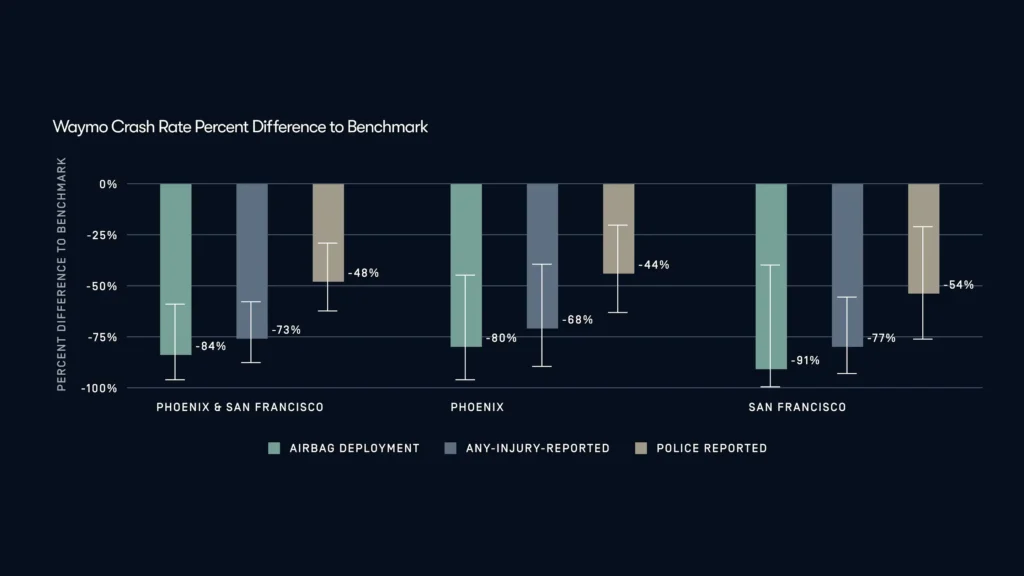
So, if Waymo’s vast dataset shows that autonomous cars are safer than human drivers, why do we still feel so scared of the technology?
In the years since Waymo hit the streets of the United States, anti-autonomous-car sentiment has risen, including attacks on Waymo cars and vehicles being set on fire in protests targeting the robotaxi company (Luscombe 2024).
Groups like the “Safe Street Rebels” have been running campaigns to disrupt and disable driverless vehicles in San Francisco since Waymo began operations in 2022.
The members of the group use tactics such as covering the sensors on the driverless cars, which puts them into “panic mode” and requires a human employee to drive to the car’s location and reset it.
Much of the anti-AI sentiment in the United States stems from the fact that large corporate data systems aren’t always the most popular.
As Kate Crawford, author of the Atlas of AI, puts it, artificial intelligence as we know it depends entirely on a much wider set of political and social structures.
Due to the capital required to build AI at scale, and the ways of seeing that it optimises AI systems are ultimately designed to serve existing dominant interests. In this sense, artificial intelligence is a registry of power (Crawford, 2021, p. 8).
Automation vs. human judgment is still an open discussion.
There is a cascading logic of automation at work in such systems: automated data collection leads to automated data processing, which, in turn, leads to automated response. This is the overarching trajectory of the current information environment toward automated action that takes place at the speed of pre-emption. (Andrejevic, 2019, p. 9)
It’s easy for us to pass off self-driving cars as “dumb”. Every time an autonomous vehicle makes news headlines, it often draws the reactions of “that would never happen if a human were behind the wheel”.
One of Crawford’s (2021) hallmark arguments about AI is that it is “neither artificial, nor intelligent”:
AI systems are not autonomous, rational, or able to discern anything without extensive, computationally intensive training with large datasets or predefined rules and rewards.
In fact, artificial intelligence as we know it depends entirely on a much wider set of political and social structures. And due to the capital required to build AI at scale and the ways of seeing that it optimizes AI systems are ultimately designed to serve existing dominant interests. (Crawford, 2021, p.8)
But one of the key factors that sets AI driving apart from human driving is the automated, sometimes pre-emptive actions that a human brain wouldn’t be able to take in a split second.
Studies by MIT researchers have found that it takes an average of 1.6 seconds for a human driver to hit the brakes when a road obstacle appears, but a self-driving car’s radar and lidar sensors have reaction times of 0.5 seconds.
But when stories like this one below hit the mainstream news, we can’t help but remember that autonomous systems are still nowhere near perfect in their current state.
So, it’s no secret that autonomous vehicles lack human judgment and reasoning. While self-driving software takes prediction and optimisation to the next level, and reaction times and crash avoidance may be lightning fast, what’s the point if the cars perform so comically badly that the above news story needs to be written?
The Black Box Society Problem
This leads us to Pasquale’s (2015) Black Box Society problem. He states that decisions that used to be based on human reflection are now made automatically. Software encodes thousands of rules and instructions computed in a fraction of a second.
Such automated processes have long guided our planes, run the physical backbone of the Internet, and interpreted our GPSes. In short, they improve the quality of our daily lives in ways both noticeable and not (Pasquale, 2015, p. 8).
Yet in the next paragraph, Pasquale offers an interesting juxtaposition:
But where do we call a halt? Similar protocols also influence— invisibly—not only the route we take to a new restaurant, but which restaurant Google, Yelp, OpenTable, or Siri recommends to us. They might help us find reviews of the car we drive.
Yet choosing a car, or even a restaurant, is not as straightforward as optimizing an engine or routing a drive. Does the recommendation engine take into account, say, whether the restaurant or car company gives its workers health benefi ts or maternity leave? Could we prompt it to do so? (Pasquale, 2015, p. 8)
With this in mind, Pasquale concludes his statement with the poignant sentence: “The values and prerogatives that the encoded rules enact are hidden within black boxes” (Pasquale, 2015, p. 8).
Last year, a Medium article wrote that a AAA (American Automobile Association) survey found that 68% of Americans are afraid to ride in a self-driving car, a sharp rise from previous years. One major reason? People worry machines will make cold, calculating decisions without human values (Fedytskyi, 2025).
This is where our discussion now asks an important question: Will AI technology, such as self-driving cars, ever be able to take human ethics and reason into account?
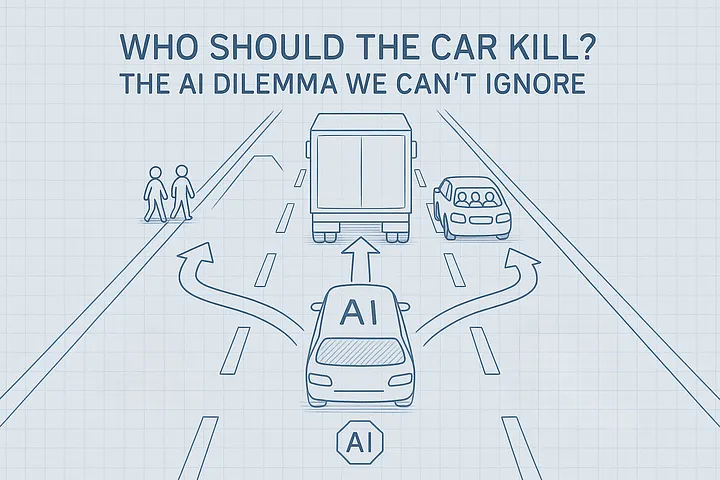
Why is our trust in AI breaking down?
Knowledge is power. To scrutinize others while avoiding scrutiny oneself is one of the most important forms of power. Firms seek out intimate details of potential customers’ and employees’ lives, but give regulators as little information as they possibly can about their own statistics and procedures. (Pasquale, 2015, p. 3)
The millions of computational processes and systems that companies like Waymo own are not open source, and probably will never be. It is in companies’ interests to keep their algorithms locked up tight and secret. Therefore, autonomous driving, being a process that cannot be fully understood, challenged, or audited (Pasquale, 2015, p. 25), makes people scared.
Waymo still faces scepticism despite strong safety claims, and public trust is not easily won through data alone (Hawkins, 2024). Trust is built upon explanation and accountability, and AI is usually fairly opaque and abstract.
In the United States, since self-driving cars are still an emerging industry, there are many blind spots in state and federal laws regarding accountability, liability, and other power structures needed to properly regulate these companies.
In United States Senate hearings this past February, recurring themes included the need for Congress to establish a national framework to regulate AVs rather than a patchwork of state regulations, the need to outcompete China in the development of AVs, and room for improvement in Tesla’s and Waymo’s AV safety features (C-SPAN, 2026).
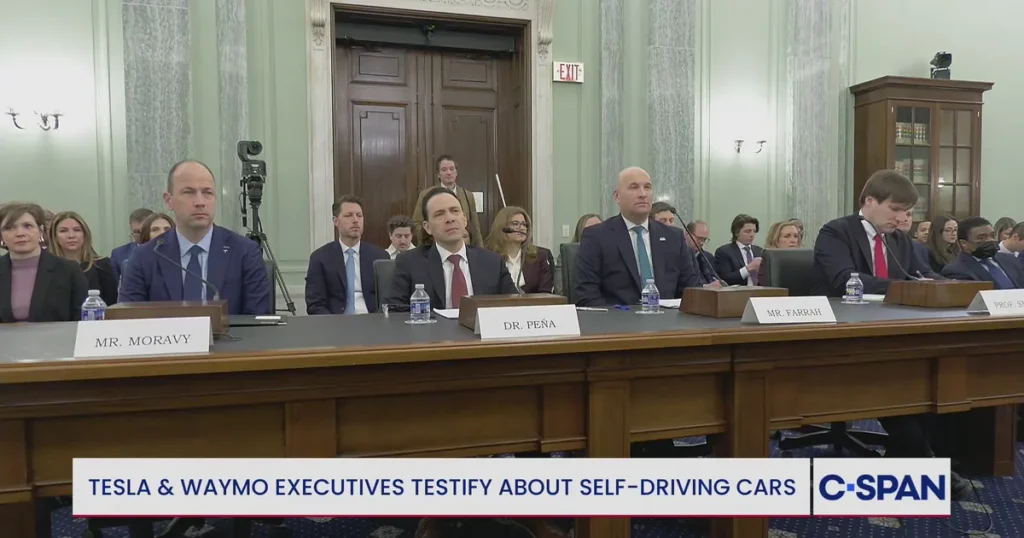
It was never just about driving, wasn’t it?
The viability of technology, like democracy, depends in the end on the practice of justice and on the enforcement of limits to power (Crawford, 2021, p. 20).
Waymo is part of a broader data ecosystem encompassing a wide range of complex areas, including surveillance infrastructure, algorithmic governance, and invisible systems of control. As a subsidiary of Alphabet Inc., the same company that owns Google, Waymo is intertwined with many other facets of the modern-day tech world.
It may be that we cannot stop the collection of information, but we can regulate how it is used. This is easier said than done; data collection has run so wild that it will take time and effort to purify reputation systems of inaccurate or unfair data points. But the alternative is worse (Pasquale, 2015, p. 57).
The fervour and anger that come with viral Waymo mistakes aren’t only about road safety. It is a broader reflection of the general public’s sentiment towards AI. Multiple centuries of industrial and technological evolution have brought us to this point, and only in the past decade have we really dealt with something like the rise of AI.
Like all emerging technologies, there will always be teething problems. Each new technological age, from the adoption of electricity to the end of horse-drawn carriages, or the mass adoption of telephones and the start of the internet, has led to the creation and destruction of multiple industries, businesses, and jobs, with both positive and negative effects.
Scholars, businessmen, early adopters, and the general public all have varying opinions on AI. Some positive, some negative, but what’s clear to us now is that it’s here to stay.
The ending of Crawford’s (2021) first chapter of her book The Atlas of AI: Power, Politics, and the Planetary Costs of Artificial Intelligence gives us a good sentiment to hold on to:
Addressing the foundational problems of AI and planetary computation requires connecting issues of power and justice: from epistemology to labour rights, resource extraction to data protections, racial inequity to climate change.
To do that, we need to expand our understanding of what is underway in the empires of AI, to see what is at stake, and to make better collective decisions about what should come next (Crawford, 2021, p. 21).
Works Cited
ABC7 News Bay Area. “Waymo Cars Honk at Each Other throughout the Night, Disturbing SF Neighbors.” YouTube, 13 Aug. 2024, www.youtube.com/watch?v=Xvs0K1LG1ac.
Andrejevic, Mark. Automated Media. London, Routledge, 2019.
C-SPAN. “Tesla and Waymo Executives, Others Testify about Self-Driving Cars.” C-SPAN.org, C-SPAN, 4 Feb. 2026, www.c-span.org/program/senate-committee/tesla-and-waymo-executives-others-testify-about-self-driving-cars/672835.
Crawford, Kate. ATLAS of AI : Power, Politics, and the Planetary Costs of Artificial Intelligence. New Haven, Yale University Press, 2021.
Fedytskyi, Roman. “Who Should the Car Kill? The AI Dilemma We Can’t Ignore.” Medium, 29 July 2025, medium.com/@roman_fedyskyi/who-should-the-car-kill-the-ai-dilemma-we-cant-ignore-354dbd995525.
FOX 10 Phoenix. “Driverless Waymo Pulled over by Phoenix Police.” YouTube, 4 July 2024, www.youtube.com/watch?v=7W-VneUv8Gk.
Hawkins, Andrew J. “Waymo Hits 170 Million Miles While Avoiding Serious Mayhem.” The Verge, 19 Mar. 2026, www.theverge.com/transportation/896837/waymo-170-million-miles-safety-crashes-injuries. Accessed 2 Apr. 2026.
Hawkins, Andrew J.. “Waymo Thinks It Can Overcome Robotaxi Skepticism with Lots of Safety Data.” The Verge, The Verge, 5 Sept. 2024, www.theverge.com/2024/9/5/24235078/waymo-safety-hub-miles-crashes-robotaxi-transparency.
Luscombe, Richard. “Driverless Taxi Vandalized and Set on Fire in San Francisco’s Chinatown.” The Guardian, 12 Feb. 2024, www.theguardian.com/us-news/2024/feb/12/waymo-car-fire-san-francisco.
Matheson, Rob. “Study Measures How Fast Humans React to Road Hazards.” MIT News | Massachusetts Institute of Technology, 7 Aug. 2019, news.mit.edu/2019/how-fast-humans-react-car-hazards-0807.
National Highway Traffic Safety Administration. “NHTSA.” NHTSA, Apr. 2026, www.nhtsa.gov/press-releases/traffic-deaths-2025-early-estimates-2024-annual. Accessed 2 Apr. 2026.
Pasquale, Frank. The Black Box Society: The Secret Algorithms That Control Money and Information. Cambridge, Massachusetts, Harvard University Press, 2015.
Waymo. “New Data Hub Shows How Waymo Improves Road Safety.” Waymo, 2024, waymo.com/blog/2024/09/safety-data-hub/.
Waymo. “Safety Impact.” Waymo, 2024, waymo.com/safety/impact/.