When regulators fail to curb malicious behaviour on social media platforms, a tragedy in Wuhan demonstrates that a week of unrestricted online hate speech can even be a matter of life and death.
Source: Wikimedia Commons
In June 2023, A tragedy unfolded in Wuhan, Hubei Province, where Ms Yang, also a mother, jumped to her death a week after her son died in a car accident. The incident has drawn widespread attention from both the public and netizens, not only out of grief and sympathy but also anger over negative online comments directed at the mother.
According to netizens, the woman had been suffering serious online abuse. She took her own life due to the grief of losing her child, combined with the unbearable pressure of online criticism. It was the latter factor that caught the police’s attention.
From the death of Ms Yang’s son to her own suicide, what exactly happened on social media in the space of just one week? Why has she become the target of online abuse? Whose fault is this tragedy, really?
It all started with a few photos circulating online. Most of them were taken after the car accident, when Ms Yang spoke out on behalf of her son.

Figure 1
Ms. Yang speaking to the media in Wuhan. This appearance later became the subject of intense “moral auditing” by netizens who claimed her attire was inappropriate for a grieving parent.
Note. From Wuhan bei zhuang xiao xue sheng mu qin zhui lou shen wang, yuan lai piao liang ye shi yi zhong cuo [Photograph], by 雨过天阴, 2023, Zhihu (https://zhuanlan.zhihu.com/p/634357193). Copyright 2023 by 雨过天阴.
For example, in this photo, Ms Yang is seen crying as she seeks justice for her son. In the photograph, Ms Yang is seen crying as she seeks justice for her son. However, some people on social media argued that her immaculate appearance did not reflect the grief of a bereaved mother but rather suggested she was posing for the camera. Very soon, public opinion began to turn against her, with increasing numbers of people voicing doubts; some even went so far as to spread rumours and slander Ms Yang. Under such media pressure and the grief of losing her son, Ms Yang took her own life on 2 June.
Following the incident, the police immediately launched an investigation into the malicious online comments directed at her. By Monday following the incident, the Weibo platform had blocked 33 accounts that had posted “unfriendly comments” regarding Ms Yang and her family, and taken action against 36 posts. But it is too late; a life lost cannot be brought back.

Figure 2
Screenshots of some malicious comments.
Note. From Wuhan bei zhuang xiao xue sheng mu qin zhui lou shen wang, yuan lai piao liang ye shi yi zhong cuo [Photograph], by 雨过天阴, 2023, Zhihu (https://zhuanlan.zhihu.com/p/634357193). Copyright 2023 by 雨过天阴.
The screenshot shows some of the hate speech directed at Ms Yang,
‘Does this mother want to become an internet celebrity?’
‘Is this the child’s mother? How can she speak so calmly??’
‘(She) can even dress this formally.’
‘It’s like (she is) talking about someone else’s child.’
A survey on online hate speech
According to an Ipsos survey covering 16 countries and 8,000 respondents, two-thirds of people said they frequently encounter hate speech.
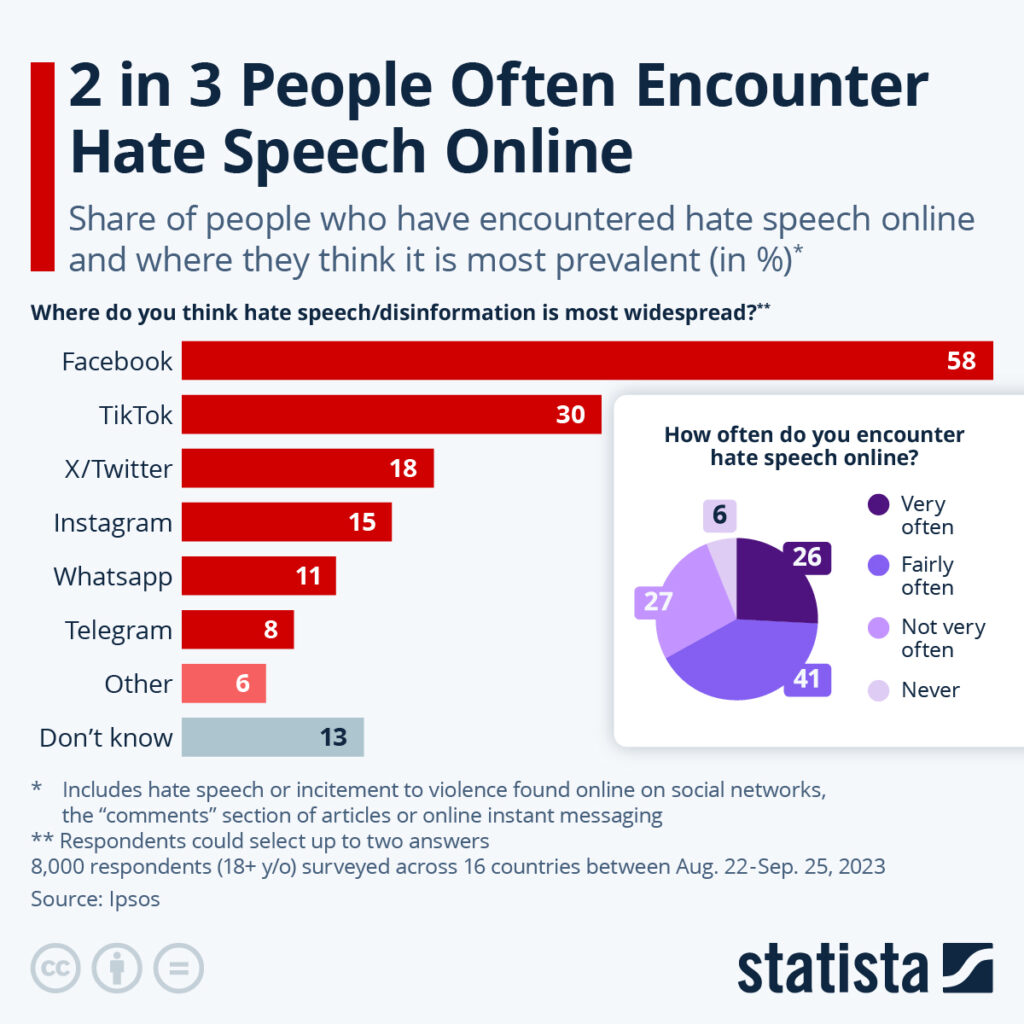
Figure 3
This chart shows the share of people who have encountered hate speech online and where they think it is most prevalent (in %). Source:https://www.statista.com/chart/33299/online-hate-speech-encounters/
The urgent need for a shift in platform governance is underscored by global public sentiment. There is an overwhelming consensus that both governments and social media companies must take proactive steps to address digital harms; 88% of citizens believe regulators must act, while 90% demand more from the platforms themselves (UNESCO, 2023, pp. 8–9).
Why Her?
Why did she become the target of online abuse? Is this really the fault of her dress or appearance?
Initially, the news of a primary school pupil being killed in a traffic accident on campus stirred public outrage, making it more likely to attract attention on social media platforms operating within the ‘attention economy’.
This was followed by a focus on Ms Yang’s appearance. Surveys show that women are more likely than men to experience gender-based abuse online. Gender discrimination is one aspect of these abuses. Given Ms Yang’s attire, many felt it did not comport with the image of a mother grieving the loss of her child but rather appeared to be a carefully orchestrated display. Furthermore, in the East Asian context, married women with children are expected to focus on their families; her polished appearance has triggered a digital ‘witch hunt’ by self-appointed morality police, leading to a flurry of rumours. As Guan and Chen (2026) explain, Ms Yang is seen as a ‘symbolic threat’ to the traditional image of a mother who has lost a child. This criticism stems from her identity as a ‘woman’ and a ‘mother’. ‘Being pretty’ became her ‘original sin’. A similar case is that of ‘Zheng Linghua’, a female student at a teachers’ college who was subjected to online abuse for visiting her seriously ill grandfather with pink-dyed hair; unable to bear the pressure of the rumours, she took her own life. The online abuse she suffered stemmed from the intersection of her gender and her status as a student. And so, the negative public sentiment stirred up by the ‘moral police’ on social media platforms was amplified by the algorithms, thereby becoming a form of ‘social consensus’, ultimately crushing one vibrant life after another.
Whose Fault is it?
When we see a viral hate campaign, our first instinct is to blame the “trolls” typing the comments. While those individuals are responsible for their words, we must ask: who gave them the megaphone?
The scholar Matamoros-Fernández (2017) argues that although platforms appear neutral, features such as ‘like’ and ‘share’ draw users into the dissemination process, ultimately amplifying the spread of negative discourse. Negative content is more likely to grab people’s attention than positive content, thereby garnering more likes and shares. While individual users type the hateful comments, it is the social media platform that decides how far that hate travels. The design of media platforms has inadvertently facilitated the spread of negative comments. We might think of these applications as buildings: if a building is constructed without security measures or fire escapes, when a fire breaks out, we would not simply blame the arsonist; we would ask: why was this building so unsafe to begin with?
Since negative impacts arising from the design of platform features are inevitable, regulation must not be neglected. However, there remains controversy over who should be responsible for regulation and what kind of speech should be restricted.
As scholars Lorna Woods and William Perrin (2021) suggest, we need to hold platforms to a “Duty of Care”. First, the ‘polluter pays’ rule, this requires companies to assume responsibility for the safety of their designs and holds those responsible for causing harm to account; this approach is both cost-effective and fair. The second point is ‘Safety by Design’, as Lorna Woods and William Perrin (2021) argued in their article, ‘the platforms which affect user behaviour reflect choices made by the people who create and manage them and those who make choices should be responsible for, at least, the reasonably foreseeable risks of those choices’ (p.95).
For example, in the Wuhan incident, Weibo, as a platform for the dissemination of negative comments, took responsibility for suspending accounts and imposing speech restrictions, but its regulatory measures still fell short.
In short, safety shouldn’t be an optional feature; it must be the foundation. The platform’s design should incorporate regulatory features to prevent online bullying, such as automated monitoring of comments and the ability to mute users, rather than merely removing content after the fact. Although most media platforms can now automatically identify and block hate speech, Ms Yang’s tragedy highlights a flaw in today’s regulatory mechanisms: media platforms’ ‘universal community guidelines’ do not necessarily align with local cultural realities. As those comments about her mentioned above contain virtually no abusive language, they have therefore evaded the platform’s automated monitoring. However, when viewed within the East Asian context, these comments are undoubtedly hate speech. The report ‘Facebook: Regulating Hate Speech in the Asia-Pacific’ provides examples of the proportion of hate speech targeting different groups across various countries in the Asia-Pacific region, illustrating the regional characteristics of online hate speech.
Regulation of the platform requires a legislative basis. The fight against online hate is no longer just about clicking “report” on a single comment; it is becoming a global movement to change how platforms are built. Currently, there are already a few legislative provisions worldwide targeting online hate speech. In Australia, the Online Safety Act 2021 empowers a dedicated eSafety Commissioner to protect platform users. Similarly, the EU has enacted the Digital Services Act (DSA), while the UK has enacted the Online Safety Act. Germany has enacted the Network Enforcement Act (NetzDG), which is one of the first pieces of legislation to attempt to regulate social media, with a particular focus on the speed of content removal. Except the United States, where the Constitution protect freedom of speech, preventing the introduction of legislation targeting online hate speech, most major Western developed nations have already enacted relevant legislation. However, these Western laws cannot curb hate speech on platforms within China and simply adopting them would prove ineffective due to regional cultural differences. Therefore, China has taken its own action.
Building the Digital Shield
To address the growing problem of online hate speech and the spread of harmful content, China has launched “Operation Qinglang” (meaning “clear and bright”). In the early stages of the operation, the regulatory targets primarily focused on disputes among fan groups in the entertainment and sports circles.
In September 2023, China issued the ‘Guiding Opinions on Punishing Cyberbullying and Related Criminal Acts in Accordance with the Law’, which sets out the criminal liability for acts of cyberbullying. In addition, China began implementing cyber abuse regulations in August 2024. Through legislation, we’re seeing a massive shift in the rules of the game. Instead of just crossing our fingers and hoping platforms or users will report the bullies, new laws are finally stepping in to make safety a requirement, not an option. According to the law, many platforms will alert users to take protective measures when they detect that a user is at risk of being subjected to hate speech, and the platforms will also identify and block harmful content.
Under the protection of the law and with the help of automated detection technology, a great deal of hate speech has been removed from media platforms. However, can legislation and platforms’ automated regulation truly safeguard against the “attention economy”? When viewed through a cultural lens, much of this malice can be conveyed through simple nouns or emoticons alone, easily evading automated detection. Rules on paper aren’t enough. That’s why we need more than just general oversight. We need specialist auditors who know exactly what to look for, helping to review content and keep our online spaces from turning into a ‘Wild West’.
Beyond the Pixels: Reclaiming Our Digital Humanity
Recently, diving champion Quan Hongchan has been subjected to cyberbullying over her body. The Swimming Centre of the General Administration of Sport has reported the matter to the police and is taking legal action to protect her rights, demonstrating that combating online abuse through the law is not merely an empty promise.

Figure 4
Quan Hongchan in 2023
Note. From Quan Hongchan [Photograph], by China News Service, 2023, Wikimedia Commons (https://commons.wikimedia.org/w/index.php?curid=138509806). Licensed under CC BY 3.0.
However, in the end, we never received the results of the investigation into the online abuse suffered by Ms Yang; all we saw were comments and accounts being blocked. This tragedy reminds us that online hate is not merely a collection of pixels on a screen; it can have devastating real-world consequences. A healthy online environment is created through the joint efforts of platforms, users and the law. Although online hate and harm have already attracted the attention of platform operators and governments, and new legal frameworks and regulations are being put in place, this work is far from over. It is time to recognise that a safer internet isn’t just about better moderation or smarter filters; it’s about reclaiming our humanity in digital spaces.
Sources
BFJ – Enforcement of the law in social networks. (n.d.). BFJWEB. https://www.bundesjustizamt.de/EN/Topics/EnforcementoftheLawinSocialNetworks/EnforcementoftheLawinSocialNetworks_node.html
China News Service. (2023, June 10). Quan Hongchan [Photograph]. Wikimedia Commons. https://commons.wikimedia.org/w/index.php?curid=138509806
Department for Science, Innovation and Technology. (2024, December 17). Online Safety Act – Illegal Content Codes of Practice 2024 and explanatory memorandum. GOV.UK. https://www.gov.uk/government/publications/online-safety-act-illegal-content-codes-of-practice-2024-explanatory-memorandum
Department of Infrastructure, Transport, Regional Development, Communications and the Arts. (2024, May 13). Current online safety legislation. Australian Government. https://www.infrastructure.gov.au/media-technology-communications/internet/online-safety/current-legislation
eSafety Commissioner. (n.d.). Online risks for women. Australian Government. https://www.esafety.gov.au/women/online-risks-for-women
Fleck, A. (2024, October 21). 2 in 3 People Often Encounter Hate Speech Online. Statista Daily Data. https://www.statista.com/chart/33299/online-hate-speech-encounters/?srsltid=AfmBOoq_s8BodDOMCFk5dxBk6eSqChO05PpEThfDr5abQAxQpPt6rxMn#google_vignette
Guan, T., & Chen, X. (2026). Threat Perception, Otherness and Hate Speech in China’s Cyberspace. Journal of Contemporary China, 35(158), 1337–1352. https://doi.org/10.1080/10670564.2025.2475051
Matamoros-Fernández, A. (2017). Platformed racism: the mediation and circulation of an Australian race-based controversy on Twitter, Facebook and YouTube. Information, Communication & Society, 20(6), 930–946. https://doi.org/10.1080/1369118X.2017.1293130
Sinpeng, A., Martin, F. R., Gelber, K., & Shields, K. (2021). Facebook: Regulating Hate Speech in the Asia Pacific. Department of Media and Communications, The University of Sydney. https://hdl.handle.net/2123/25116.3
The Digital Services Act. (n.d.). Shaping Europe’s Digital Future. https://digital-strategy.ec.europa.eu/en/policies/digital-services-act
Tone, S. (2023, June 5). In Wuhan, mother takes own life days after son’s fatal accident. #SixthTone. https://www.sixthtone.com/news/1013045
U.S. Const. amend. I. https://constitution.congress.gov/constitution/amendment-1/
UNESCO & IPSOS. (2023). Survey on the impact of online disinformation and hate speech (M. Gallard, Ed.) [Report]. https://www.ipsos.com/sites/default/files/ct/news/documents/2023-11/unesco-ipsos-online-disinformation-hate-speech.pdf
Wikipedia contributors. (2026, February 25). Operation Qinglang. Wikipedia. https://en.wikipedia.org/wiki/Operation_Qinglang
Zhang, S., & Zhang, S. (2026, April 3). Olympic champion diving star Quan Hongchan says she is victim of cyberbullying over her body. South China Morning Post. https://www.scmp.com/sport/other-sport/article/3348424/olympic-champion-diving-star-quan-hongchan-says-she-victim-cyberbullying-over-her-body
曹伟 [Cao, W]. (2023, June 2). Wuhan xiao nei bei zhuang si xiao xue sheng mu qin tiao lou shen wang, dang di jing fang: zheng diao cha fan ying si zhe ceng zao wang bao qing kuang [武汉校内被撞死小学生母亲跳楼身亡,当地警方:正调查反映死者曾遭网暴情况: Mother of primary school pupil killed in a collision on a Wuhan school campus dies after jumping from a building; local police: investigating reports that the deceased had been subjected to online abuse]. Xiaoxiang Morning Herald. https://baijiahao.baidu.com/s?id=1767601599602252706
刘佳妮 [Liu, J]. (2023, June 5). Dui “xiao xue sheng xiao nei bei Zhuang shen wang” shi jian fa biao bu dang ping shu, 33 ge wei bo zhang hao bei chu li [对“小学生校内被撞身亡”事件发表不当评述,33个微博账号被处理: 33 Weibo accounts have been penalised for making inappropriate comments regarding the incident in which a primary school pupil was killed in a collision on school premises]. The Beijing News. https://baijiahao.baidu.com/s?id=1767833129239877369
澎湃新闻[ [The Paper]. (2023, 2月 22). Fen se tou fa nv hai zao yu wang bao, mei ti ru he bao dao|shi jian fu pan [粉色头发女孩遭遇网暴,媒体如何报道|事件复盘: Girl with pink hair subjected to online abuse: how the media covered the story | A review of the incident]. https://www.thepaper.cn/newsDetail_forward_22030040
雨过天阴 [Yu Guo Tian Yin]. (2023, June 3). Wuhan bei zhuang xiao xue sheng mu qin zhui lou shen wang, yuan lai piao liang ye shi yi zhong cuo [Photograph]. Zhihu. https://zhuanlan.zhihu.com/p/634357193
雨过天阴[Yu Guo Tian Yin]. (2023, June 3). Wuhan bei zhuang xiao xue sheng mu qin zhui lou shen wang, yuan lai piao liang ye shi yi zhong cuo [Mother of primary school pupil hit by car in Wuhan dies after falling from a building; it turns out that being beautiful is also a mistake]. Zhihu. https://zhuanlan.zhihu.com/p/634357193
Be the first to comment