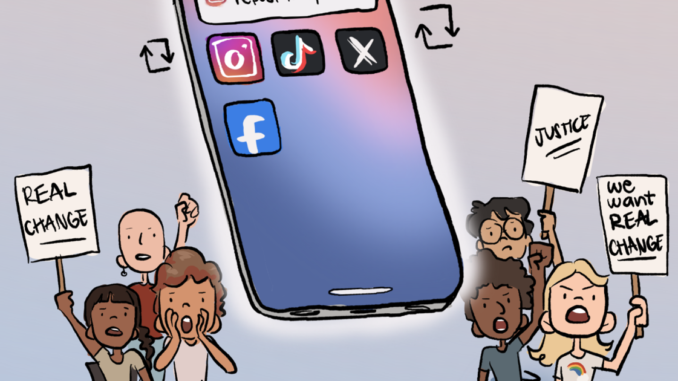
For years, social media companies have positioned themselves as neutral intermediaries, likening themselves to just “post office delivering the mail”. But things are about to change.
In a landmark decision that has sent shockwaves through the tech industry, a Los Angeles jury did something no court had ever done before. On March 25, 2026, after more than 40 hours of deliberation, it found Instagram (owned by Meta) and YouTube (owned by Google) negligent – not for the content users posted on their platforms, but for the way those platforms were designed and built. The case, brought on by a 20-year-old women identified as KGM, had sued Meta and YouTube over her childhood addiction to social media. She started using YouTube at age six and Instagram at age nine. By the time she finished primary school, she had posted 284 videos online, and was suffering from anxiety, depression, and body dysmorphia.
The jury awarded KGM $6 million in damages. Beyond the historic amount, what is more crucial is the jury’s finding that Meta and YouTube have acted with “malice, oppression or fraud” in designing their products, resulting in the $3 million punitive damages on top of the $3 million compensatory damage. Basically, it’s saying that Meta and YouTube are liable for deliberately designing their platforms to be addictive and causing personal injury, especially when they knew children were being harmed.

This is the moment digital rights advocates have been waiting years for. It is also, to borrow a phrase now circulating among legal experts, social media’s “Big Tobacco” moment in which an entire industry can no longer hide behind the argument that its products are neutral tools and the harm they cause is simply the user’s problem. It signifies the closing of an era where platforms could do almost anything they liked, collect whatever data they wanted, and design whatever psychological hooks they chose.
In its place, a new legal concept is emerging: the duty of care. And understanding what that means, and why it matters, is one of the most important things you can do as a citizen of the digital world right now.
What is a Digital Duty of Care?
At its core, a duty of care is a legal principle where simply put, if you create a system that can reasonably cause harm, you have a responsibility to prevent that harm from occurring. Traditionally this is applied in clearly defined contexts such as doctors being accountable for patient safety, employers responsible for workplace conditions, and manufacturers liable for the safety of their products. Research suggests that such “process-based regulation orientated towards preventing harmful outcomes, which puts responsibility on companies to design services safely, will work better” (Woods & Perrin, 2021, p. 94). Importantly, this same logic is now being actively extended and implemented in the digital context.
This approach is systemic rather than content-based, and preventative rather than palliative. Wood and Perrin (2021) posit that a duty of care recognises that the platform, not the content, should be the focus of regulation, and that duty of care implies a risk assessment so that reasonably foreseeable harms are avoided or mitigated. This is a profound shift in regulatory logic. Instead of asking “was this content harmful?”, the question now becomes “did this platform take reasonable steps to prevent foreseeable harm from arising in the first place?”.
Seen this way, harm is not simply the result of bad actors or isolated incidents. It can be systemically produced, emerging from the very architecture of the platform. A duty of care framework makes this explicit: if harm is built into the system’s logic, then responsibility must also sit with those who design and profit from these digital environments.
The KGM verdict applies exactly this logic. Meta and YouTube were found negligent not because of the harmful content that it hosts, but because they knowingly designed products that created foreseeable harm to its user without taking adequate steps to mitigate that harm.

Machines Designed to Addict
Have you ever picked up your phone thinking to have a quick scroll and the next time you checked the clock an hour has went by? If so, you’ve experienced platform design at work.
Social media platforms are engineered environments built to maximise the time you spend on them because time on platform equals profits generated for the platform. Features such as infinite scroll, personalised recommendations, and push notifications are not accidental but deliberate design choices with roots in behavioural psychology to keep young users hooked and difficult to stop. KGM’s lawyer Mark Lanier told the jurors:
“These companies built machines designed to addict the brains of children, and they did it on purpose.”
During the trial, multiple internal Meta documents were presented to the jury highlighting not just the company’s deliberate effort to attract and keep young users on their platform even when they were underaged, but also how they did nothing even when they knew that their control measures did little to reduce teens’ compulsive social media use. This is evidence that harm was not just foreseeable, but it was anticipated and ignored.
For children and teenagers, the stakes are uniquely high. KGM told the court she has stopped engaging with family because she was spending all her time of social media, and her therapist testified that KGM’s social media experience were contributing factors to her mental issues. This is significant because it directly links the platform’s design choices to real-world psychological harm.
Why Design is a Form of Governance
The KGM case serves as a reminder that platform design is inseparable from its governance. When the jury holds a company liable for the addictive nature of its interface, they are also acknowledging that the way a platform is built dictates how it is ruled. As Gillespie (2018, p. 257) argues, “everything on a platform is designed and orchestrated”, and that these digital spaces are built “to invite and shape participation, toward particular ends”. This link between design and governance is why scholars argue that online harms are not accidents, but structural features:
- Algorithmic Oppression: Noble (2018) shows that when recommendation engines are designed for speed and profit, they end up governing search results in ways that systematically reproduce racist and sexist discrimination.
- Platform Racism: Matamoros-Fernández (2017) argues that design and moderation decisions are active tools of governance that decide which voices are amplified and which are silenced.
- Engineered Toxicity: Massanari (2017) demonstrated how Reddit’s design choices created the rules of engagement and contributed to toxic cultures, including harassment campaigns like #Gamergate.
- Punishing the Victim: Carson and Frazer (2018) demonstrate how automated moderation designs often result in governance by algorithm that penalise the victims of abuse rather than the perpetrators.
Looking at these examples, it becomes clear that online harm is not just user-driven but platform-mediated and platform-amplified. But if evidence of this structural failure has been documented for years, why has the law been so slow to demand a “Duty of Care”?
Twenty-Six Words: The Shield Against Accountability
The reason the law has been so slow to catch up lies in twenty-six words that effectively created the modern internet:
“No provider or user of an interactive computer service shall be treated as the publisher or speaker of any information provided by another information content provider.”
Brannon and Holmes (2024)
These words are the core of Section 230 of the Communications Decency Act (1996). For decades, they provided a “safe harbour” for platforms to argue that there were merely neutral intermediaries. In the eyes of the law, platforms didn’t create content, they just hosted it. Therefore, if harm occurred, it was framed as the result of a bad actor or poor user choice, not the failure of the system itself.
While this immunity made sense in 1996 when the internet was passive and text-based, it created a massive loophole for the social media giants that came later.
This is why the KGM case is a legal breakthrough. By framing the issue as a product defect rather than a content dispute, they rendered the traditional Section 230 defense irrelevant. By shifting the spotlight to the system, it moved the case into the regulated realm of consumer safety.
This is the missing link that makes a statutory digital duty of care possible. By recognising that a platform’s design can be a defective product, we can finally apply the same safety standards to big tech companies that we already apply to many other industries.

The Global Regulatory Sea Change
The KGM verdict is not an isolated event. Around the world, policymakers are moving in favour of a shared recognition that platforms are not just communication tools, but powerful infrastructures that shape society. This international consensus marks a move away from policing individual posts and toward regulating the systemic risks built into platform design.
This shift is already being codified into law across major jurisdictions:
- The United Kingdom (Online Safety Act 2023): This landmark legislation a statutory duty of care, requiring platforms to identify and mitigate risks. Non-compliance carries massive stakes, with fines of up to £18 million or 10% of global turnover, whichever higher.
- The European Union (Digital Service Act): This targets “very large platforms” (those with over 45 million monthly EU users), forcing them to conduct independent assessments of the systemic risks arising from their algorithms and to implement mandatory mitigation measures.
- Australia (The 2024 Reform): Following the UK and ET lead, the Australian Government announced in November 2024 its intention to future-proof the Online Safety Act with a Digital Duty of Care model. As then-Communications Minister Michelle Rowland stated, “The duty of care will put the onus on industry to prevent online harms at a systemic level, instead of individuals having to ‘enter at their own risk’”.
These frameworks represent a fundamental pivot in digital rights, proving that a statutory Duty of Care is the new global standard for the digital age.
Structural Hurdles to Real Reform
While the duty of care framework marks a significant step forward, it does not resolve the underlying systemic tensions of the digital age. Instead, it exposes a new set of difficult problems that require careful balancing rather than simple legal solutions.
A central challenge lies in the direct conflict between user safety and platform business models. Many features criticised as addictive (e.g., infinite scroll, and personalised feeds) are not design flaws, but the engines of platform profitability. As Gillespie (2018, p.35) notes, “most social media platforms, if they have a functioning business model at all, depend on either advertising, on the data their users generate, or both”. This creates a structural tension as the same design choices that drive profit are often those that undermine user wellbeing. Without clear, enforceable standards that specify what constitutes “harmful design”, there is a risk that a general Duty of Care remains nothing more than a symbolic exercise.
A second limitation is the tension between safety regulation and freedom of expression. By expanding platform responsibility, we inadvertently incentivise over-moderation. Under the pressure of massive fines, platforms may choose to remove borderline or controversial content to minimise risk. This risk is most acute for marginalised communities as automated moderation systems often fail to understand cultural context, leading to the disproportionate suppression of marginalised voices (Carlson & Frazer, 2018). Consequently, the challenge for the next decade of digital policy is not simply to make platforms safer, but to do so without undermining open and inclusive participation online.
From Platform Power to Platform Responsibility
KGM was only six years old when she first watched YouTube. She was nine when she joined Instagram. The companies behind those platforms knew she was there, and actively designed the platforms to keep her glued in. While cases against major tech companies have historically struggled to succeed, this ruling is significant because it appears to directly link platform design to real-world mental health harm, and to assign legal responsibility for it.
The duty of care framework offers an alternative by shifting responsibility towards the systems themselves. It recognises that platforms design the environments in which users act, and therefore bear responsibility for that foreseeable risks those environments create.
However, a single ruling does not resolve the structural tensions between profit, design, and user wellbeing. What it does signal, is how harm can be understood as a systemic issue that can carry real legal consequences.
This is not just one family’s story. It is a signal that the governance of the internet is shifting, and that online harm is increasingly being recognised as a real and compensable injury.
References
Allyn, B. (2026, February 18). Zuckerberg grilled about Meta’s strategy to target “teens” and “tweens.” NPR. https://www.npr.org/2026/02/18/nx-s1-5717117/zuckerberg-testimony-social-media-addiction-trial
American Psychological Association. (2024, April). Potential risks of content, features, and functions: The science of how social media affects youth. Apa.org; American psychological association. https://www.apa.org/topics/social-media-internet/youth-social-media-2024
Brannon, V. C., & Holmes, E. N. (2024, January 4). Section 230: An Overview. Congress.gov. https://www.congress.gov/crs-product/R46751
Carlson, B., & Frazer, R. (2018). Social Media Mob: Being Indigenous Online. https://research-management.mq.edu.au/ws/portalfiles/portal/85013179/MQU_SocialMediaMob_report_Carlson_Frazer.pdf
Gillespie, T. (2018). Regulation of and by Platforms. The SAGE Handbook of Social Media, 254–278. https://doi.org/10.4135/9781473984066.n15
Gillespie, T. (2018). The myth of the neutral platform. In Custodians of the internet: Platforms, content moderation, and the hidden decisions that shape social media (pp. 24–44). Yale University Press. https://doi.org/10.12987/9780300235029-002
Godoy, J., & Gorman, S. (2026, February 25). Woman suing Meta, YouTube over social media addiction takes the stand at trial. Reuters. https://www.reuters.com/legal/litigation/woman-suing-meta-youtube-over-social-media-addiction-takes-stand-trial-2026-02-25/
Hays, K. (2026, February 27). “I spent all my time on Instagram,” says woman in landmark trial. https://www.bbc.com/news/articles/c89kdpjn7eqo
Is Big Tech the New Big Tobacco? Lawsuits Say ‘Maybe’ (2026, April 2). The Legal Examiner. https://www.legalexaminer.com/all/technology/is-big-tech-the-new-big-tobacco-similarities-verdict-against-meta-say-maybe/
Massanari, A. (2017). #Gamergate and The Fappening: How Reddit’s algorithm, governance, and culture support toxic technocultures. New Media & Society, 19(3), 329–346. https://doi.org/10.1177/1461444815608807
Matamoros-Fernández, A. (2017). Platformed racism: the mediation and circulation of an Australian race-based controversy on Twitter, Facebook and YouTube. Information, Communication & Society, 20(6), 930–946. https://doi.org/10.1080/1369118x.2017.1293130
Noble, S. U. (2018). Algorithms of Oppression: How Search Engines Reinforce Racism. In JSTOR. NYU Press. https://www.jstor.org/stable/j.ctt1pwt9w5
Online Safety Act: explainer. (2025, April 24). GOV.UK. https://www.gov.uk/government/publications/online-safety-act-explainer/online-safety-act-explainer
Perez, S. (2026, February 18). Meta’s own research found parental supervision doesn’t really help curb teens’ compulsive social media use. TechCrunch. https://techcrunch.com/2026/02/17/metas-own-research-found-parental-supervision-doesnt-really-help-curb-teens-compulsive-social-media-use/
Rowland, M. (2021). New Duty of Care obligations on platforms will keep Australians safer online. Ministers for the Department of Infrastructure. https://minister.infrastructure.gov.au/rowland/media-release/new-duty-care-obligations-platforms-will-keep-australians-safer-online
Sadrolodabaee, N. (2026, February 19). Zuckerberg on the stand: Why this new social media trial could be a turning point. SBS News. https://www.sbs.com.au/news/article/mark-zuckerberg-on-the-stand-why-this-new-social-media-trial-can-be-a-turning-point/te9xkchob
The Digital Services Act. (n.d.). Shaping Europe’s Digital Future. https://digital-strategy.ec.europa.eu/en/policies/digital-services-act
Vanian, J. (2026, March 25). Jury in Los Angeles finds Meta, YouTube negligent in social media addiction trial. CNBC. https://www.cnbc.com/2026/03/25/meta-youtube-los-angeles-california-verdict.html
Woods, L., & Perrin, W. (2021). Obliging Platforms to Accept a Duty of Care. In Regulating Big Tech: Policy Responses to Digital Dominance Regulating Big Tech: Policy Responses to Digital Dominance (pp. 93–109). Oxford University Press. https://doi.org/10.1093/oso/9780197616093.003.0006


Be the first to comment