Why does TikTok seem to know exactly what you want to watch—sometimes before you even realise it yourself?
From personalised recommendations to predictive shopping, artificial intelligence systems are increasingly able to anticipate our behaviour with uncanny accuracy. But these systems are not simply observing us. They are quietly shaping what we see, what we want, and even what we do next.
While these systems are often seen as convenient tools, their predictive power raises an important question: do they simply anticipate behaviour, or actively shape it?
This article argues that AI systems not only predict behaviour, but also influence and constrain it, shifting power from users to platforms.
they actively influence and constrain it. In doing so, they transform how power operates in digital environments, shifting influence away from individual users and toward the platforms that design and control these systems.
To understand how these systems shape behaviour, we first need to look at how they predict it. Every time we scroll, click, or pause on a piece of content, we generate data that platforms collect and analyse.
As Andrejevic (2020) points out, automated media work through a process of data collection, data processing, and automated response. This means that AI is not just reacting to what users have done—it is constantly learning from that data to predict future actions. In doing so, these systems become increasingly effective at staying one step ahead of the user.
What makes these systems particularly powerful is not just their ability to predict behaviour, but their capacity to act on it in advance. Andrejevic (2020) describes this as “pre-emption”—a process in which automated systems anticipate actions before they occur and intervene accordingly. Rather than waiting for users to make decisions, platforms increasingly present content, suggestions, and choices that are already shaped by predictive analysis.
As demonstrated in a video investigation by the Wall Street Journal (2021), TikTok’s algorithm can quickly identify user preferences based on subtle behavioural signals such as how long a user watches a video. This allows the system to rapidly personalise content, often within minutes, showing how predictive systems operate in real time.
In practice, AI systems do not simply respond to user preferences—they help produce them.
When platforms repeatedly recommend certain types of content, they reinforce specific interests while filtering out alternatives. Over time, this creates a feedback loop in which users are guided toward particular behaviours without being fully aware of it.
In this sense, prediction becomes a form of subtle intervention: the system does not just know what users might want—it actively shapes what they come to want.
TikTok provides a powerful predictive system for identifying users’ interests and preferences.
It tracks user interactions such as watch time, scrolling behaviour, and search activity to determine what content will keep users engaged. As Andrejevic (2020) suggests, this reflects how automated systems anticipate and act on behaviour in real time.
However, this process also illustrates the political dimension of AI systems. As Crawford (2021) argues, these technologies are not neutral, but are shaped by the interests of the platforms that design and control them. Taking TikTok as an example, its algorithm prioritises content that can maximise user engagement, which aligns with the platform’s economic interests. This means that the system is not designed to serve users’ interests, but to optimise users’ attention and time spent on the platform.
Over time, this creates a powerful feedback loop. Users are repeatedly exposed to similar types of content, reinforcing certain interests while limiting exposure to others. This can gradually narrow users’ perspectives, influencing not only what they watch but also how they think and interact with the world. In this sense, TikTok does not just predict user behaviour—it actively shapes it.
While TikTok demonstrates how predictive systems shape individual behaviour, the broader implications of these systems extend beyond personal preference into the structuring of social reality itself.
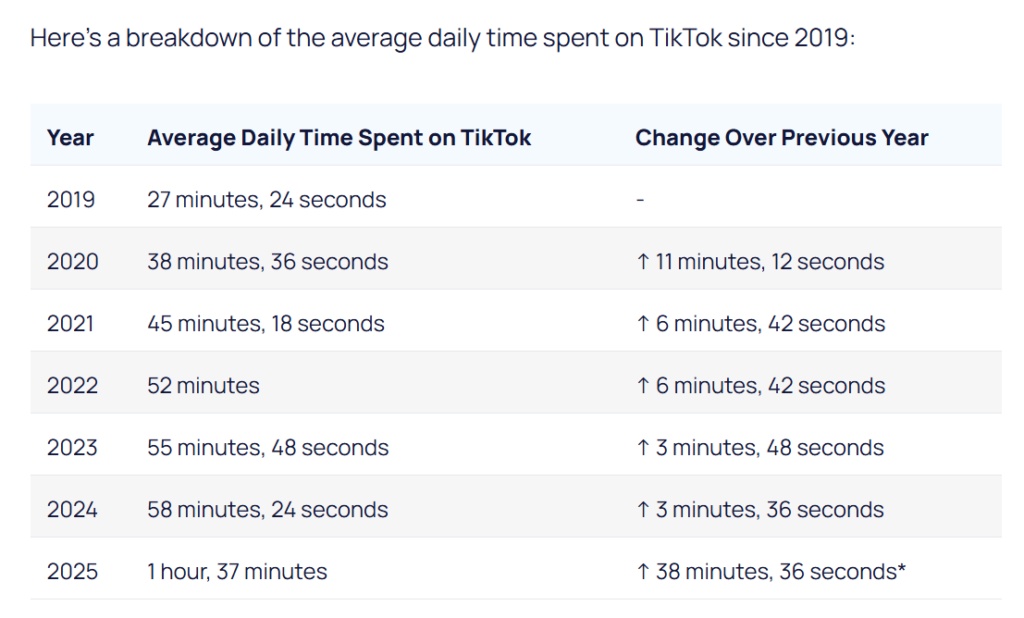
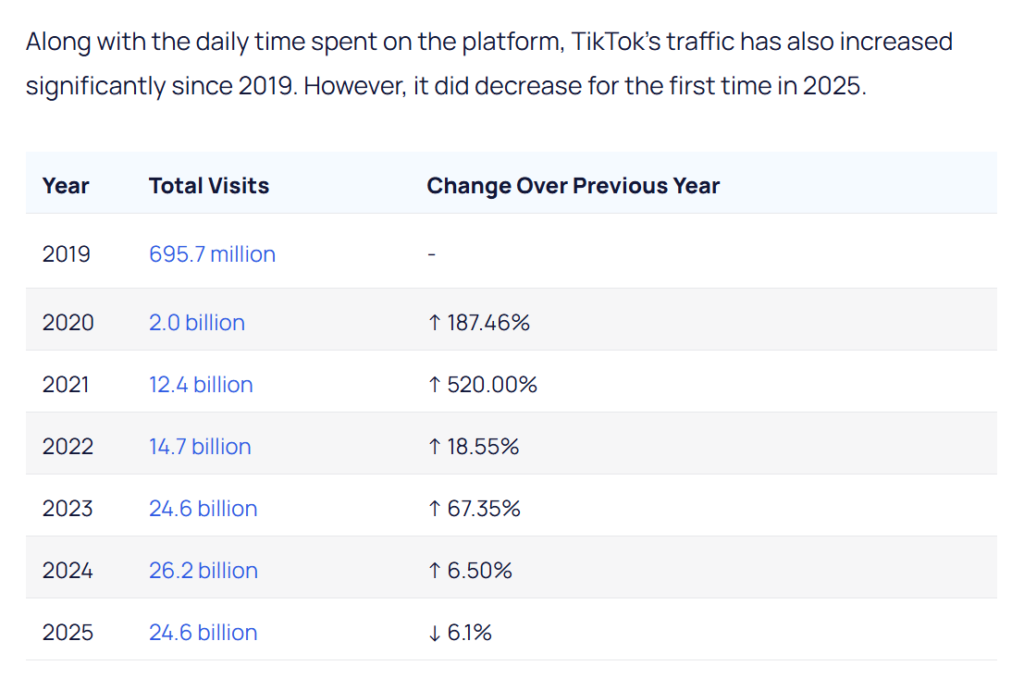
This process becomes more concerning when combined with the scale and intensity of user engagement on platforms like TikTok. Recent data indicate that users spend a significant amount of time on the app each day, with average usage reaching well over an hour and frequent repeated visits throughout the day (Exploding Topics, 2026). In addition, TikTok consistently records some of the highest engagement rates among social media platforms, outperforming competitors such as Instagram and Facebook (Emplicit, 2025). This high level of engagement amplifies the influence of algorithmic systems, as users are continuously exposed to personalised content streams that reinforce specific interests and perspectives.
Autonomy:Are we really making a choice?
On the surface, it feels like everything we watch comes from personal preference.
We scroll, pause, and like—so it seems natural to assume we are in control. But if we look closer, the situation becomes less clear.
The key issue is that we are not choosing from everything that exists—we are choosing from what the algorithm decides to show us. Every recommendation and every “For You” page is already filtered before we even see it. This means our choices take place within a space that has already been shaped in advance. As Andrejevic (2020) suggests, predictive systems do not simply respond to behaviour; they anticipate and guide it.
Instead of making fully independent decisions, users navigate a pre-structured environment where certain options are more visible and easier to engage with. Over time, these options begin to feel like “natural choices,” even though they are the result of algorithmic design.
Because the system learns from our own behaviour, recommendations feel personal and accurate, making them less likely to be questioned. As Crawford (2021) points out, these systems reflect the interests of the platforms behind them, often in ways that remain invisible to users.
Predictive systems do not remove choice entirely, but they shape the conditions in which choices are made. In this sense, what appears to be autonomy may in fact be more guided and limited than we realise.
Narrowing Experience
Another important issue is how these systems quietly narrow what we experience online while reinforcing what we already believe. At first, personalised recommendations seem helpful, showing us content we are more likely to enjoy.
However, because algorithms learn from what we watch, like, and engage with, they tend to show us more of the same. Over time, this reduces the chance of encountering different ideas or perspectives.
This effect becomes even stronger when repetition is combined with emotionally charged content. For example, in a recent online controversy involving Chinese singers Shan Yichun and Li Ronghao, users who encountered a few videos about the incident could quickly be identified by the algorithm as interested in the topic. The system would then recommend more videos with similar viewpoints, often presented in more dramatic or emotionally intensified ways.

(The incident shifted from the original infringement and cover version issue to an attack on appearance.)

(A deluge of abuse)
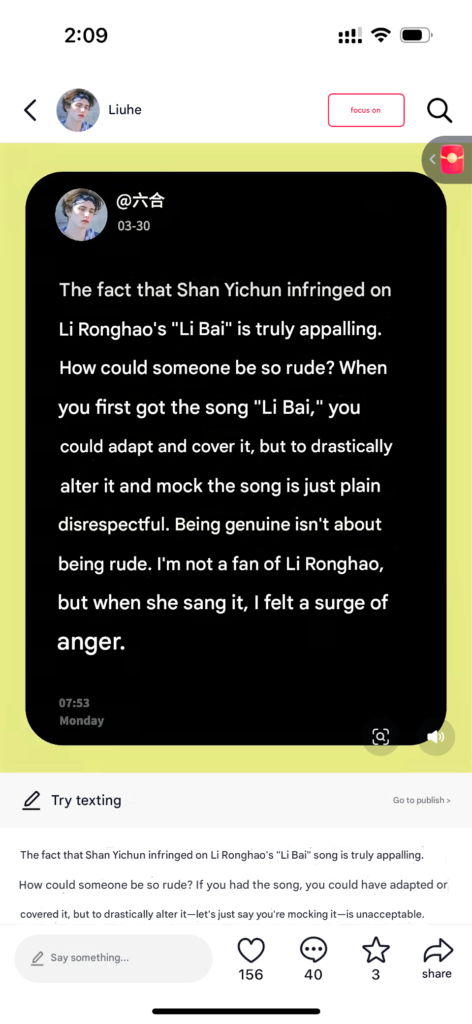
(The remarks of marketing accounts stir up the emotions of ordinary people)
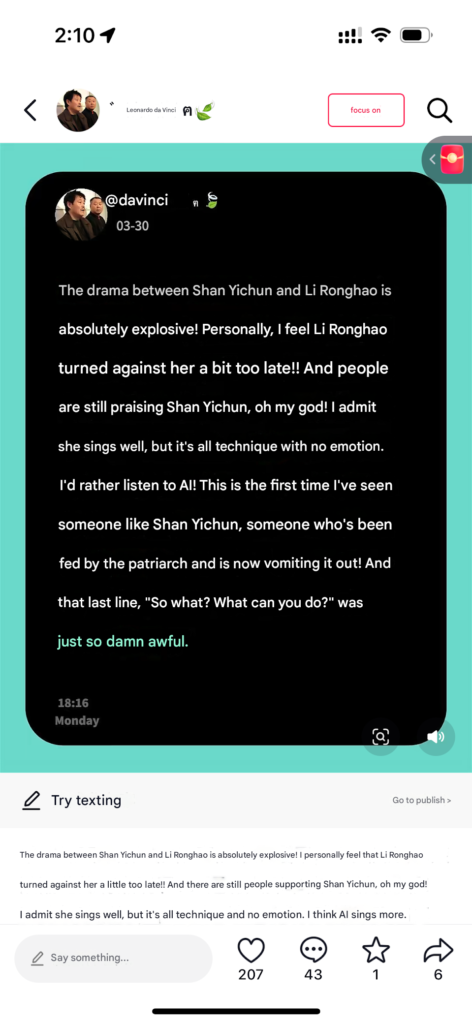
(Although the song had been modified long before, it was only after the recent controversy gained attention that many users began expressing negative opinions, claiming they had always found it unpleasant. This again illustrates how recommendation systems can amplify negative comments, exposing users to repeated criticism and shaping their emotional responses.)
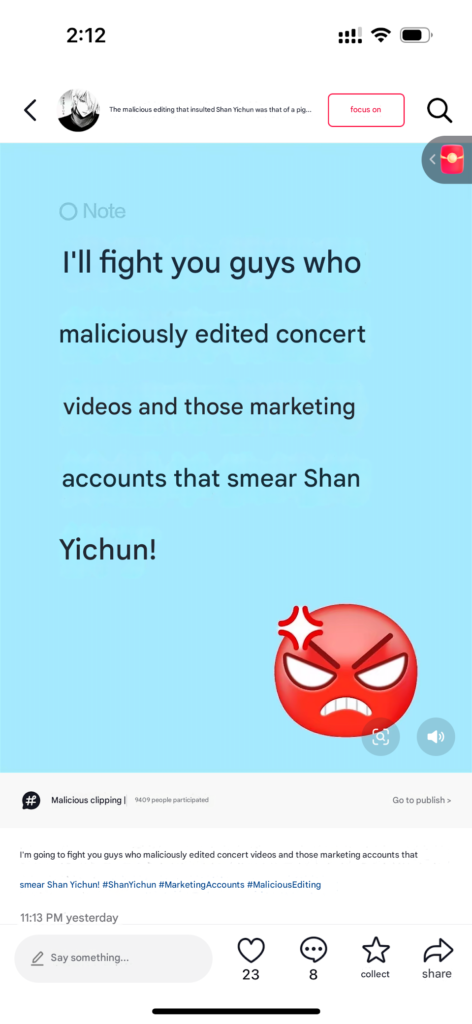
(Some fans of Shan Yichun also stepped forward to have verbal confrontations with netizens)
While a few videos would normally be enough for users to become aware of the issue, algorithmic recommendation systems repeatedly push similar content. Over time, this can make certain perspectives feel more dominant, even if they are one-sided or incomplete, while alternative viewpoints become less visible.
Research on social media also highlights how repeated exposure to similar content can shape users’ thoughts and emotions over time (YouTube, 2023). Content that expresses anger or criticism tends to generate higher engagement, making it more likely to be promoted. As a result, users may be drawn into content streams that amplify negative emotions and reinforce particular viewpoints. In addition, comment sections often become spaces where extreme or highly emotional opinions are amplified. These comments can further influence users who may not critically evaluate the information, making them more likely to be swept up by dominant narratives and emotional reactions.
Importantly, the system does not explicitly block alternative content—it simply makes it less visible. As certain ideas appear more frequently, others quietly disappear. As Just and Latzer (2017) suggest, algorithmic systems play a key role in shaping how people perceive reality.
Instead of encouraging exploration, these systems can trap users in loops of familiar content, repeated viewpoints, and intensified emotions.
Invisible Power: How Algorithms Shape What We See
Another reason these systems are so influential is that their power is often hidden from view. Rather than directly telling users what to think, algorithms shape the flow of information in subtle ways that feel natural and personalised. Because this process is seamless, users rarely question how their feeds are constructed or why certain content appears more frequently than others.
The video further illustrates that recommendation systems actively guide user behaviour.
Algorithms track patterns such as watch time, clicks, and pauses to predict what will keep users engaged. As a result, content is selected not only for relevance, but for its ability to capture attention. (YouTube, 2023).
As Crawford (2021) explains, AI systems are shaped by the goals and interests of the organisations that design them, yet these influences are often invisible to users. This suggests that what appears as neutral or personalised content is in fact structured by underlying priorities, such as maximising engagement or retaining user attention.
In this sense, the influence of algorithmic systems lies not only in what they present, but in how they continuously adjust and refine what users are likely to see next. When this process remains hidden, it becomes difficult for users to recognise its impact or question the assumptions built into it.
Economic Logic: Why Algorithms Are Designed This Way
After understanding how predictive systems shape what we see and influence how we think, an important question remains: why are these systems designed this way? The answer lies not in technology alone, but in the economic logic behind digital platforms.
Platforms such as TikTok, Instagram, and YouTube operate on attention. Their business models rely on keeping users engaged for as long as possible, because more time on the platform means more advertising revenue. As a result, algorithms are not designed to prioritise balanced or diverse content, but to maximise engagement.
This explains why certain types of content are promoted.
Emotionally intense or controversial content generates stronger reactions—more likes, comments, and shares. As a result, algorithms prioritise content that captures attention, even if it reinforces negative or one-sided perspectives.
As Crawford (2021) argues, AI systems reflect the economic and political interests of the organisations that design them. This means that what users see is shaped not only by their preferences, but also by what is most profitable. Personalisation is therefore not just about improving user experience—it is also a strategy for directing attention.
This creates a tension between what benefits users and what benefits platforms. While users may gain from exposure to diverse perspectives, platforms benefit from keeping users within familiar, emotionally engaging content loops. Over time, this can lead to environments that feel personalised but are also repetitive and polarised.
In the end, these systems are not just designed to understand users—they are designed to hold their attention. Once this becomes clear, their influence is no longer neutral, but part of a broader system shaping how users think, feel, and engage online.
When we think about AI systems that seem to “know us,” it is easy to focus on how convenient they are.
These systems work by predicting our behaviour in advance (Andrejevic, 2020). Instead of waiting for us to choose, they guide our choices before we even realise it. For example, on platforms like TikTok, even small actions—like watching a video for a few extra seconds—can quickly shape what we see next. Over time, we are shown more of the same type of content, while other ideas slowly disappear from view.
This influence is not neutral. As Crawford (2021) explains, these systems are designed to make money by keeping our attention. The goal is not just to inform us, but to keep us watching, clicking, and scrolling. That is why content that is emotional, repetitive, or even extreme is often pushed to the top—it keeps people engaged.
Because of this, AI systems are not just tools. They have power. They shape what we notice, what we believe, and what we think is normal. This influence is often hard to see, but it is part of our everyday online experience.
This does not only affect individuals—it also affects society. When many people are shown similar types of content, different groups can end up seeing very different versions of reality. This can increase division, reduce shared understanding, and make it harder for people to have meaningful conversations.
So this leads to an important question: if what we see and think online is being shaped by systems we do not fully understand, how much of it is really our own choice—and what does this mean for both our personal freedom and the way society works?
REFERENCE
Andrejevic, M. (2019). Automated media (1st ed.). Routledge. https://doi.org/10.4324/9780429242595
Bolsover, G., & Howard, P. (2019). Chinese computational propaganda: Automation, algorithms and the manipulation of information about Chinese politics on Twitter and Weibo. Information, Communication & Society, 22(14), 2063–2080. https://doi.org/10.1080/1369118X.2018.1476576
Crawford, K. (2021). Atlas of AI: Power, politics, and the planetary costs of artificial intelligence. Yale University Press.
Emplicit. (2025). TikTok engagement rate benchmarks 2025. Emplicit. https://emplicit.co/tiktok-engagement-rate-benchmarks-2025/
Exploding Topics. (2026). Time spent on TikTok. Exploding Topics. https://explodingtopics.com/blog/time-spent-on-tiktok
Just, N., & Latzer, M. (2017). Governance by algorithms: Reality construction by algorithmic selection on the Internet. Media, Culture & Society, 39(2), 238–258.
The Wall Street Journal. (2021). How TikTok’s algorithm figures you out [Video]. YouTube. https://www.youtube.com/watch?v=nfczi2cI6Cs
YouTube. (2022). How algorithms control what you see online [Video]. YouTube. https://www.youtube.com/watch?v=aFIpQLYMGXY
YouTube. (2023). Social media and your mental health [Video]. YouTube. https://www.youtube.com/watch?v=uTZXjvcsMlU
Be the first to comment