Online Communication Feels Easy, but Not Simple
We are now almost fully living in an online environment. For instance, scrolling TikTok, reading comments, sending posts to friends — these are no longer separate activities, but part of everyday life. Online communication feels very easy. You can type something, click publish, and then it appears in front of people you don’t even know.
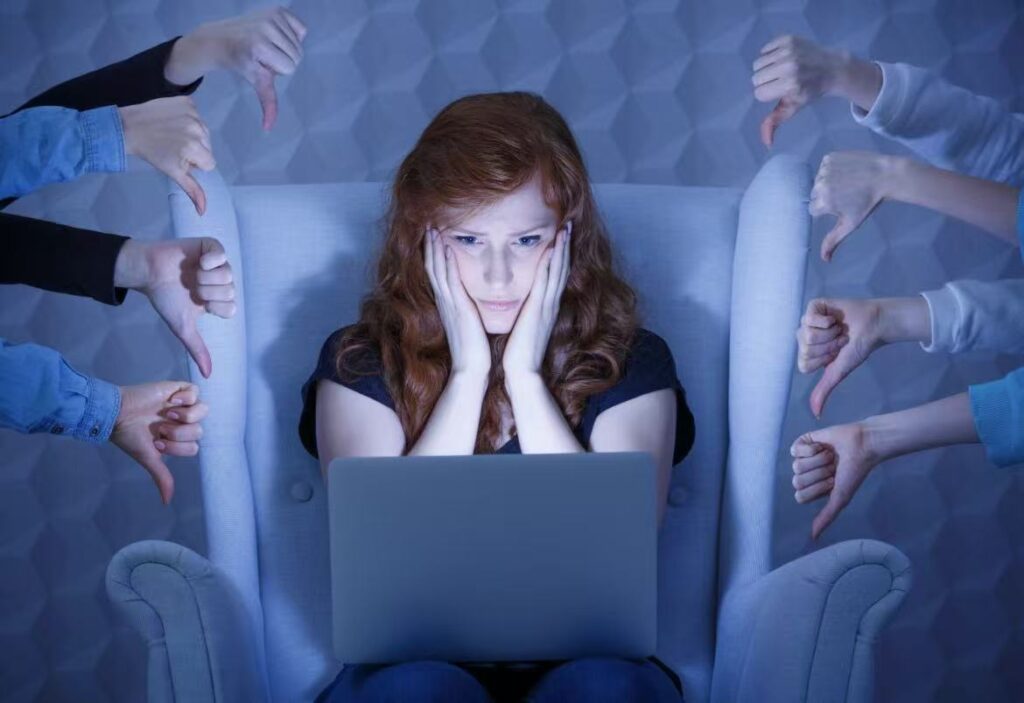
At first, it just feels normal. But if you stay a bit longer, it starts to feel a little off. One person says something a bit harsh, then someone pushes it further, slowly the focus moves away from the content itself and toward the person. People start judging appearance, personality. At that point, it feels less like a discussion and more like a series of reactions.
The strange part is, people don’t really leave, even when it starts getting uncomfortable. So simple advice like “just ignore it” doesn’t really work. It’s not just one comment. After a while, it feels like online harm is not only about individuals. The way platforms show and repeat content also makes some reactions much stronger and harder to escape.
Visibility, Repetition, and the Attention Economy
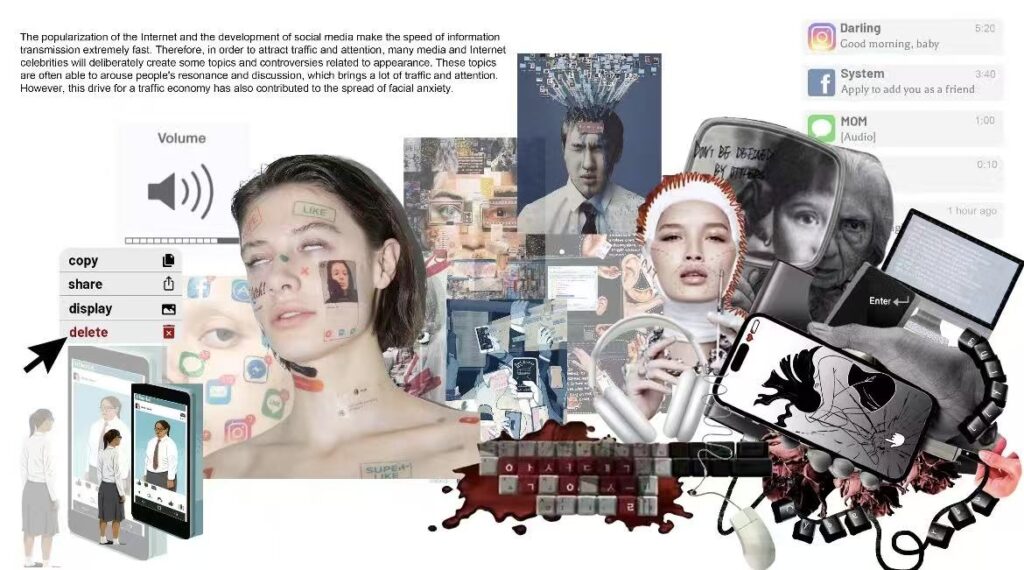
People usually say it’s because things spread faster online. That’s partly true, but it cannot explain everything. Online content works differently. It can appear again on timelines, be recommended to new users, and reach people who were not there in the beginning. The platform’s original design to push content that attracts attention. Calm or balanced responses usually do not travel very far, while emotional or extreme reactions are easier to notice and share. Flew (2021) describes this as part of the “attention economy” and platform-driven visibility. People may start to feel that negative information is everywhere, even when that is not fully true. Seeing the same type of content again and again gradually shapes what people think is normal.
Why Things Don’t Really End Online
Something I didn’t notice at first. In daily life, uncomfortable moments usually pass with time. When you leave the place, the conversation stops, and the situation comes to an end. But on the internet, this kind of boundary is harder to find.
A post can keep receiving comments long after it is first published. New users will join at different times and share their opinions without knowing what has already been said. A small situation at the beginning can slowly grow into a long chain of responses. Each comment feels small on its own, but together they feel like a continuous flow, which can be difficult to step away from. What makes this feeling endless is not just the participants themselves, the way platforms keep pushing the same content to new audiences. As Sinpeng et al. (2021) point out, content doesn’t really stop — it can keep circulating and picking up new reactions long after it first appeared. So it doesn’t really stop when the moment is over.
Nothing Fully Disappears
Another thing is, everything on the internet actually does not disappear. In reality, time creates distance. People forget, and situations lose their importance. In digital systems, things work differently. Crawford (2021) explains that digital systems are built around storing data, which means records are kept over time. People are aware that what they say may stay online for a long time. Even when something is deleted, it may still exist somewhere else.
This changes the way people handle conflicts. Conflicts do not really disappear – they can come back at any time.
Seeing It Through Performance

Writing this, I recall that during my sophomore year of my undergraduate studies, I participated in a stage play (my undergraduate major was performance). I played Lala in Дорогая Елена Сергеевна (Dear Elena Sergeevna), and that’s when I started thinking differently about being watched.
On the stage, everything looks “safe”. A story has a clear beginning and end. You enter the role, finish the performance, and then leave the role. Even if the character is emotional or annoying, the audience can understand that it is not the real you. When I played the role of Lala, she was sometimes emotional and even spoke radically, but no one would come to me and say, “This is the real you.” They are reacting to this role, instead of judging me as an ordinary person.
This is definitely not the case on the Internet. In the online world, there is no clear boundary between “this is what I did” and “this is my identity”. A short video, a sentence, or even just a facial expression may be extracted and spread. And people no longer regard it as a moment, but as evidence. Once this happens, it is actually very difficult to change people’s opinion of you, because they will not wait for more background information. They have already made a decision.
For me, as an actor, this feeling is particularly strange: I have always been used to thinking about various situations. On the stage, nothing exists in isolation. If a character reacts strongly, there will always be some causes and consequences to explain his behavior. Even silence has a reason. But on the Internet, all this has disappeared. And this is not just a problem that leads to misunderstanding. People began to fill these gaps by themselves. They guessed what kind of person you were and what your intentions were. This reminds me of rehearsal, but it’s a completely opposite way. In the rehearsal, we will try different methods to understand a character more deeply. On the Internet, people will also “interpret”, but the result will not become more complicated, but simpler and more fixed. It’s like people build a character on you, but there is almost no real material.
Another thing that impressed me was the role played by the audience. In the play, the audience is important, but they will not change the content of the play itself. On the Internet, this balance has completely disappeared. The audience will no longer just react – they will reshape everything.
Strangely enough, once these new versions are released, they will no longer belong to you completely. As someone who has studied acting, this feels a bit strange to me. On stage, you control how things are understood. But online, it doesn’t really feel like that. Shorter and more emotional content spreads faster. So most of the time, people don’t see a full version of you. They only see the part that gets the strongest reaction.
Once that first impression forms, it becomes hard to shift. If people start to see you as “arrogant”, even neutral behaviour can be read that way. It’s like the meaning comes first, and everything else follows it. This connects to the idea of the social amplification effect (Casperson et al., 1988), where repeated reactions can gradually make something seem more serious or fixed.
Being reduced to one image is about how people react and how platforms organise what we see. What appears first is usually simple, clear, and easy to respond to. So people don’t get to know someone step by step. They remember one moment, and that moment starts to stand for everything. And once that version spreads, it just keeps getting repeated. After a while, it almost feels settled, even if it wasn’t that clear at the beginning.
How Attention Shifts on Weibo
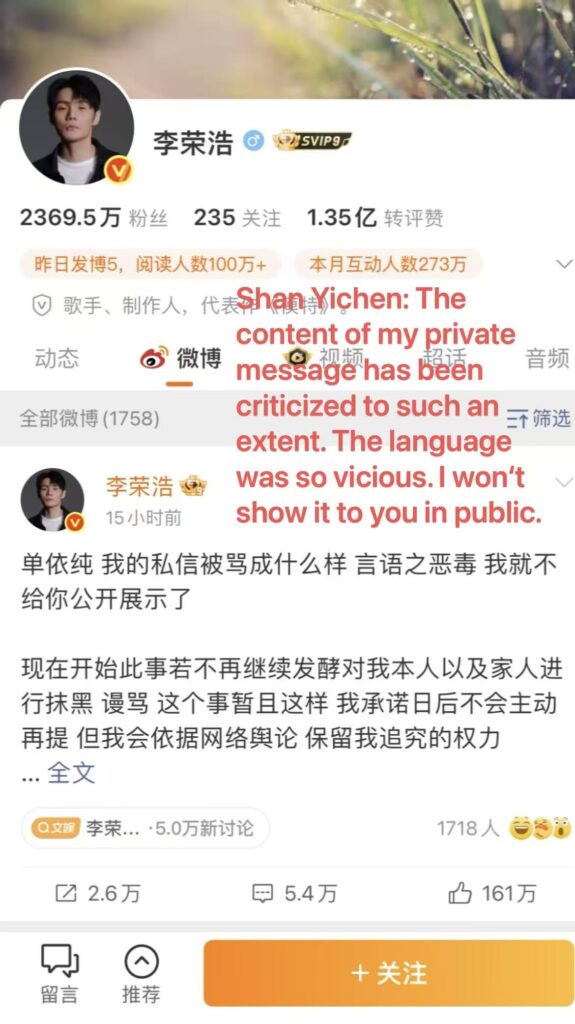
I have actually seen this happen quite a few times recently. In March this year on Weibo, there was this situation between two singers about a copyright issue. At first people were actually talking about the song itself, like whether it was used properly or not. But after a while, the comments just changed direction. People started focusing on the two people instead, arguing about their personalities and taking sides. Even when one of them tried to explain, it didn’t really calm things down. So once a major event occurs, people seem to be discussing it seriously at first. Everyone is expressing opinions and adding information, trying to figure out what happened. But then suddenly, the situation changed. A new topic suddenly appeared and quickly became a hot topic. Sometimes it is even irrelevant, but it is more emotional, more dramatic, and more likely to cause controversy. People diverted their attention in this way. The original thing was like this… gradually faded out of people’s sight. It has not completely disappeared, but it is no longer the focus of people’s attention. It seems that this platform quietly leads people to other places. I remember once, a person was criticized a lot, and just as the criticism began to become fierce, another completely different topic suddenly broke out. Everyone ran there to argue. It doesn’t feel natural. It feels like the heat has been redistributed. But for the person concerned, the matter is not really over. People are still talking about it, but in a smaller range, and in a more confusing way. It’s almost worse because there’s no clear moment to show when it’s all over.
In addition, the way of setting the topic is also very important. Sometimes it doesn’t even matter the original problem itself. Instead, it became a question of “who is right and who is wrong”. People began to attack each other instead of thinking about what actually happened. So what seems to be “public opinion” has actually been pre-shaped. What you see is not all. What you see is only the part that was forced on you.
How Meaning Gets Fixed on TikTok
TikTok feels a bit different, but it is essentially similar. It no longer focuses on hot topics, but revolves more around some random videos that suddenly become popular. You will see a video clip, which may only be 10 seconds or 15 seconds long, which is all you can see. There is no background information and no explanation. But the comment section is full of content. People are very sure of what they think is happening.
I recently saw an example, there was a short clip going around where a few influencers made comments that people thought were body-shaming. The video spread really fast, and a lot of people reacted straight away. Later on, one of them said the clip was taken out of context, but by then it didn’t really matter anymore. People had already formed an impression, and you could see the same comments repeating under different posts. It just stayed like that. These clips have already determined how people understand the situation, and before that, people have not even thought about it. This is related to the framework theory (Entman, 1993), that is, the way things are presented will affect people’s understanding of it.
That’s the problem. On TikTok, the important thing is not whether the matter itself is true or not, but the content that spreads first and the content that is more likely to arouse people’s reaction. Once a certain version becomes popular, all the content after that will follow suit. People no longer react to the actual situation, but to the version that has been circulated. When you combine these two points, you no longer think it is a problem of “people are mean”. Of course, it’s true that people do say something sharp. The environment is also working. It will choose certain moments, enlarge it, present it repeatedly, and then make it difficult for anything else to replace them.
Not Just Harm, but an Unstable System
I don’t really think it’s fair to say the internet is just full of bad things. At some point, it is helpful to people. I have seen such a situation: some people shared their experiences, such as unfair treatment (such as domestic violence, sexual assault, salary arrears, etc.), which attracted people’s attention. At the same time, more information was disclosed, and the situation also improved. Without social media, this kind of ordinary people’s voice and attention may not have happened. So to some extent, it does give people a real and credible voice channel.
At the same time, this system, which can play a positive role in some cases, will also put pressure on others in some cases. It doesn’t care what the form of this attention is. As long as people react, it will continue. Therefore, the way of support and attack is the same. That’s why it will look unstable. You can never know exactly in which direction things will develop. So when people say that cyber attacks feel worse, the words are sharper and the attack lasts for a long time. It will spread, repeat, and will not disappear completely. And you don’t have a chance to start over at all. In real life, things will be over. But on the Internet, they seem to have been going on.
In fact, it may not disappear, but it will no longer appear in front of you.
Reference
Carlson, B., & Frazer, R. (2018). Social media mob: Being Indigenous online. Macquarie University.
Entman, R. M. (1993). Framing: Toward clarification of a fractured paradigm. Journal of Communication, 43(4), 51–58. https://doi.org/10.1111/j.1460-2466.1993.tb01304.x
Flew, T. (2021). Regulating platforms. Polity Press.
Kasperson, R. E., Renn, O., Slovic, P., Brown, H. S., Emel, J., Goble, R., Kasperson, J. X., & Ratick, S. (1988). The social amplification of risk: A conceptual framework. Risk Analysis, 8(2), 177–187.
Sinpeng, A., Martin, F. R., Gelber, K., & Shields, K. (2021). Facebook: Regulating hate speech in the Asia Pacific. The University of Sydney.
Be the first to comment