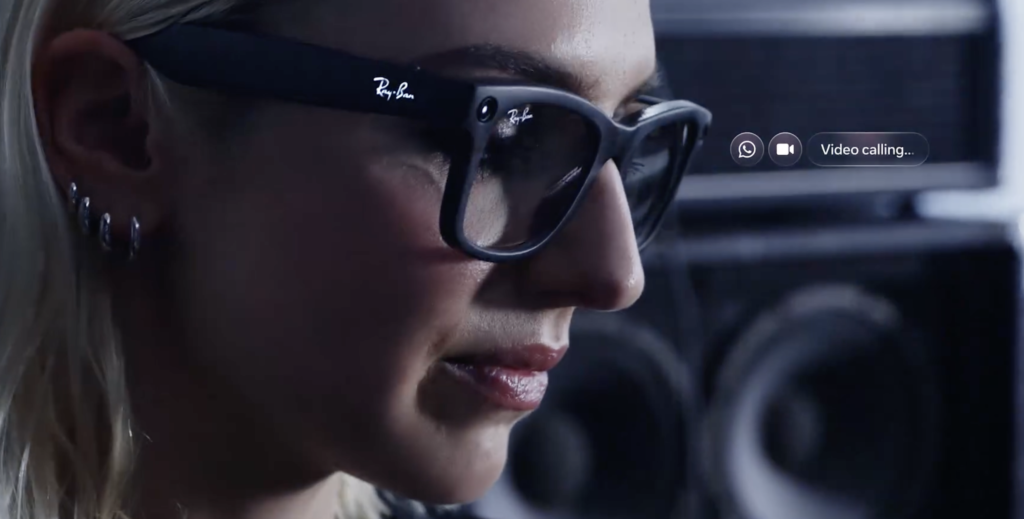
Meta AI glasses, image from Meta website.
On March 10, 2026, at Meta’s latest press conference, Ray-Ban Meta and Oakley Meta AI glasses V23 were released. The latest smart glasses support users to have real-time dialogue with Meta AI, real-time translation and support for snow sports. Before that, other Artificial intelligence glasses have many practical functions, such as intelligently playing music according to the scene in front of them, adding subtitles to real-time calls, real-time AI complex dialogue and other functions. Most of these practical functions are participated by AI.
Thanks to the deployment and research of some technology companies (such as Apple, Google, etc.) in the field of artificial intelligence (Crawford, 2021, p.6). The development of artificial intelligence glasses has grown from simple photography devices such as google glass and professional virtual reality AR glasses such as Microsoft HoloLens, to the new artificial intelligence glasses.
Especially, from 2025, Xiaomi AI smart glasses, Apple’s Apple vision Pro, Meta’s Ray-Ban Meta and Oakley Meta and other more comprehensive artificial intelligence glasses Appear. This means that AI glasses are being popularized to ordinary users.
Artificial intelligence tools transform from literary, film and television works to reality

It has been less than a hundred years since the official birth of Artificial intelligence to the large number of popularizations. AI has become a reality from the vague and imaginative concept of ordinary users.
Before the popularization of AI, most users imagined AI from cultural film and television works (including books, TV series, movies, comics, etc.). For example, the artificial man in Blade Runner (1982), the electronic brain in Ghost in the Shell (1989), and the robot and mecha in Love, Death and Robots (2019). Words such as cyberpunk and bionic electronics in relevant literary and film works give AI more meaning and broaden the form of AI’s existence. (Image from Google image)
In the past, when people saw robots and robot dogs, they could immediately realize that this was artificial intelligence but ignored the small areas. Artificial intelligence is also constantly developing. When ChatGPT, Gemini, DeepSeek and other text artificial intelligence appear frequently, ordinary users have a deeper understanding of AI. Nowadays, different kinds of AI software, cars equipped with AI, AI smart glasses and other AI tools have entered the lives of ordinary people.
The birth of these literary, film and television works provides us with space to imagine the development of AI. In such film and television works, creators are not limited to using AI as a tool, but link AI with human development and raise the deep meaning of the work to whether AI can become a “human”.
In The Atlas of AI (2021), Kate Crawford mentioned that artificial intelligence is a tool that relies on physical electronic devices, algorithms and huge data (2021). Therefore, in real life, we don’t have to worry about artificial intelligence becoming ‘human’. However, we must be alert to the consequences of over-reliance on artificial intelligence.
The use of artificial intelligence glasses in daily life
Artificial intelligence has penetrated our lives from all aspects. Common AI tools, such as ChatGPT, DeepSeek, Gemini, etc., seem to have become a part of users’ daily life. Asking questions, generating renderings, voice dialogue and other functions make people happy to use it.
From 2025, different companies will actively launch and promote smart glasses. It can be predicted that technology companies are normalizing AI. As a common tool, glasses have more diverse functions after combining with AI. The essence of the artificial intelligence glasses is the same as that of ordinary AI. They are all composed of physical devices, data and algorithms (Crawford, 2021). In dadaism, data is a ‘raw material’ that can be analyzed and processed into predictive algorithms about user behavior (Flew, 2021, p.201). It’s just that the physical device of the AI of smart glasses has been changed from computers and mobile electronic devices to glasses.
Meta’s AI glasses include the function of real-time AI detailed dialogue. In the introduction of Meta website, it can be learned that through the AI carried by glasses, users can know more detailed visual descriptions, and more information can be known without too much observation.
So, where does the information provided by these AIs to users come from? The information provided by artificial intelligence comes from human-designed algorithms and the huge data information provided (Crawford, 2021). When the pictures, paintings, literary knowledge, and even the user’s own behavioural habits uploaded by the user become collectable data.
The World Economic Forum describes personal data as a new and valuable resource, a new type of raw material that is comparable to capital and labour (World Economic Forum, 2011, p.5). In the process of developing this new resource, it is naturally necessary to rely on the development of the earth’s energy and mineral resources, cheap labour and large-scale data (Crawford, 2021).
First of all, in order to build a database, this requires the investment of natural resources such as minerals and metals to be exploited and the maintenance of energy-supply. Secondly, to collect and analyse huge data, it is necessary to divide digital workers and train artificial intelligence. This will cause the exploitation of ‘digital pieceworkers’ (Crawford, 2021). Finally, large-scale data, as a new resource itself, needs to be collected and analysed from individual personal information. A person’s selfies, gestures, conversation habits with others, etc. are all data resources that can be collected. Tools such as AI itself and artificial intelligence glasses are built on the cost of a large amount of natural resources and human resources.
The advantages of AI glasses are also obvious. It can be of great help to the visually impaired. AI can act as the ‘eyes’ of special groups, seeing the environment for them and describing it to them. Even artificial intelligence glasses can analyse the detailed information of items for them and guide them to travel. This has undoubtedly provided great help to the visually impaired.
However, the function of artificial intelligence glasses is based on the product optimised by a large number of personal data collected. As a result, personal data, including users’ behaviour habits, hobbies, and even everything seen, will be collected and analysed by the AI carried by the glasses. Like in film and television works, the existence of artificial intelligence glasses regards each actor, events and transactions that users can see as visible, recorded and calculable (Cinnamon, 2017, p, 609).
The use of artificial intelligence glasses that need to be worn by users, artificial intelligence glasses can collect a large number of personal data during this period of wearing. Other people’s appearance, surrounding sounds, environment, people’s dialogues, gestures, body movements, etc., will be used in algorithms to improve facial recognition, language prediction and object detection and other functions (Crawford, 2021, p.16).
Based on the sound data collected by artificial intelligence, the first basic function of all artificial intelligence glasses is language translation. The difference is the number of languages that AI glasses can translate. Meta’s Ray-Ban Meta and Oakley Meta smart glasses V23 also have real-time translation functions, such as Hindi, Arabic, Russian, Swedish and Finnish. Rokid, Xiaomi and other smart glasses also support multi-language translation.

Image from Google image
On various social media platforms, users’ first impression of artificial intelligence glasses is that they can translate the languages of different countries in real time with them. Most people think that for people who travel abroad but do not understand the language, international students, and workers who go abroad, the emergence of such smart glasses omits the process of language learning or reduces the need for the depth of language learning.
This undoubtedly proves the view that artificial intelligence is a predatory industry (Crawford, 2021). Artificial intelligence will plunder other people’s knowledge views and information resources. As a result, others lose their original working environment.
The emergence of AI has caused a serious impact on the translation industry. A Korean to English interpreter and translator said that the industry is in decline, and a large number of interpreters and translators are being replaced by AI. The number of traditional translation job opportunities is decreasing (2025). The emergence of artificial intelligence glasses has deepened this influence and exacerbated the decline of the traditional translation industry. This leads to a decrease in human willingness to learn speech.
The emergence of smart glasses is just one of the ways to use artificial intelligence. As Crawford said, it can refer to everything from consumer devices like the Amazon Echo to nameless back end processing systems, from narrow technical papers to the biggest industrial companies in the world(2021,p.19). What we need to consider is how to use artificial intelligence glasses reasonably, how to regulate the scope of its collection of personal data and other profound issues.
The changes brought by artificial intelligence tools to society
Artificial intelligence scientists can create a machine that learns “like a child” (Crawford, 2021, p.5). Based on the openness of artificial intelligence to configuration (Crawford, 2021, p.19), common tools in daily life and AI can be combined. This means that artificial intelligence can be used in many ways.
Artificial intelligence glasses are an intelligent tool that relies on big data and human algorithms. Like users’ common text AI (such as ChatGPT, Gemini, and DeepSeek, etc.) and picture generation AI (such as Midjourney and DALL·E, etc.), Artificial intelligence glasses also provide convenience to users through big data analysis. But it will inevitably bring some negative effects.
The difference is that the AI of smart glasses interacts with reality more frequently. They collect data on real objects and users’ usage data through cameras, such as people they meet most often, food they eat, shops they often go to and other personal data. They also collect data from users and associated apps. For example, Meta’s smart glasses can collect users’ Instagram data, and Rokid’s smart glasses can collect users’ WeChat data. Artificial intelligence glasses can not only collect users’ actual behaviour data but also collect users’ usage data on the Internet.
In addition, other smart tools combined with AI include cars, Bluetooth audio, home appliances, etc. They can all be awakened and operated by artificial intelligence. Although it is not as flexible and smooth as artificial intelligence glasses. User can also do some simple operations (such as opening or closing). They focus more on scanning external road data, predicting suitable driving routes, speed and other choices for car owners by collecting personal driving habits and other behaviour data, collecting music that users like to listen to, playing suitable music, etc.
With the increasing variety and faster development of artificial intelligence tools, these artificial intelligence tools have brought about the improvement of the efficiency of travel tools, the optimisation of communication methods, the change of knowledge acquisition methods and other changes. Under these changes, artificial intelligence tools are shaping participants in knowledge, communication and rights (Crawford, 2021, p.19).
Conclusion
When diversified artificial intelligence tools, which used to exist only in literary, film and television works, becomes a reality and enters people’s daily life. Artificial intelligence is composed of physical electronic devices, large-scale data and algorithms (Crawford, 2021). Among them, the carrier of artificial intelligence can change, such as huge supercomputers, mobile phones, computers, glasses and other different forms. Based on the openness of artificial intelligence to configuration (Crawford, 2021, p.19), various artificial intelligence tools have emerged.
Artificial intelligence tools have brought many changes to users’ daily life. The positive impact can be reduced to the ability to interact with users in real time, which brings convenience to the lives of special disabled people; the negative impact has a different impact on different industries, leading to a reduction in jobs and inhibiting people’s thinking ability and so on. Therefore, we should maintain subjective scepticism and identity positioning.
Reference list
Cinnamon, J. (2017). Social injustice in surveillance capitalism. Surveillance & Society, 15(5), 609–625.
Crawford, K. (2021). Atlas of AI: Power, politics, and the planetary costs of artificial intelligence. Yale University Press.
Flew, T. (2021). Regulating platforms. Issues of Concern. Polity Press.
r/TranslationStudies. (2025). Yes, the current translation industry is dying. But that doesn’t necessarily mean the end of all of us [Online forum post]. Reddit.
World Economic Forum. (2011). The global information technology report 2010–2011. World Economic Forum.


Be the first to comment