AI Overviews and AI Mode look like simple upgrades to search. But what they really change may be the platform’s power over knowledge, visibility, and attention.
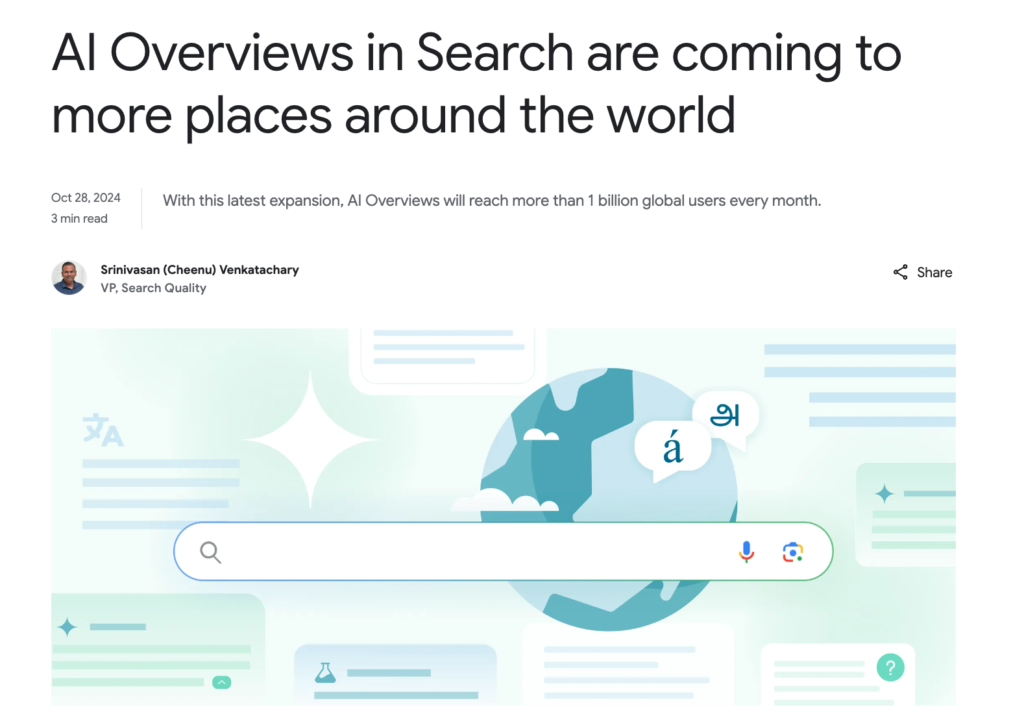
Figure 1. Google AI Overviews interface. Source: Google (2024).
On the surface, AI Overviews and AI Mode make search look faster and more convenient. What they really change, however, is the platform’s power over knowledge, visibility, and attention. In 2024, Google expanded AI Overviews to more than 100 countries and territories and said the feature now reaches more than 1 billion global users each month (Google, 2024). By 2025, the company had introduced AI Mode, making Search even closer to AI responses (Google, 2025a).
In the past, using Google Search was like looking for information in a huge library. After posing a query, you receive several links. Then, which webpage to consider, which source to trust, and which assertions to contrast? The choice is primarily yours.
However, that arrangement is changing now. As AI Overviews have become more prevalent, Google is becoming not only a search engine, but also a summariser and organiser of issues even before users can visit a source.
This makes perfect sense. Why shouldn’t one strive for receiving less material to search through, saving his time, and getting an unambiguous answer right away?
Nevertheless, this is the problem – the approach in question is by no means impartial. As soon as the platform sets itself a task of making the “first step toward understanding” in behalf of its users, it gains not only technological advantages but also gatekeeping power over knowledge at the same time.
Google AI Search should be understood not only as innovation, but as a matter of algorithmic governance(Flew, 2021; Just & Latzer, 2017).
Google is changing more than search results.
Nevertheless, it would seem that the key feature of Google AI Search is the fact that, besides the aesthetics of the web page, where you will find beautiful pictures with answers which appear right away, the order in which the information appears is shuffled around. Instead of having to study various sources and make up one’s mind about the issue on their own, the first thing they see is the conclusion of the AI itself and after that they determine whether or not the source deserves to be clicked.
Therefore, not only is the platform dictating which websites we will be shown but also the “problem framing”, which, according to Just & Latzer (2017) is called algorithmic selection. Just and Latzer (2017) describe algorithmic selection as a non-neutral process that prioritises some information over others and shapes what users come to see as important. It means that, as a result, Google ceased to be just a search engine. This fact explains clearly enough why the problem in question needs to be considered seriously.
Indeed, this kind of selection is not as direct as the one made by other platforms but it is still worth paying attention to.

Figure 2. AI Mode product page. Source: Google (2025).
What the platform is best at is to package power into convenience.
Digital platforms rarely tell you directly: “Now I’m going to judge for you.” Their more common statement is that we just make the experience smoother, more efficient and more helpful. Google’s public framing of AI Overviews is similar. It emphasizes that this function can help users understand the problem faster, while continuing to help people discover the content of publishers, businesses and creators, and add more prominent links (Google, 2024).
But it is precisely this kind of logic of “saving you trouble” that is most worth being wary of. When discussing automation, Andrejevic (2019) pointed out that automation not only completes repetitive work for people, but also gradually takes over the judgment process that belongs to human beings themselves. Putting it on Google AI Search means that users not only do a little less work to search for information, but also do less work to compare sources, form understanding and build doubts. In other words, the problem with Google AI Search is not only that it is smarter, but that it is increasingly deciding for users: what is the key, what is more reasonable, and what is worth believing first.
What’s really dangerous is not necessarily the wrong answer, but you can’t see how to answer it.
However, many debates over AI would eventually boil down to a technical matter: whether the response is correct, whether the system is stable, and whether it is prone to hallucinations. However, the question raised by Google AI Search is not whether the answer is sometimes wrong; but whether it is possible at all to understand how the system answers.
As Pasquale (2015) argues, this reflects the logic of the black box. The systems users should be most wary of are not necessarily the ones that fail most visibly, but the ones they cannot meaningfully inspect and yet must rely on. This is exactly the case with Google AI Search. The user will get a concise and elegant answer, while the selection algorithm stays invisible to them: which sources are used as inputs? Which sources are prioritised, and which are deprioritised? By which criteria does the algorithm assess their level of reliability and representativeness?
This is not only a technical problem, but also a form of power. The platform will not directly explain that “you should understand this problem in this way”, but cleverly hides this choice in a seemingly neutral, natural and convenient answer. The more perfect the answer is, the less likely it is for users to question it. The more it seems to be “just technology”, the more difficult it is for people to realize that it is a governance model.
The problem is especially dangerous since it will slowly reshape users’ perception of the search process itself. Earlier, the output was only a beginning, and users had to access various sources, analyze multiple claims, and determine which of the information presented can be considered reliable. However, the abstract created by an AI system has already modified this approach. Given that the search engine generates a comprehensive and refined answer at the very top of its output, users will start to treat it as a definitive conclusion rather than a piece of information that requires verification from other sources. Moreover, the problem is that the system conceals how the abstracts are produced in the first place, while also discouraging the users to verify the acquired information independently. In this sense, the process itself gradually transforms from an exploratory and comparative search to one of getting pre-organized information. This transformation strengthens the role of the platform as an information gate. For users, this means that they are increasingly dependent on a system that cannot effectively check, question or challenge.
The bias in the search will not disappear automatically because of the addition of AI.
Another common saying is that AI just sorts out the existing information on the Internet, so the real problem is not AI, but the Internet itself. This statement is only half right.
Noble (2018) argues that search engines are never neutral knowledge systems. It will bring the original racial, gender and power structures in society into the search results and often appear as “technically neutral”. If the traditional search sorting already amplifies bias, then AI summary may make this problem more hidden.
The reason is not complicated. The most dangerous scenario of prejudice is that it is not obvious at a glance, but is packaged into a natural, concise and seemingly authoritative answer. A string of links will at least expose the differences: different media, different websites, and different positions are all there, and users can still see conflicts. But summary will compress complex problems into a smooth version, so that differences and disputes can be hidden behind, and even hidden out of vision.
Crawford (2021, p. 1) argues that AI is “an idea, an infrastructure, an industry, a form of exercising power, and a way of seeing.” This is what makes Google AI Search significant: it is not simply to make the search faster, but to redistribute visibility, authority and attention more deeply.
The publisher’s backlash shows that this is not a “small function”, but a public problem.
If Google AI Search is really just a small function that saves users more time, it will not cause continuous industrial and regulatory disputes. In 2025, an independent publisher filed an antitrust complaint with the European Union, accusing Google’s AI Overviews of using publishers’ content to generate abstracts, but leaving the traffic and income that would have flowed to the original website on Google’s own search results page (Reuters, 2025); the complaint also pointed out that publishers do not have a truly meaningful opt-out mechanism, because exiting the AI function may also damage the visibility in ordinary searches (Reuters, 2025).
By 2026, under the pressure of British competition regulation, Google said that it was developing new search control options that allow websites to more specifically exit their generative AI functions in response to concerns from publishers and regulators about Google’s search dominance (Reuters, 2026).
This controversy shows that the problem of Google AI Search is far more than “good or not”. It involves at least three larger issues at the same time: first, who can be seen and who can only be the “raw material” behind the AI summary; second, who benefits from this new information order; third, who will be held accountable when the platform is deeply involved in knowledge distribution and gradually becomes the core organizer.
The same question comes up here as well. The problem is not just in offering a better service, but also in altering the rules of the game in the public information environment.
Of course, the even more important factor is the fact that, alongside its consequences for the publishing companies and regulators, Google’s innovation may result in radical behavioral shifts among ordinary users seeking information through the engine. With an increasing number of platforms acting as mediators between the users and the knowledge, a person may simply perceive the information generated by artificial intelligence as “the answer,” without realizing that they need to analyze, compare, and check the information provided by the latter in the first place. As a consequence, the approach they employ when searching for answers may undergo alterations: while before they tried to find a number of sources of information in order to compare their views and come to conclusions, now they will be more inclined to rely on the interpretations offered by the platform in question. Consequently, information asymmetry will be getting worse yet again, because the platform understands the way its algorithms summarize the information, the signals and criteria employed, and the information that gets suppressed. On the other hand, ordinary users are not aware of all those things (Pasquale, 2015).
Figure 3. News image accompanying Reuters coverage of publishers’ complaint against Google AI Overviews. Source: Reuters (2025).
What should really be asked is not whether it is smart enough.
The real question about Google AI Search is not whether it is advanced enough, but whether it is transparent enough, contestable enough, and accountable enough. And when it comes down to affecting the value of the content and the knowledge distribution, then, whose responsibility should it be to answer for it?
At the very least, there are three things that need to change in order for it to be more responsible. Firstly, increased transparency, whereby explaining not just the simple fact “This is generated by AI,” but rather the limitations of the answer and how did it reach such conclusions. Secondly, error-correction and appeal mechanism that allows people and the creators of the content to have some kind of power over how they perceive things. Lastly, the regulators would need to treat this as a matter of public concern and governance, and not as a mere product development, for the platform already affected who would be able to be heard, believed and benefit from the knowledge distribution.
But, Google will claim, this is only to make Search more useful. When the time comes, however, and the platform becomes the one answering questions, not just providing access to the content, then it will no longer be just the portal, but also the architect of the knowledge order.
And perhaps, this is where Google AI Search gets the most concerning of all – the less obtrusive it is and the more natural it becomes.
References
Andrejevic, M. (2019). Automated media. Routledge.
Crawford, K. (2021). The atlas of AI: Power, politics, and the planetary costs of artificial intelligence. Yale University Press.
Flew, T. (2021). Regulating platforms. Polity.
Google. (2024, October 28). Expanding AI Overviews to more than 100 countries. Google.
Google. (2025, May 20). AI in Search: Going beyond information to intelligence. Google.
Just, N., & Latzer, M. (2017). Governance by algorithms: Reality construction by algorithmic selection on the Internet. Media, Culture & Society, 39(2), 238–258.
Noble, S. U. (2018). Algorithms of oppression: How search engines reinforce racism. New York University Press.
Pasquale, F. (2015). The black box society: The secret algorithms that control money and information. Harvard University Press.
Reuters. (2025, July 4). Google’s AI Overviews hit by EU antitrust complaint from independent publishers.
Reuters. (2026, March 18). Google developing options to allow AI opt-out in search to ease UK concerns.
Image References
Google. (2024, October 28). Expanding AI Overviews to more than 100 countries [Digital image]. Google. https://blog.google/products-and-platforms/products/search/ai-overviews-search-october-2024/
Google. (2025, May 20). AI in Search: Going beyond information to intelligence [Digital image]. Google. https://blog.google/products-and-platforms/products/search/google-search-ai-mode-update/
Reuters. (2025, July 4). Google’s AI Overviews hit by EU antitrust complaint from independent publishers [Digital image]. Reuters. https://www.reuters.com/legal/litigation/googles-ai-overviews-hit-by-eu-antitrust-complaint-independent-publishers-2025-07-04/


Be the first to comment