
Have you ever had such an experience: You originally intended to open TikTok for just two minutes, but an hour passed unconsciously. What’s more amazing is that each video is more in line with your preferences. You may even think: How does it understand me so well? But if we consider the issue from a different perspective: Are these contents chosen by you? Or is it actually the algorithm that decides what you see, what you like, and even gradually shaping who you are?
In fact, this experience is not accidental. The latest statistics show that the global average TikTok user spends 95 minutes per day on the app, the highest of all social platforms. The average daily usage time of TikTok has also seen a significant increase in recent years: it rose from less than 30 minutes in 2019 to over 1 hour and 30 minutes by 2025. At the same time, most of the content you see is actually not from the accounts you have actively followed. The data shows that over 80% of the watched content comes from the “For You” recommendation page, and more than 90% of the videos even come from people you have never followed. In other words, you are not browsing, but rather being recommended by the algorithm.
Therefore, a more crucial question emerges: Who is making the decisions regarding these recommended contents?
What is algorithm?
The core of all this lies in TikTok’s recommendation algorithm. The term “algorithm” refers to a set of computational rules used for sorting, filtering, and recommending information (Flew, 2021). Algorithm selection is essentially a process of assigning different “relevance” to information through automatic analysis of the data generated by users, thereby determining which content will be prioritized for presentation to the users (Just & Latzer, 2017). Its goal is not to tell you which content is of the highest quality, but to prolong your viewing time as much as possible. By analyzing every single pause, click, and swipe you make, it continuously predicts what you will watch next.
Therefore, this article argues that algorithmic culture redefines the meaning of “culture”. Contemporary culture is transforming from a value and meaning system jointly constructed by people to a system driven by data and shaped by algorithms. Taking TikTok as an example, this transformation is mainly reflected in three aspects: Firstly, at the level of cultural evaluation, the value judgment of content shifts from whether it is good to whether it is suitable for you, and personalized recommendations gradually replace public standards. Secondly, at the level of cultural distribution, users are continuously classified and grouped, and different individuals are placed in their respective algorithmic environments, thereby shaping differentiated and even fragmented cultural experiences. Finally, at the level of cultural production, creators increasingly rely on algorithmic feedback to adjust their content strategies, and the platform decides which content is worth being produced and disseminated based on data performance.
How algorithms reshape cultural evaluation
This section discusses how algorithms are altering the criteria for cultural evaluation.
In the traditional media environment, people’s evaluation of cultural products often relies on certain public standards, such as whether a film is excellent, whether music is meaningful, or whether a work has social value, etc. However, in the algorithm-driven content ecosystem, this evaluation logic is quietly changing. The recommendation systems of platforms like TikTok do not base their core judgment on the objective quality of the works, but rather predict which content is most likely to keep users engaged longer and participate more based on a large amount of user behavior data. This actually causes a fundamental shift in the way cultural evaluations are conducted.
Algorithm selection is a process of automatically allocating “relevance” to information, that is, by analyzing the user’s data to determine which content is more worthy of being displayed (Just & Latzer, 2017, p239). TikTok’s recommendation algorithm ranks content by analyzing every tiny behavior of the user on the platform, such as whether they have completed watching, interaction frequency, and repeat viewing, and then decides which videos are more suitable to be recommended to you. According to TikTok’s official statement, the For You page is a highly personalized content stream, which displays videos that may match the interests of this user, rather than content simply sorted by time of release or creator relationship. The algorithm dynamically adjusts the recommended content based on signals such as user likes, comments, shares, and viewing duration, making the recommendation results more in line with the user’s past behaviors and preferences.
A direct result of this recommendation logic is that everyone’s “For You” page will become a highly personalized information space. The platform does not use unified standards to judge the quality of content; on the contrary, it will constantly adjust the type of content you see according to your behavior. For example, if you often watch makeup videos, your recommendation page will contain more similar content, if you like funny videos, you will constantly see short films of the same style. This personalized distribution mechanism strengthens the trend of personalized cultural experience, reduces the common evaluation standards between different users, and makes cultural judgment more fragmented (Just & Latzer, 2017). Algorithms not only determine what we see, but also affect how we interpret the content, thus changing the criteria for judgment itself (Just & Latzer, 2017). In the past, people tended to evaluate according to the quality or importance of the content itself, but now, in many cases, people are more concerned about whether the content is in line with their interests. In other words, the evaluation criteria have changed from common judgment based on universal to personal preference. This change shows that the recommendation algorithm not only affects what we see, but also subtly changes the way we understand and judge cultural content, making our judgment more and more dependent on platform recommendations rather than broader public standards.
How algorithms reshape cultural distribution through classification and grouping
This section further discusses how algorithms can reshape the distribution structure of culture and personal experience by constantly classifying and grouping users.
In the traditional understanding of human collective construction culture, individuals usually form and expand their value system by participating in public spaces, encountering diverse content, and engaging in conversations. However, on algorithm-driven platforms such as TikTok, this process has changed. The recommendation algorithm no longer simply displays all the content, but continuously analyzes user behavior and classes users into different interest categories.
Algorithm classification refers to the process of the platform building user interest portraits through statistical analysis of user interaction signals such as viewing time, likes, sharing, comments, etc., and adjusting the recommended content accordingly. TikTok does not recommend content randomly, but classes you into a personalized interest group according to your interaction habits.
At the same time, the information environment on social media is not formed naturally, but is deeply influenced by algorithms and automation mechanisms. Bolsover and Howard (2019) pointed out that algorithmic systems and automated accounts can amplify specific content or views, thus affecting the information structure exposed to users. This means that the content you see is not only driven by personal interests, but also influenced by the platform’s recommendation logic. In this environment, the content that may trigger interaction will be constantly recommended, while other contents may be ignored.
Over time, this algorithmic behavior will put users in an increasingly narrow and personalized content circle. The academic community usually refers to this phenomenon as “filter bubbles”, which means that the algorithm will strengthen users’ existing interests and reduce their exposure to information that is different or contrary to their own interests (Boeker & Urman, 2022). This kind of personalized recommendation may lead to the gradual homogenization of information acquisition, making it difficult for users to access a wide range of diverse content, resulting in the experience of “information isolation”.
How algorithms reshape cultural production
This section further explores how algorithms intervene in the cultural production process itself.
In the algorithm-driven platform environment, content production no longer depends mainly on the creativity or value judgment of creators, but increasingly depends on the feedback of algorithm data. The platform collects and analyzes data such as users’ viewing time, likes, comments and shares to determine which content is more likely to attract attention, thus affecting and even determining what content is worthy of being created. Under this mechanism, a feedback loop is formed between content production and distribution: user interaction data influences algorithmic recommendations, and these algorithmic recommendations in turn shape the creative decisions of creators. Research shows that TikTok’s recommendation system continuously adjusts content recommendations based on users’ viewing, likes, and repeated viewing behaviors, thereby strengthening the dissemination of specific types of content. (Zhou, 2024)
Therefore, creators often adjust the content form based on these data feedback, such as enhancing rhythm, emotional expression or opening attraction, to increase the possibility of being recommended. The platform filters cultural content based on data, indirectly influencing which content is extensively produced and disseminated. Therefore, similar video formats often appear on the platform, such as a unified template or gameplay around a certain “TikTok hotspot” being widely imitated. This is not because the creators lack creativity, but because the algorithm’s preferences prompt them to replicate content that is more likely to gain exposure. Over time, the content on the platform will show obvious trends and homogeneity, and behind these trends lies the role of algorithm data.
Case study: Algorithmic impact and challenges on platforms
In the content production environment dominated by algorithms, although the platforms have improved the efficiency of content distribution, they have also brought about some problems.
According to ABC News, in France, seven families have filed lawsuits against TikTok, accusing the social media platform of continuously recommending videos related to self-harm, depression and suicide to teenagers through its recommendation algorithm, which has severely affected the mental health of some children. Two of them even chose to commit suicide. These contents were not actively searched by users but were continuously reinforced and recommended by the algorithm based on users’ behaviors, keeping teenagers immersed in a single and negative information environment. This case shows that the information environment of social media is deeply affected by algorithms and automation mechanisms. When the user is in a passive information environment, the algorithm will not only distribute content, but also constantly strengthen certain specific types of information, thus deeply affecting the user’s cognition and emotions.
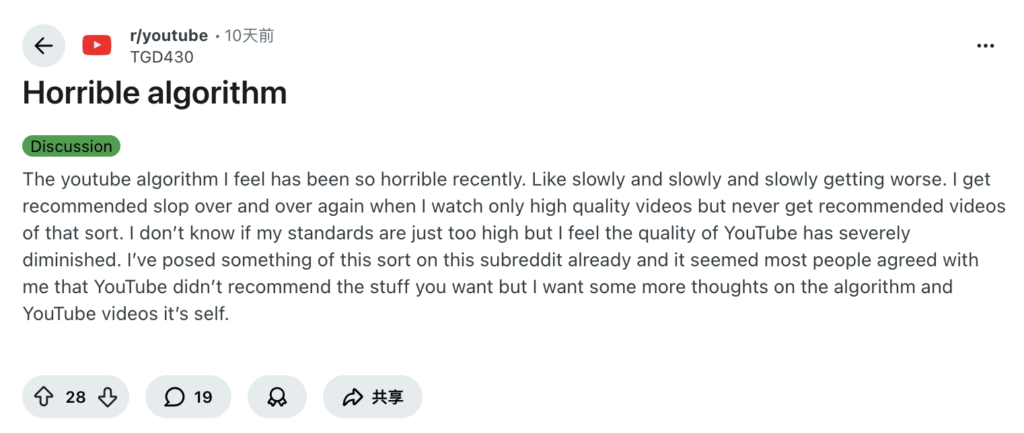
Many users on social platforms also complain that the recommendation system over-strengthens the existing behavior pattern, thus reducing the diversity of information. For example, many YouTube users have expressed dissatisfaction with the recommendation algorithm on communities such as Reddit. Some users pointed out that the algorithm repeatedly recommends videos that are not interested in or have been watched, resulting in poorer and worse recommended content on the homepage. It is difficult for users to find the content they really want to watch, and even need to search manually to find the videos they are interested in. This experience makes users feel very frustrated. Some users complain that even if they marked videos as “not interesteded in” many times, the system will still recommend old content or videos with similar styles. This shows that the recommendation system has obvious flaws in content filtering.
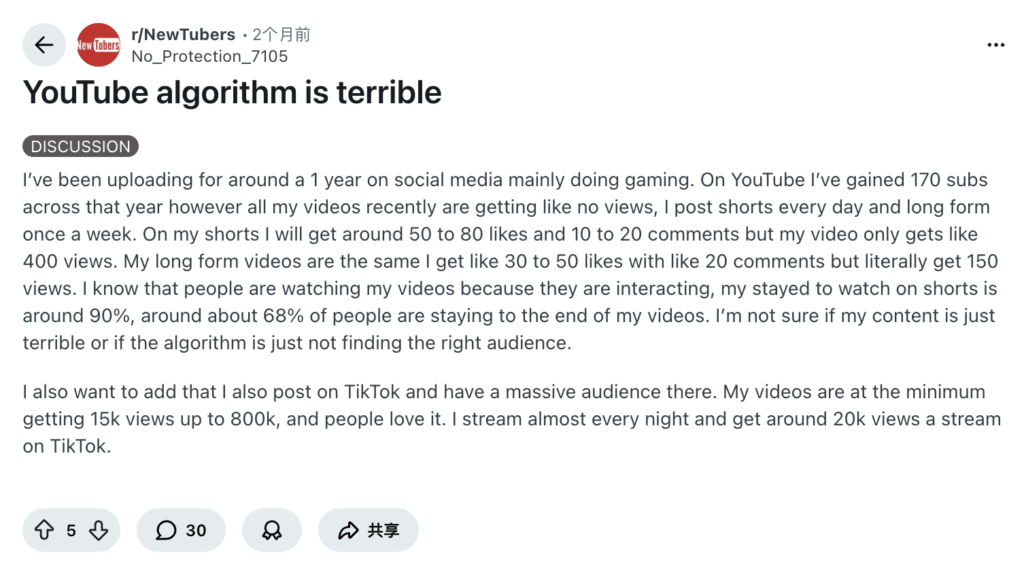
Some creators have also expressed similar frustration. For example, even if the video itself is of good quality, the system still seems to be unable to accurately identify the right audience, forcing them to cater to the algorithm instead of relying on the content itself to attract the audience.
In response to the problems such as monotony, repetition and difficulty in finding new content caused by the recommendation algorithm, the platform can make the following improvements: First of all, in terms of content recommendation, content diversity should be appropriately increased, instead of repeatedly recommending content according to users’ existing interests. By introducing different types or new content, the platform can not only meet the preferences of users, but also broaden their information access, thus alleviating the problems of content homogenization and information isolation to a certain extent. Secondly, it is necessary to enhance the ability of users to participate and control recommended content. For example, the platform can optimize the feedback function of “not interested” and provide a brief explanation of the reason for the recommendation, so that users can understand the basis of the content recommendation and make adjustments to a certain extent instead of passive acceptance. Finally, it’s necessary to improve the transparency of the recommendation mechanism and strengthen the restraint and supervision of inappropriate content on the platform. This is especially important for teenagers because they are more susceptible to extreme or negative content. As shown in the above case, the algorithm continues to recommend videos related to self-harm, depression and suicide, which has had a serious impact on the mental health of some teenagers and even led to tragic events. Therefore, improving transparency and strengthening supervision will help build a healthier and more diversified information environment.
References
ABC News. (2026, February 24). French social media ban: Families suing TikTok. https://www.abc.net.au/news/2026-02-24/french-social-media-ban-families-suing-tiktok/106348256
Bolsover, G., & Howard, P. (2019). Chinese computational propaganda: Automation, algorithms and the manipulation of information about Chinese politics on Twitter and Weibo. Information, Communication & Society, 22(14), 2063–2080. https://doi.org/10.1080/1369118x.2018.1476576
Boeker, M., & Urman, A. (2022). An empirical investigation of personalization factors on TikTok. In Proceedings of the ACM Web Conference 2022 (pp. 2298–2309). https://doi.org/10.1145/3485447.3512102
Backlinko. (2026). TikTok statistics you need to know in 2026. https://backlinko.com/tiktok-users
Flew, T. (2021). Regulating Platforms. Cambridge: Polity.
Just, N., & Latzer, M. (2017). Governance by algorithms: Reality construction by algorithmic selection on the Internet. Media, Culture & Society, 39(2), 238-258. https://doi.org/10.1177/0163443716643157
Kemp, S. (2025). Digital 2026: Global overview report. DataReportal. https://datareportal.com/reports/digital-2026-global-overview-report
TikTok. (2020, June 18). How TikTok recommends videos #ForYou. https://newsroom.tiktok.com/how-tiktok-recommends-videos-for-you
Wariditech. (2026). How TikTok algorithm works in 2026 (simple explanation). https://wariditech.com/blogs/social-media/tiktok/how-tiktok-algorithm-works.html
Zhou, R. (2024). Understanding the impact of TikTok’s recommendation algorithm on user engagement. International Journal of Computer Science and Information Technology, 3(2), 201-208. https://doi.org/10.62051/ijcsit.v3n2.24
Be the first to comment