Many discussions of online hate focus only on what users say. In their opinion, the
problem is that individual users have published extremely hurtful words. The most direct
solution is to delete posts or restrict their reach. But this view is too one-sided, especially on a
platform dominated by recommendation algorithms like Rednote. It is never only the comments
themselves that cause harm, but also the content pushed by the platform, the people who are
harmed by these contents, and why the pressure to deal with risks always falls on ordinary users.
Therefore, on a platform like Rednote, online hate is not only a matter of speech, but also a
matter of platform design and management.

Rednote was founded with the aim of providing users with a platform for sharing, connecting, and loving. But when users actually use it, they can’t feel the connection and love advertised by the platform at all. On the contrary, they are always worried about malicious attacks and online harm, and they always have to think about how to protect themselves. When users post content about appearance, interests, emotions, consumption or daily life, they often receive some comments. Although there is no explicit criticism, these comments are obviously humiliating and hostile. These harms are not isolated incidents, but are constantly amplified through the platform’s recommendation, moderation and interaction mechanism.
Hate speech is not just “saying unpleasant words”
When discussing hate speech, Flew (2021) pointed out that the reason why such expressions are serious is not because they only “offend” others, but because they will shape certain people or groups into unpopular and even hostile objects, further affecting their public a sense of security, dignity and participation in space. More importantly, hate speech and discriminatory expression are not completely separated. There is a continuum in the middle: from the derogatory of what seems to be just a “joke” or “complaining” to a clearer stigma and exclusion and finally develops into a more direct attack (Flew, 2021). On Rednote, what many users describe as “unprovoked hostility” may not always be the most extreme threat of violence, but it often pushes the sharer to a position of “unworthy to be expressed” and “not worthy of respect” through humiliation, belittlement, and emotional judgement that may not look like direct abuse at first glance. In essence, this is beyond the scope of ordinary differences of opinion.
Guan and Chen (2025) also emphasized that the core of hate speech is not specifically for what someone does, but towards a certain social identity; this kind of expression constantly shapes specific groups into threats, aliens or inferiors through “otherization”. Therefore, victims suffer not only emotional discomfort, but also the pressure of longer-term humiliation, rejection and loss of public participation (Guan & Chen, 2025). This is also why “delete or not” is not enough to explain the problem. Many injuries are not the most conspicuous form at all. A note may not directly curse or explicitly incite violence, but can still create hostility by repeating stereotypes – such as describing a certain type of women as naturally emotional, describing sexual minorities as “abnormal”, or acquiescing that people in a certain region or class are of “low quality”. This kind of content may not be immediately recognised by the platform as a serious violation, but it will still slowly create an exclusive environment.
Why is Rednote particularly suitable for discussing this issue?
Because it is not a platform that simply relies on the operation of attention relationships, but a content platform that relies heavily on the recommendation mechanism. Wan et al. (2025) directly described it as a recommendation-driven social platform, and pointed out that although algorithmic recommendation improves the efficiency of content distribution, it also provides creators to predict and manage audience. Reach has brought difficulties, especially marginalized users who are already more likely to face hostility and harassment. They also found that some female users would actively try to control who saw the content by reusing tags. For example, some female creators on Rednote attach tags such as “baby food”(宝宝辅食) to posts that are not actually about parenting, suggesting an attempt to shape audience reach and avoid unwanted attention. This matters because users on Rednote are not only worried about hostile comments, but also about who the platform may push their content to. That is to say, the harm does not only come from a hateful speech itself, but also from the platform pushing the content to someone (Wan et al., 2025).

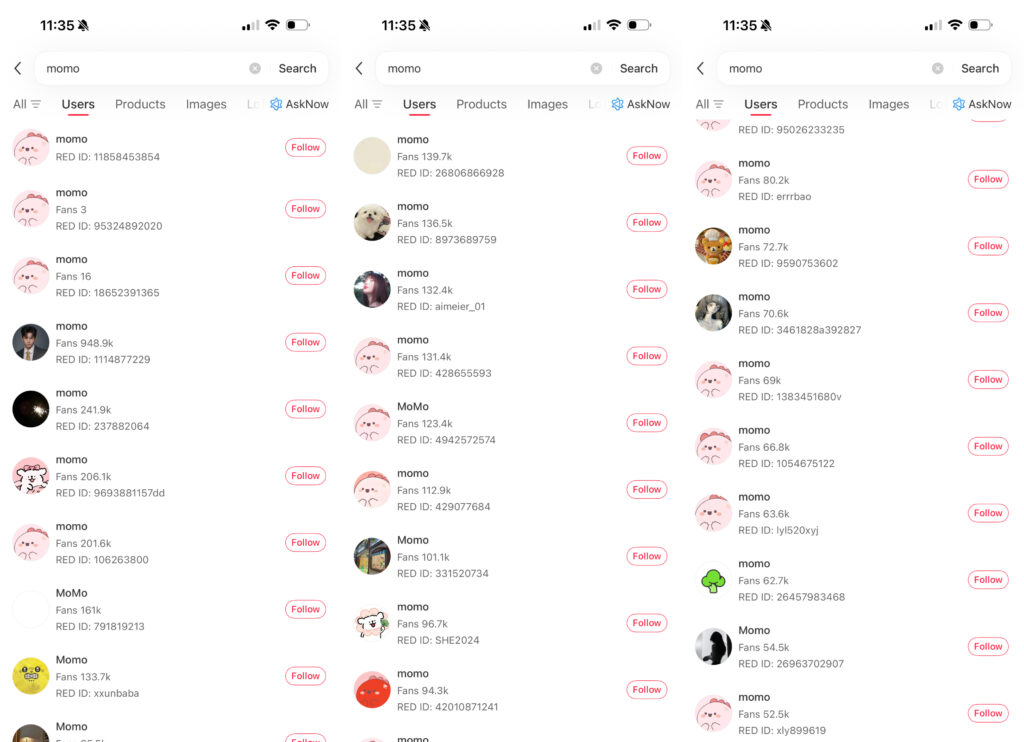
The “momo” phenomenon of Rednote can intuitively reflect the dual impact of platform identity design on expression and harm. Momo is the default nickname and avatar given by the platform to users who have not customized information. A unified identity can conceal personal characteristics, making users feel safer and more willing to express their thoughts in the comments section. However, this design also weakens the responsibility of personal speech. When a large number of momo accounts aggregate, malicious comments are no longer isolated individual acts. With the recommendation mechanism that constantly pushes to strange users on the platform, scattered negative emotions can easily evolve into group and untraceable attacks. This also demonstrates the online harm shaped by the platform’s default identity settings and exposure logic.
How can the recommendation mechanism turn scattered malice into large-scale damage?
Recommendation-driven platforms will make content with high interaction, strong controversy and high emotional concentration gain higher visibility, and this visibility distribution logic can easily amplify the initial scattered negative comments into a larger-scale siege. Originally, it was just a few negative or hostile comments. Once it continues to be pushed because of active comments and obvious controversy, it is more likely to enter a larger traffic pool, attracting more strange users to join the judgment and siege.
Users do not fully control who ends up seeing their posts on Rednote. When a note causes a large number of comments, especially when there is a controversy, the platform will automatically expand the scope of push and expose the content to more strange users. For creators, what is really disturbing is not only individual malicious comments, but also the platform’s continuous push of content to people who are more prone to sarcasm, hostility and even harassment.
The harm never comes from a certain negative message, and the platform’s recommendation mechanism will constantly amplify the original limited malice. At first, it was just sporadic dissatisfaction, but as the traffic poured in, it would soon turn into a mass attack. Even if the user has been obviously harmed, the moderation system of the platform often cannot identify it in time.
Reporting fatigue and self-censorship: Why should the user ultimately bear the risk?

If the recommendation mechanism continues to amplify the malice, and the moderation system misses many really hurtful content, then we have to ask: can the platform really give effective protection when users are attacked? This is “report fatigue”, as Sinpeng et al.(2021) said in the study, when users report harmful content again, but do not receive clear feedback, and do not see the actual processing results, they gradually do not want to report it anymore. Many community administrators in their study also mentioned that there is basically no follow-up of reporting hate speech, which makes users increasingly distrustful of the platform’s governance ability.
Many attacks on the platform are not straightforward “standard hate speech” at all, but always in the guise of “just talking about opinions”, “simple complaining” and “making a joke”. For example, negative comments on women, sexual minorities, specific regions or groups rarely swear directly, and more by repeating those routine stereotypes to hurt people. Sinpeng et al. (2021) also mentioned that hate speech is closely related to language, culture and specific context, and cannot be fully identified by general rules and automatic moderation. Moreover, they also believe that the platform’s definition of hate speech cannot cover the various harms actually encountered by vulnerable groups.
The platform may be able to clean up the most straightforward and vulgar malicious attacks, but there is nothing to do about the more common, more routine and harmless implicit hostility. Even if the platform formulates relevant rules, this kind of damage will not disappear. It is precisely because these injuries have never been clearly defined and have not been effectively handled that they have slowly evolved into a common atmosphere on the platform. When users find repeatedly that the harm they feel is completely incompatible with the damage identified by the platform, they gradually lose trust in the reporting system. In the end, the burden of self-protection fell back on users. Some people would choose to hide the content they posted, some people would deliberately reduce interaction, some people would not dare to express it at will, and some people would simply leave the platform.
Some student users who share their daily review on Rednote, record their study plan and exam preparation experience. Originally, it was a very ordinary positive sharing, but it was ridiculed by some comments as “creating academic anxiety”, ” another study-obsessed overachiever”, and even stigmatized as “a tool person who can only study hard”. These comments may not contain obvious slurs, but they still work as a form of group-based humiliation and attack. If such comments are treated as “expression of personal views” in the platform review and are not effectively handled, the victim will easily fall into the fatigue of reporting after many unsuccessful reports. In the end, they can only hide the content, no longer update, and even gradually withdraw from the platform. Such damage comes not only from the attack itself, but also from the moderation defects of the platform that only recognizes the superficial form and does not deal with context discrimination, as well as the lack of transparency and low response of the reporting mechanism.
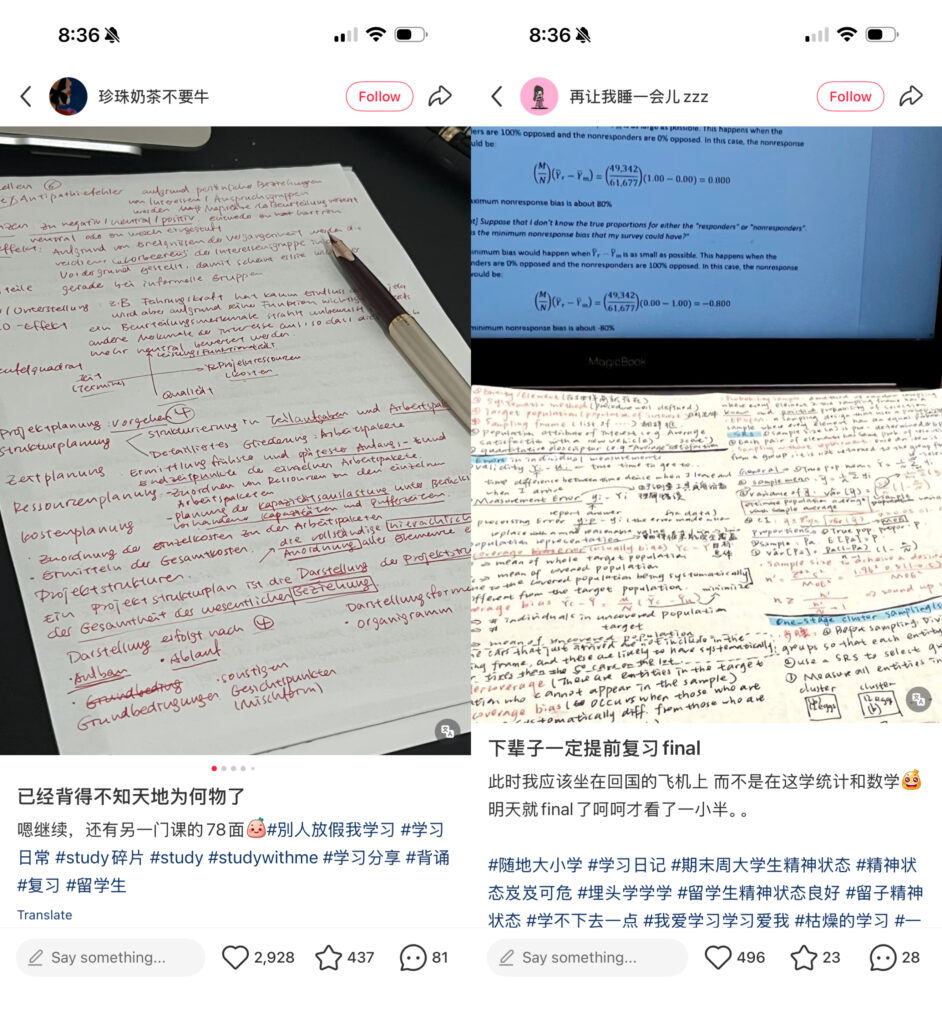
Users try to control the audience through the strategic use of tags on the recommendation-driven platform. While this may seem like a display of user skill and creativity, it also reveals that the platform doesn’t automatically provide a sufficiently stable and safe environment (Wan et al., 2025). The reason why users need to do this is precisely because they must find ways to counter the exposure risks brought by the platform’s recommendations. In other words, it’s not that the platform provides excellent protection, but rather that users are forced to develop a “self-defense” mechanism to compensate for loopholes in the platform’s design.
This also echoes the research of Chang (2025) very well. When discussing China’s online feminism, she pointed out that on social platforms like Rednote creators often face not a single attack, but the double pressure of online misogyny and censorship. To maintain a relatively safe expression space as much as possible, many people have to use coded language, metaphors and various self-censorship strategies to avoid attacks and censorships at the same time. It shows that “security” is not automatically provided by the platform, but by users through extra labor. When creators must constantly predict risks, modify expression, and control the audience in order to barely maintain vocal space, the problem is not only speech itself, but also visibility, moderation and self-censorship how visibility, moderation, and self-censorship together constitute harm (Chang, 2025).
Platform responsibility is not equal to unlimited review.
Of course, there will be a very realistic rebuttal here: if the online hate on Rednote is understood as a platform design problem, will it eventually become a stronger intervention in the platform, and even give the platform and the government more reasons to expand the censorship? This concern is not unreasonable. Because once the platform manages the content more actively, it is easy to have another question: which expressions will be considered “harmful” and which discussions will be overly restricted? Flew (2021) also discussed the long-standing tension between hate speech and freedom of speech, which cannot disappear easily.
But this does not mean that we can only stay on the question of “whether we will delete too many posts”. Because treating online hate as a platform design problem is not the same as advocating the unlimited expansion of the platform’s censorship power. More precisely, this perspective reminds us that what needs to be questioned about the platform is not only “how much content has been deleted”, but also how it distributes exposure, how to identify hostility in the context, how to interpret the processing results, and how to provide more transparent and reliable protection in the governance process. The real question is not the management of the platform, but how and according to what standards the platform governs, and whether this governance is clear, fair and questionable.
When the platform is no longer just “carrying” the harm
In fact, what really makes the situation worse is not only that someone sends malicious comments, but also that the platform allows these contents to spread and does not deal with them effectively. Once this negative emotion spreads on the platform, the problem is no longer as simple as a comment, but closely tied to the platform’s recommendation rules, review methods and reporting processes. Rednote has never been a neutral “bystander”. Its own design and management model are exacerbating the spread and continuation of damage and finally let ordinary users bear the consequences alone.
Reference lists
Chang, A. (2025). Safe spaces for feminist activists online: Chinese networked feminists’ self-censorship strategies in response to online misogyny and government censorship. Humanities and Social Sciences Communications, 12(1). https://doi.org/10.1057/s41599-025-04802-2
Flew, T. (2021). Hate speech and online abuse. In Regulating platforms (pp. 91–96). Polity.
Guan, T., & Chen, X. (2025). Threat Perception, Otherness and Hate Speech in China’s Cyberspace. 35(158), 1337–1352.
Wan, R., Tong, L., Knearem, T., Li, T. J.-J., Huang, T.-H. “Kenneth,” & Wu, Q. (2025a). Hashtag re-appropriation for audience control on recommendation-driven Social Media Xiaohongshu (rednote). Proceedings of the 2025 CHI Conference on Human Factors in Computing Systems, 1–25. https://doi.org/10.1145/3706598.3713379
Sinpeng, A., Martin, F. R., Gelber, K., & Shields, K. (2021). Facebook: Regulating. Hate Speech in the Asia Pacific. Department of Media and Communications, The University of Sydney. https://hdl.handle.net/2123/25116.3
Be the first to comment