Have you ever felt that the most extreme voices on the Internet are often the most “attractive”? From the controversial Internet celebrity Andrew Tate to the extreme racist Paul Miller, it seems that the more vicious and outrageous people are, the greater their influence. At first glance, it seems that this is just to get traffic and make a fuss. But with in-depth exploration, things are much more complicated.
Emotions drive everything: How algorithms amplify hatred
Today’s hate speech on the Internet is no longer as simple as people’s bad words – it also involves platform logic, attention-driven economy and collective user participation. Hate speech is no longer “just what people say” – it has become a type of content generated, promoted and even monetized through online platforms. Through case studies such as Andrew Tate, an extremist, and Paul Miller, an extremist racist, as well as existing academic achievements on network harm and platform governance, this article discusses how hate speech has become a profitable and normal phenomenon in online culture and why it is so difficult to solve.
That’s why there are domestic and international laws prohibiting hate speech. Many people tend to enate hate speech with offensive language or extreme views. However, it turns out that it is much more than that. Hate speech is based on identity – race, gender, religion – and it may have real psychological and social consequences (Sinpeng et al., 2021).
Scholars usually divide the harm caused by hate speech into two forms. First of all, it may lead to discrimination or violence because it has the potential to incite such behavior. The second form is subtle, but also influential: it makes us feel that certain groups are inferior, making exclusion and inequality commonplace. Over time, when people are repeatedly exposed to such remarks, they gradually get used to looking at others in a certain way and begin to think that discrimination is acceptable or even permissible.
Perhaps the most important aspect is that hate speech often stems from the opposition of “we and them”. It Seems To Have Some Kind Of Hint. According To Some Studies On This Topic, When A Group Feels That Its Identity Or Status (Cultural, Social Or Economic Aspects) Is Threatened By Another Group, Such Speech Will Appear, And This Group Increasingly Feels That Its Identity Or Status Is Being Attacked (Guan & Chen, 2025). In virtual space, this situation becomes more serious because negative and inflammatory speech spreads faster and has a wider audience (Guan & Chen, 2025). This means that hate speech is not only shared, but also intentionally disseminated.
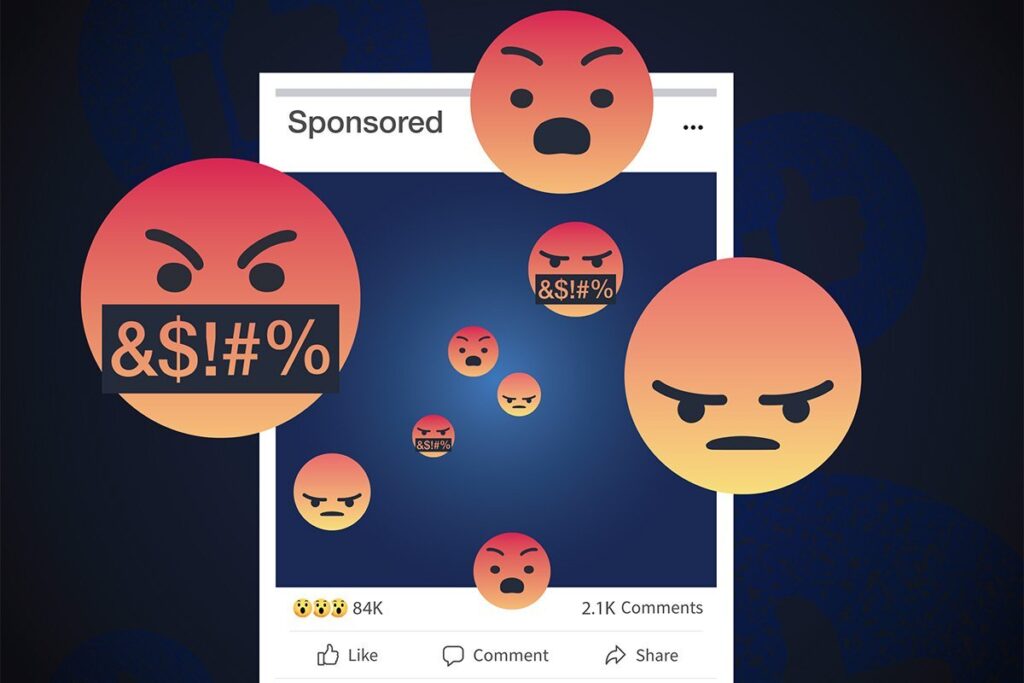
If hate speech is harmful, shouldn’t we ask why such speech can spread so wantonly on the Internet? The answer lies in the architecture of these platforms. Social media not only reflects what people are talking about, but also affects what they can see. Content that is easy to arouse strong emotions, especially those that is angry or unbelievable, are more likely to be shared, commented and amplified by algorithms (Carlson & Frazer, 2018).
Therefore, the “attention economy” was born. In this economic model, attention depends on participation rather than the value or authenticity of the content. In this environment, extremist propaganda obviously prevails. Rational and restrained views are often not responded to, while inflammatory or offensive remarks can quickly trigger responses. In other words, hate speech is becoming more and more “performance” – it is not only a voice, but also a tool to attract attention. However, the key is that this is not just the behavior of a few people. The scope of participation is actually very wide. Audiences participate through interaction, sharing and debate, all of which can expand the dissemination of content (Carlson & Frazer, 2018). Online hate content is not only promoted by Internet celebrities. In a sense, both the platform and the users are involved.
Andrew Tate – Turning Controversy into a Traffic Password
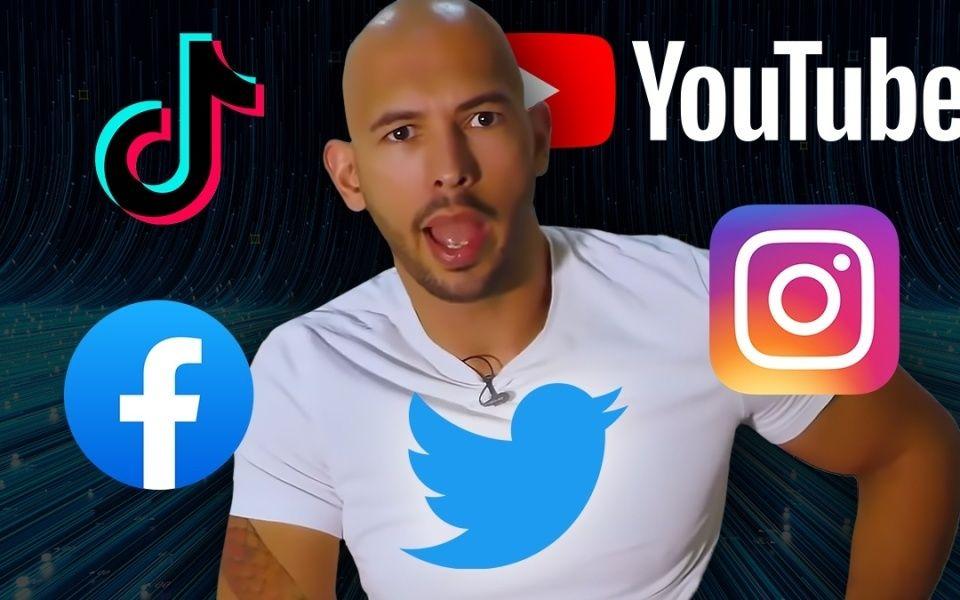
Look at Andrew Tate. He is a typical representative of packaging hate speech into Internet marketing strategies. This person has been banned by many social platforms because of his strange views on women, but he still continues to post content that is criticized as “misominous”, which eventually attracts a large number of fans. He even dared to say the absurdity that “men are superior to sex”, completely ignoring women. The most surprising thing is that the more he is criticized, the worse he becomes.
Tate’s “success” in the traffic economy is by no means accidental. This guy is very good at provoking trouble. His content always accurately grasps the timing and focuses on topics that can arouse emotions – especially those that make people angry or want to argue. These topics perfectly fit the formula of viral content loved by many platforms (Carlson & Frazer, 2018). Every comment, every share, and even every post criticizing him has helped him gain great exposure. In short, anger is the traffic password. Remarks that may be self-destructing in the eyes of others have become a routine means for him to attract attention and fans.
Hate speech is not just bad words. It is a kind of social cancer. Long-standing research shows (Sinpeng et al., 2021) that such content solidifies gender discrimination and packages prejudice as a common thing. Even if people are skeptical at first, they will be unknowingly affected by exposure to such content day after day. Over time, they will be brainwashed to think that this kind of discrimination is normal.
In the end, this interaction also shows that the audience is also promoting the dissemination of such content to some extent. Many people who follow Tate do not agree with him. They just think he is outrageous and want to seize every opportunity to oppose him. But the problem is that whether they support him or oppose him, this kind of back-and-forth interaction is in the middle of the algorithm – this mechanism does not distinguish between good and bad; as long as it is popular, it can make him popular on all platforms (Carlson & Frazer, 2018). To put it bluntly, hate speech is actually a vicious circle: the more people follow, the more eye-catching they are; the more eye-catching, the more people follow.
The most obvious point of Tate’s case is that it confuses expression with utilization. His content is mixed together in that vague network environment, some of which is not obviously illegal, which makes platform management particularly tricky (Flew, 2021). This actually exposes a major problem in network management: when harmful content can both make money and attract traffic, the platform will be in a dilemma – both to protect users and not to lose traffic.
Paul Miller – The Direct Manifestation of Extreme Hatred
If Andrew Tate is basically the kind of carefully packaged and familiar with the way of business, then Paul Miller (“Gypsy Crusade”) is like a spokesperson for completely unrestrained extreme hate speech on the Internet. Unlike Tate’s “master of success”, Miller purely relies on blatant racism to shape his online image – using racist words in live broadcasts, wearing racist logos, and insulting black people wantonly. He even admitted himself: “This is not an obscure secret word or irony, but purely to attract attention and provoke trouble.”
Miller looks like an isolated extremist with almost no support: he is just a troublemaker who makes waves outside the mainstream digital norms. But what’s disturbing is that he actually hangs out outside. His remarks are generally regarded as hate speech, and major platforms have also banned them. However, the problem is that the most naked hate content has found a place to stay on those platforms that chase clicks, although these platforms are still dominated by mainstream Internet celebrities.
From the perspective of the platform mechanism, Miller’s case shows that attracting attention is a kind of capital in itself. His work relies entirely on arousing instant emotional reactions – disgust, anger, and disbelief – which are precisely the key emotions that drive interaction (Guan & Chen, 2025). In a system where traffic determines exposure, negative attention is still attention and can still push the content to the forefront. Therefore, his output is especially in line with the most fundamental meaning of “steracle”: you consume it not necessarily because you agree, but simply because you can’t stop.
The audience actually contributed to the spread of extreme content unconsciously. Many people click or interact at the beginning just out of curiosity, annoyance, or just want to vent to the anchor. But just like Tate’s case, these reactions will roll bigger and bigger like a snowball – the more interaction, the higher the exposure of his content (Carlson & Frazer, 2018). Therefore, this cannot be entirely attributed to a certain person; although there are indeed people who incite negative emotions on the Internet, it is ultimately more like a group behavior, and everyone is adding fuel to the fire.
In addition, this extreme hatred may also contribute to a wider range of “we and them” opposition system – some groups are racially threatened, while others are treated differently ((Guan & Chen, 2025). This shows that even the most naked hate speech does not exist in isolation, but is closely linked to deeper social and cultural trends.
However, Miller is completely different from Tate in some ways. Although Tate may still be in the gray area, Miller has obviously crossed two red lines – both of which are very striking, indicating that he has entered the penalty area. The fact that he was banned by multiple platforms shows that some bottom lines can never be crossed. But on the other hand, the widespread dissemination of his video before it was removed from the shelves inevitably made people question the timeliness of the platform’s supervision. Such extreme hate speech can spread quickly once it appears, and by the time the platform takes action to stop it, the damage has already been caused. This shows that platform management is inherently remedial rather than preventive (Flew, 2021).
The role of the user: You are also “nudging” the spread.
The Tate and Miller incident actually exposed a bigger problem with the platform – not only the improper speech of some people, but the platform itself is also fueling hate speech. Many people think that social media companies are just neutral messengers, but in fact, they will secretly increase traffic to certain content through algorithms designed based on interaction (Flew, 2021).
Neutrality or fanning the flames?
This leads to a question: if the platform does amplify harmful content, how much responsibility should they bear in controlling this content? On the surface, content review seems to be quite simple – they can delete posts, block accounts or tighten rules. But in fact, managing these contents is much more complicated. The problem is that many harmful contents are not even illegal. As Flu (2021, pp. 115 to 118) pointed out, a large number of online comments are in the gray area: offensive, suspicious or less beneficial to society – enough to provoke trouble but not to violate the law. Therefore, how should the platform be determined to draw boundaries? Well, it’s really difficult.
In the end, the identity politics we see is actually just a makeover of hate speech in the online world. It is no longer a marginal phenomenon, but has quietly integrated into our daily online culture. As long as attention is still the currency of the online world, and as long as the platform continues to rely on user participation to make profits, it is basically futile to eradicate hate speech. In a word: it is not enough to strengthen the content review – we must rethink the whole system of rewarding the clicks and revenue of such content.
Reference
- Carlson, B., & Frazer, R. (2018). Social media mob: Being Indigenous online.
- Flew, T. (2021). Regulating platforms. John Wiley & Sons.
- Guan, T., & Chen, X. (2026). Threat perception, otherness and hate speech in China’s cyberspace. Journal of Contemporary China, 35(158), 1337-1352.
- Sinpeng, A., Martin, F. R., Gelber, K., & Shields, K. (2021). Facebook: Regulating hate speech in the Asia Pacific. Facebook content policy research on social media award: Regulating hate speech in the Asia Pacific.


Be the first to comment