If Platforms Have Rules, Why Does Hate Still Spread?
Topic: Hate speech, online harms and moderation | Case study: Meta, 2025
Introduction
For years, large platforms have told users a reassuring story: harmful content exists, but there are rules for it. There are community standards, reporting buttons, moderation teams, appeals channels and increasingly AI systems meant to detect abuse at scale. On paper, that sounds like governance. Yet the contradiction is now hard to miss. Platforms can have extensive rules and still remain environments where hate circulates quickly, visibly and sometimes profitably.
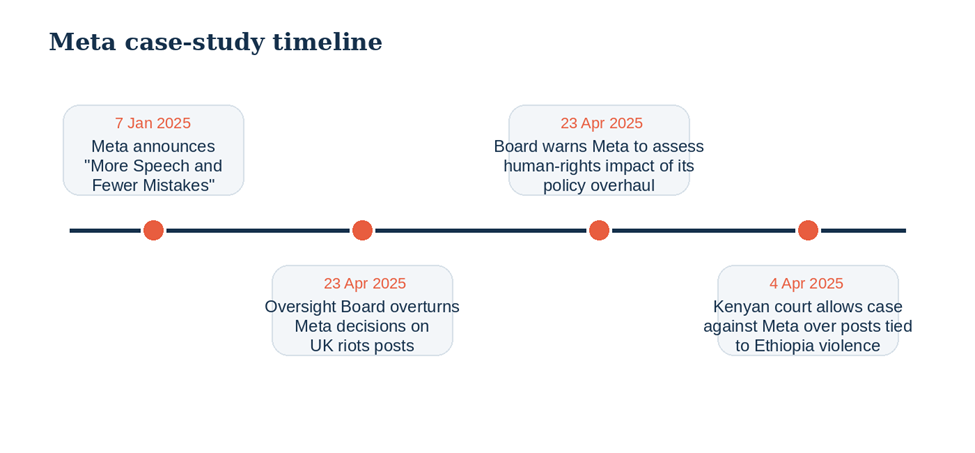
Meta’s January 2025 announcement, framed as “More Speech and Fewer Mistakes,” made that contradiction unusually clear. The company said it would reduce enforcement mistakes, end third-party fact-checking in the United States, introduce Community Notes, and narrow proactive enforcement toward what it called illegal and high-severity harms (Meta, 2025a). Presented as a defence of expression, the shift also revealed something deeper: platform governance is not only about whether rules exist. It is about which harms are prioritised, how those harms are defined, how quickly rules are enforced, and whether recommendation systems continue to reward the very content that makes social spaces more hostile.
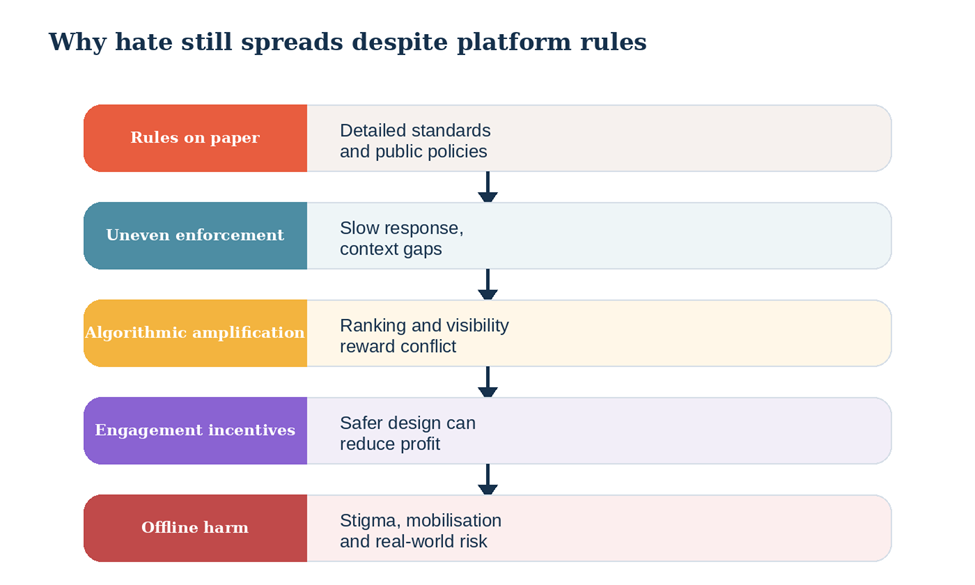
That is why the better question is not whether Meta has rules. It clearly does. Its Community Standards and Hateful Conduct policies are detailed and public (Meta, 2025b). The real question is why hate continues to circulate on platforms already covered in policy text. This article argues that hate persists because the problem is structural. It lives in the gap between policy and practice, in uneven enforcement across contexts, in ranking systems that amplify conflict, and in business incentives that often place engagement above safety.
The problem is not whether platforms have rules. The problem is whether their systems are built to prevent foreseeable harm.
Why rules do not settle the problem
The first problem is definitional. Hate speech is not simply rude language or unpopular opinion. In the Week 6 materials, Sinpeng et al. (2021) describe hate speech as expression that harms people because of their perceived membership of a marginalised group and that therefore warrants policy and regulatory responses. That sounds straightforward, but platforms must turn that social and political judgment into operational rules: protected characteristics, thresholds of severity, exceptions, labels, and review procedures. What looks clear in principle becomes unstable in practice.
Meta’s 2025 policy shift highlights that instability. When a company says it wants to allow more speech on topics now treated as part of mainstream public debate, it is not making a neutral technical adjustment. It is redrawing the boundary of acceptable speech (Meta, 2025a). Some users gain more room to speak, while others face greater exposure to contempt, intimidation or dehumanising rhetoric. “More speech” is therefore not experienced equally. It can expand participation for some while shrinking the practical safety of others.
This matters because platform rules do not simply describe harm; they actively construct what counts as harm. A company can publish a lengthy hate-speech policy and still make interpretive choices that tolerate more hostility around migrants, Muslims, queer people or other targeted groups. In this sense, the issue is not a total absence of regulation. It is the politics of selective permissiveness. The rules remain, but their meaning shifts.
When enforcement arrives too late
The second problem is enforcement. Moderation does not fail only because it is difficult; it fails because it is uneven. The existence of rules says very little about speed, consistency or contextual judgment. This became especially clear in the Oversight Board’s April 2025 decisions on three Facebook posts shared during the 2024 UK riots. The Board overturned Meta’s original decisions to leave the posts online and said each one created a risk of likely and imminent harm (Oversight Board, 2025a). Those posts were circulating in a moment already shaped by misinformation, anti-Muslim anger and anti-immigrant mobilisation.
The significance of that case study is obvious: the rules were already there. Meta had moderation systems, escalation tools and later activated a Crisis Policy Protocol. Yet harmful content still remained visible during a volatile event. The failure was temporal and institutional. It was not no governance, but governance that arrived too slowly. In crisis situations, delay is not a minor flaw. A platform can technically be moderating while still allowing harm to scale faster than its systems can respond.
Reuters reporting on the UK riots helps explain why timing mattered so much. Following the Southport murders, false claims spread online that the suspect was an Islamist migrant, fuelling anti-Muslim and anti-immigrant unrest across the country (Smout & Robertson, 2024). In that context, posts praising violence or intensifying hostility were not just isolated opinions floating in cyberspace. They were part of a broader information environment in which misinformation, identity-based blame and offline mobilisation were feeding one another.
The Oversight Board’s broader April 2025 statement made the lesson even sharper. The Board said these were the first cases reflecting on Meta’s January 7 policy and enforcement changes and warned that the company needed to assess the human-rights consequences of its new approach (Oversight Board, 2025b). Reuters likewise reported the Board’s concern that the overhaul could worsen hate speech, misinformation and incitement (Chee, 2025). That warning matters because it shifts attention away from single posts and toward platform design. Harm is not only a matter of whether one post crosses a line; it is also a matter of whether the overall system is becoming more permissive at precisely the wrong time.
Amplification, visibility and engagement
A third reason hate still spreads is amplification. Harmful content does not merely survive moderation; it is ranked, circulated, repeated, recommended and rewarded with attention. This is where rule-based defences start to look thin. A platform may remove some posts while still running systems that privilege outrage, identity threat and conflict because those forms of content produce reaction. As Massanari (2017) argues in her work on toxic technocultures, harm is not just a problem of bad users. Platform affordances, governance choices and community cultures can help make toxicity durable.
Meta’s January 2025 announcement is relevant here too because it linked moderation to visibility. The company said it would take a more personalised approach to political content so people who want more of it can see more of it (Meta, 2025a). On one level, that sounds like user choice. On another, it confirms that moderation and recommendation cannot be separated neatly. Even if a platform removes some hateful material, the surrounding system may still privilege emotionally charged, divisive and identity-based content that keeps users engaged.
This is why the slogan of “more speech” can be misleading. The issue is not whether there is more speech in the abstract. The issue is what kinds of speech become visible under platform conditions organised around scale and engagement. Content does not need to contain an explicit slur to contribute to a hateful atmosphere. It can insinuate, target, normalise, rally or dehumanise by association. By the time a platform intervenes, if it intervenes at all, the social work of that content may already be done.
Why incentives matter
The fourth problem is the business model. Platforms are not public utilities designed primarily for democratic safety. They are commercial media systems built to maximise use, relevance and retention. If stronger safety interventions reduce participation, slow virality or trigger accusations of political bias, companies have clear incentives to soften enforcement or define harms more narrowly. In that sense, moderation debates can become too polite. They talk about difficulty, scale and trade-offs while avoiding the simpler point that safer platforms may be less profitable platforms.
The tension between public safety and commercial incentive is visible in Meta’s response to criticism. The company framed its January shift as a correction to over-enforcement. But the Oversight Board’s response, along with Reuters’ reporting on it, suggests a different reading: reducing friction for speech can also reduce friction for hate, especially when enforcement thresholds are raised and contextual judgment remains uneven (Chee, 2025; Oversight Board, 2025b).
The stakes are not hypothetical. In April 2025, a Kenyan court ruled that Meta could be sued in Kenya over allegations that Facebook amplified content linked to ethnic violence during Ethiopia’s Tigray conflict. Reuters reported claims that Facebook’s algorithms promoted violent and hateful content and that this contributed to real-world harm, including threats and the murder of one plaintiff’s father (Winning, 2025). Whatever the final legal outcome, the case reinforces a key point: hate is not only a moderation issue. It is also a design, distribution and accountability issue.
References
Chee, F. Y. (2025, April 23). Meta’s content policy overhaul in Europe under scrutiny after Oversight Board rebuke. Reuters. https://www.reuters.com/technology/metas-content-policy-overhaul-europe-under-scrutiny-after-oversight-board-rebuke-2025-04-23/
Flew, T. (2021). Issues of concern. In Regulating platforms (pp. 91-96). Polity.
Massanari, A. (2017). Gamergate and The Fappening: How Reddit’s algorithm, governance, and culture support toxic technocultures. New Media & Society, 19(3), 329-346. https://doi.org/10.1177/1461444815608807
Meta. (2025a, January 7). More speech and fewer mistakes. About Meta. https://about.fb.com/news/2025/01/meta-more-speech-fewer-mistakes/
Meta. (2025b). Community Standards. Transparency Center. https://transparency.meta.com/policies/community-standards/
Oversight Board. (2025a, April 23). Posts supporting UK riots. https://www.oversightboard.com/decision/bun-6aqh31t6/
Oversight Board. (2025b, April 23). Wide-ranging decisions protect speech and address harms. https://www.oversightboard.com/news/wide-ranging-decisions-protect-speech-and-address-harms/
Sinpeng, A., Martin, F. R., Gelber, K., & Shields, K. (2021). Facebook: Regulating hate speech in the Asia Pacific. Department of Media and Communications, The University of Sydney. https://hdl.handle.net/2123/25116.3
Smout, A., & Robertson, J. (2024, August 2). Keir Starmer warns social media firms after Southport misinformation fuels UK riots. Reuters. https://www.reuters.com/world/uk/pm-starmer-warns-social-media-firms-after-southport-misinformation-fuels-uk-2024-08-01/
Winning, A. (2025, April 4). Meta can be sued in Kenya over posts related to Ethiopia violence, court rules. Reuters. https://www.reuters.com/technology/meta-can-be-sued-kenya-over-posts-related-ethiopia-violence-court-rules-2025-04-04/
Woods, L. (2021). Obliging platforms to accept a duty of care. In M. Moore & D. Tambini (Eds.), Regulating big tech: Policy responses to digital dominance (pp. 93-109). Oxford University Press.
Be the first to comment