Why do you always keep scrolling through TikTok without stopping?
Has there ever been a situation where you just opened TikTok to watch for a few minutes, but before you knew it, an hour had passed?
These experiences may seem convenient and make you feel like the platform understands you. For example, they know what you like and then show you the content that interests you in the next video. But what if these systems not only “discover” your preferences, but also gradually influence what you watch, how long you watch it, and even change your interests as you keep browsing?
Source: Shoplazza (2025)https://www.shoplazza.com/blog/tiktok-algorithm
Artificial Intelligence (AI), automation, and data-driven algorithms are usually regarded as merely neutral and unbiased tools, as if they are merely used to make life faster and more convenient, such as recommending videos, searching for information, organizing content, etc. However, this understanding is overly simplistic and tends to overlook more important issues. AI is not just a technical tool; it is more like an invisible system. Because it is quietly involved in our daily lives. For instance, the content you see on TikTok, the recommendations you receive on Netflix, all are selected and adjusted by algorithms based on your behaviors. These choices may seem to be serving you, but at the same time, they are also determining what content you will see and what you will not see. These systems do not merely respond passively to your preferences; instead, they are constantly collecting your clicks, dwell times, and viewing habits. Then they in turn influence what you will click next and what you will watch. They may even gradually change your interests and preferences, making you think you are freely choosing, but in fact, the range of choices has been pre-designed.
The main point of this article is:
We usually view artificial intelligence (AI) and algorithms as neutral tools because they can provide better services based on our behaviors. However, in reality, they are embedded in the social structure and daily life. They subtly influence our cognitive and behavioral patterns through information recommendations, sorting, and filtering. And the more we rely on these systems, the less likely this influence is to be noticed.
AI is not a neutral tool, but a designed system.
In fact, AI is not as intelligent as we imagine. Often, we treat it as a system that can think and understand humans, but the reality is that it is more like a trained tool rather than a truly conscious “intelligent entity”. As Kate Crawford said in “Atlas of AI”, AI is neither entirely “artificial” nor truly “intelligent”; it is more like a system composed of data, resources, human labor, and social power (Crawford, 2021). AI can operate because there are a large number of humans involved behind it. For example, many AI models require humans to label data, filter content, and even constantly correct errors. At the same time, it also relies on the data and computing resources provided by companies. Without these supports, AI would be unable to make judgments at all. Therefore, it is not an independent thinking entity, but a result shaped by humans continuously.
These systems were not designed with the intention of helping you make better choices from the very beginning. Take social media as an example. Its main focus is on how to make you spend more time, watch more videos, and click more likes, because all of these will help the platform make money. Therefore, what the algorithms truly care about is not whether the content is helpful to you, but how to “retain” your attention.
Crawford also pointed out that AI systems are usually designed to serve institutions that have access to resources and power (Crawford, 2021). This means that the algorithms do not make completely neutral judgments from the user’s perspective, but operate according to pre-defined goals. Therefore, when we see various recommended content, it is not just “what we like”, but rather the platform wants us to keep viewing. So this can show that AI is not a completely objective and fair tool, but rather a system that is designed by people and has a clear direction. It seems to be helping us make choices, but in fact, it is gradually influencing what we watch, click on, and even slowly changing our interests and habits.
TikTok Case: How Algorithms Change What You Like
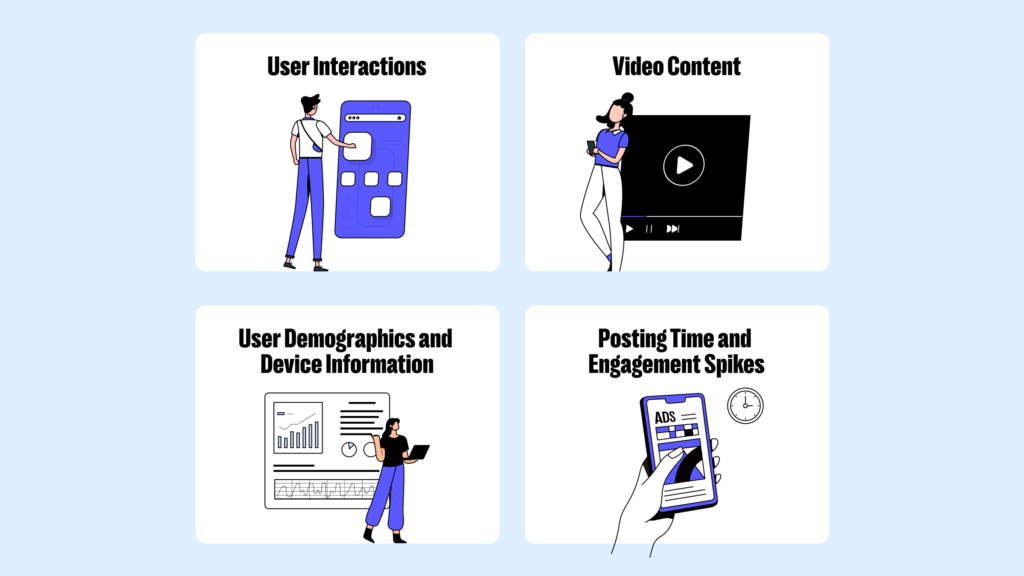
TikTok is a very typical example. Its “For You Page” seems to be recommending content based on your interests, but in reality, it is more like constantly “testing” and “adjusting” you. For instance, when you are watching videos, the system not only records what you click on, but also records how long you stay on a particular video, whether you repeatedly watch it, whether you like or comment on it. These seemingly minor behaviors are all used by the algorithm to determine what content you might be attracted to next.
At first, you might just accidentally click on a certain type of video, but if you stay a little longer, the system will interpret this behavior as a sign that you are “interested”. Then, it will gradually increase the frequency of such content appearing, making this type of video become more and more common. Over time, your entire page will be filled with this type of content, looking as if it “just matches your interests”. But this is not just a simple recommendation; it is a gradual strengthening process. The platform will continuously adjust the content based on your every stay and interaction, making it easier for you to continue watching the same type of videos. During this process, your viewing habits and interests will be gradually shaped, rather than being fixed from the beginning. This mechanism has been observed in real-world studies. For example, a study found that TikTok’s recommendation system can quickly identify user interests within a short period of time and gradually reduce the diversity of content. This means that the types of content that users view will be very similar (Baumann et al., 2025). At the same time, some studies have also found that such recommendation algorithms tend to push more emotionally intense or even extreme content, because such content is easier to attract users to stay and interact (Dias et al., 2021). In other words, the algorithm is not prioritizing “the most valuable” content, but rather “the content that makes you stop”.
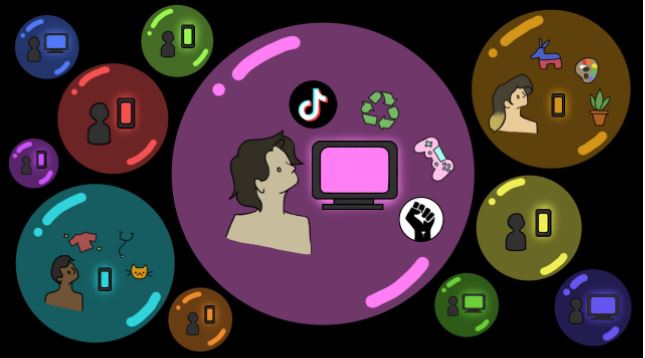
From the user’s perspective, this means that you are not merely “choosing the content you want to watch”, but making choices in an environment that is constantly being adjusted. Over time, your interests may be gradually guided or even changed by this environment. Therefore, TikTok does not merely present the content you already like; rather, it gradually influences you through the repeated presentation of certain information, making you gradually accustomed to and even beginning to prefer these contents. They are re-shaping our interests. This precisely confirms the “information bubble” phenomenon mentioned in “Automated Culture”: when people are constantly exposed to repetitive information, the viewpoints they encounter will become increasingly monotonous, thereby reducing their understanding of different perspectives (Andrejevic, 2019).
The algorithm is not only in recommending information, but also in shaping reality.
Source: Alara Dasdan, via LHS Epic (2021)https://lhsepic.com/9373/in-depth/isolated-in-online-social-spaces-the-filter-bubble-algorithm/
When the algorithm starts to determine what we see, it is actually already exerting a kind of “governing” function. Just and Latzer (2016) pointed out that the algorithm, by constantly filtering and sorting information, makes certain content become more “important” and easier for us to see. This means that the algorithm does not directly tell you “what the world is like”, but it affects how you perceive the world by deciding what information you see. The algorithm is not only helping us find information, but actually determining what can be seen and what will be ignored, so the “world” we see is actually a part of it that has been filtered by the algorithm, rather than the complete reality. Therefore, the algorithm is not only reflecting reality, but also subtly shaping our understanding of reality. This is different from previous television and newspapers. Now the content pushed by the algorithm is “tailored to individuals”, so what each person sees is different, just like each person lives in a slightly different information world. This will lead to the content we see becoming increasingly different. The common topics between people will become fewer, and the understanding of the world is more likely to have differences.
When choices are automated, are we still making our own judgments?
The truth is that the problem is not just what content we see, but how we began to rely on this content. “Automated Culture” points out that we have unknowingly handed over the power to select information to algorithms. Previously, the information we came into contact with was usually pre-screened by others. For example, news editors would choose to report on important events, and teachers would tell us which contents needed to be focused on for study. These were all judgments made by humans on what was important rather than being automatically decided by the system. But now, this process is increasingly being completed by the system automatically. This recommendation method merely helps us find the content we are interested in faster, but the problem lies in that the algorithm does not judge whether this content is valuable or more meaningful. What it truly cares about is what content can make you stay longer and watch more videos. For instance, some videos require you to listen carefully and think slowly, and many people may lose patience and just scroll away. But those videos that are captivating, emotionally charged, and even make you want to like or comment, are more likely to make you stop and keep watching. Finally, the algorithm will continuously record your these behaviors and then it will increasingly push similar content to you.
This is what is called “information cocoons” – you think you are freely browsing, but in fact, you are in a constantly reinforced content loop. This change will also gradually affect our thinking patterns. When we get used to relying on recommendation systems, it is easy to default to “what is recommended is important”, thereby reducing our own judgment. This “automated judgment” means that we have handed over thinking to the system, which may also gradually weaken our independent thinking ability and make it harder for us to understand different viewpoints.
We can see the content, but we cannot see the system.
Source: Investopedia, image by Julie Bang (2019)https://www.investopedia.com/terms/b/blackbox.asp
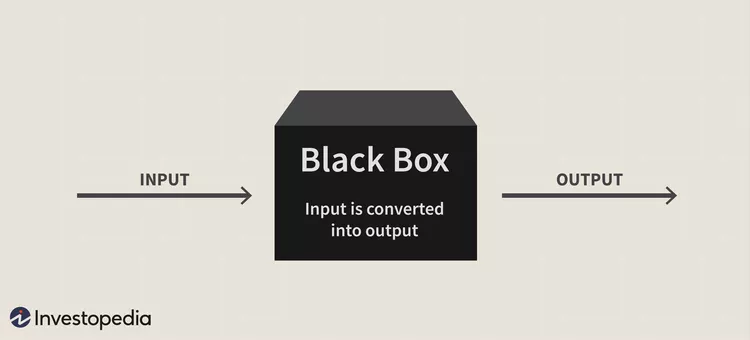
Frank Pasquale mentioned in “Black Box Society” that we actually live in a “black box society”. In simple terms, it means: you can see the result, but you have no idea how this result came about (PASQUALE, 2015). For example, on TikTok, you can see the videos recommended to you, but you don’t know why these videos were selected. At the same time, the platform is constantly collecting your data. Pasquale pointed out that this would create a “information asymmetry”: the system knows more and more about you, but you almost know nothing about the system (PASQUALE, 2015). This asymmetry is not just a technical issue, but also a power relationship. Because when you don’t know how the system operates, it is difficult for you to question it, and even difficult for you to realize that it is influencing you.
Are we still making choices on our own?
When we look at these issues together, we will find that AI is no longer just a convenient tool. It is more like a system that operates behind the scenes, and is gradually influencing what we see, as well as changing what we like and what we consider important. TikTok is just an example, but it clearly shows how the algorithm shifts from “recommending content” to “shaping choices”. So the next time you open TikTok, you can ask yourself a simpler question: Is it just understanding you, or is it gradually changing you?
References
Andrejevic, M. (2019, September 24). e-Reader. Taylor & Francis Grou. Andrejevic, M. (2019, September 24). e-Reader. Taylor & Francis Grou. https://www.taylorfrancis.com/reader/download/00dccf8a-55c6-4305-8b17-4710c8fce65f/chapter/pdf?context=ubx
Baumann, F., Arora, N., Rahwan, I., & Czaplicka, A. (2025, March 26). Dynamics of algorithmic content amplification on TikTok. arXiv.org. https://arxiv.org/abs/2503.20231?utm_source=chatgpt.com
Crawford, K. (2021, April 6). ProQuest ebook central. Reader. https://ebookcentral.proquest.com/lib/usyd/reader.action?docID=6478659&ppg=10&c=UERG
Dias, A., McGregor, J., & Day, L. (2021, July 25). Lauren got TikTok for a laugh. The app would change the direction of her life. ABC News. https://www.abc.net.au/news/2021-07-26/tiktok-algorithm-dangerous-eating-disorder-content-censorship/100277134?utm_source=chatgpt.com
Just, N., & Latzer, M. (2016). Governance by algorithms: Reality construction by algorithmic selection on the Internet. Media, Culture &Amp; Society, 39(2), 238–258. https://doi.org/10.1177/0163443716643157
Kenton, W. (2003, November 25). Understanding black box models: Definition, finance use, and examples. Investopedia. https://www.investopedia.com/terms/b/blackbox.asp
Medepalli, S. (2021, February 19). Isolated in online social spaces: The filter bubble algorithm. The Epic. https://lhsepic.com/9373/in-depth/isolated-in-online-social-spaces-the-filter-bubble-algorithm/
PASQUALE, F. (2015). The secret algorithms that control money and information. Harvard University Press. http://www.jstor.org/stable/j.ctt13x0hch
Team, S. C. (2025, January 8). TikTok algorithm: Secret to boosting video views. https://www.shoplazza.com/blog/tiktok-algorithm



Be the first to comment