
Standfirst
Browsing the internet often gives people a sense of personal habit. However, a major lawsuit may reveal another possibility: the real problem may be not only what we watch, but also how the platform is designed so that we can continue to watch.
Why staying online is not just a personal choice
We have all experienced this situation: picking up the mobile phone just to check some notifications, maybe videos, posts, emails, or just a quick browsing before going back to work. But unconsciously, forty-five minutes passed, and you were still watching a short video. It felt like you were in a digital fog.
For a long time, we have been blaming ourselves. However, the key evidence may show that we just think we need stronger self-control. Nevertheless, important research results may indicate that this explanation is not complete. Based on these results, this study may show that things are far from that simple.
Millions of people experience the same thing every day. Evidence shows that this pattern seems to be too consistent and unlikely to be a personal problem. Thus, the significant findings may indicate that some apps appear particularly hard to leave. Furthermore, the results might demonstrate that these platforms could show a consistent ability to keep us watching.

Platforms do more than deliver content. Notwithstanding this observation, the evidence may suggest that these systems appear to pursue sustained attention rather than simple delivery. However, the findings could indicate that they are not simply showing us posts. So, the results might suggest that the real goal could involve holding our attention for as long as possible.
Evidence shows platforms pursue attention deliberately. That is why a major court decision in Los Angeles matters so much. On 25 March 2026, a jury found Meta and Google negligent in a case about harm to a young user, and awarded about $6 million in damages.

Reuters described the case as a possible lead case for thousands of similar lawsuits still moving through California courts. The importance of this case is to make people realise that the real problem may not be the content presented on the screen, but the design logic behind it.
This case redefined the core of the problem and changed the way I think about it. What if the problem is the platform itself? What if this system is specially designed to make us addicted?
AI shapes what we see. This is where AI and algorithms come into play. Instead of presenting content on the screen in a neutral order, they rank, sort, predict, and learn from user behaviour.
As time goes by, the system will become better at retaining us. Therefore, the problem is not only what content we choose to watch, but also the content pushed to us by the platform.
That’s why I think these systems not only reflect user interests, but organise user interests as well. Just and Latzer believe that algorithm selection has become an increasingly important source of social order, because it shapes daily life, affects the way people see the world, and influences people’s behaviour. This point of view is especially important because it shows that the recommendation system is more than a technical tool that runs silently in the background; it’s an important part of the platform to guide users’ attention as well.
From this perspective, the real problem is not only the screen time, but also the platform design itself. If a platform can quietly guide us to browse the content and dwell time, then it is shaping the behaviour of users through algorithms.
This blog believes that the AI-driven recommendation system is not a neutral tool, but a part of a larger system. The system converts the user’s attention to the object that needs to be controlled.
How does the AI and algorithm attract our attention
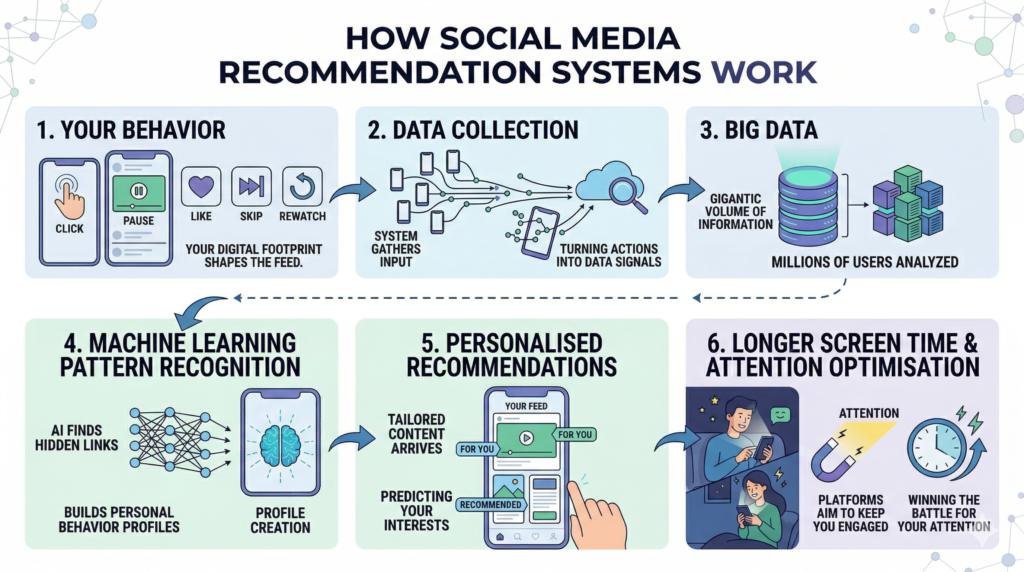
The reason why these platforms are addictive is that they are always changing in the process of use. It will be constantly updated according to some of our browsing actions, such as staying for a few seconds, watching a certain content repeatedly, or quickly skipping a post.
The platform will regard all this information as useful information, and then quietly adjust the content of the follow-up push. Therefore, users will feel that this application seems to know themselves very well, so they will spend more time on it.
What I think is interesting is that this system actually doesn’t need to really “understand” us. It only needs to identify what we are doing. If users who often watch a certain type of video turn to another one, the platform will remember this. If a certain type of video is more attractive to users, it will also learn this.
As time goes by, the system will become better and better at predicting the reasons why we may stay. Therefore, the recommendation system will “understand” us more and more, and then push the content we want to see.
That’s why I don’t think these systems are neutral. These systems set clear goals at the beginning of the construction. One of the important goals is to extend the stay time of users on the platform. The longer the user stays, the more data the platform will collect. The more data collected, the more accurately the platform can predict the content that users like.
In short, our behaviour will be converted into data and continuously tracked. With these data, AI algorithms can accurately capture our interests through big data and machine learning, and then push content that we want to see next.
As time passes, it will tell us what to watch next, what to pay attention to, and how long to stay. That is why attention on digital platforms is not just personal. It is organised, measured, and optimised.
Why this case matters
Before going further, it’s necessary to look at what actually happened in the Los Angeles case. (Click here to the report)
On 25 March 2026, a jury in Los Angeles found that two major tech companies were negligent in a lawsuit involving harm to a teenage user. At the centre of the case was a young woman identified as KGM. She said she became heavily engaged in YouTube at the age of six and Instagram at around nine.
She said that as time went by, her use of these platforms became more and more addictive. By the age of ten, she was already experiencing depression and had started engaging in self-harm. It also began to affect her daily life, including her relationships with family and her performance at school.
At thirteen, her therapist diagnosed her with body dysmorphic disorder and social phobia, which she believes were linked to her long-term use of these platforms.
The jury supported KGM’s claim and awarded her about $6 million in compensation. Of course, the amount of money is huge, but for me, money is not the most important part.
What is really important is that this case is not just a disturbing post or a bad online experience, but about the whole platform. More specifically, it is about whether these applications are designed to make young users more addicted to them and whether they will harm their physical and mental health.

That’s why this case feels different. It shifted the focus of the discussion from “What did she watch?” Moved to a bigger question: what kind of digital environment does she live in every day?
I think this is the problem. Most of the time, surfing the Internet feels relaxed and natural. When you open the app, just slide the screen and enjoy. Unconsciously, time has passed.
But perhaps this is the key. The user experience is very smooth and natural, because the platform is designed in this way.
This is also the reason why I don’t agree with the simple argument of “lack of self-discipline”. People can make choices online, that’s for sure. But these choices do not occur in a natural state.
They occur in a flow of information that has been sorted out and personalised. The next post does not appear randomly, but is carefully arranged. Therefore, when people say that users should be more self-disciplined, I think they overlook something more important.
The platform will not only respond to user behaviour, but also shape their behaviour little by little every time they scroll.
What makes this case more interesting is the description of these platforms by KGM’s lawyers. In the case closing remarks, her lawyer called it “engineering of addiction”. He argued that the design of these applications makes it difficult for children to put down their mobile phones.
He also used the image of a “Trojan horse”: this thing seems attractive and harmless at first glance, but once allowed to enter, it will slowly control you. KGM’s lawyer also argued that her experience was not an exception, and many young users also experienced the process of addiction to media platforms.
However, I don’t think this case means that social media will always cause harm. A comprehensive review published by Sala and his colleagues in 2024 shows that the relationship between teenagers’ use of social media and mental health is more complex, and platform design is also an important factor.
In my opinion, this is the reason why this case is of great significance. It has turned application design into a public issue. The problem is no longer just how young people use these platforms, but what kind of platforms and algorithms companies should be allowed to build.
Why this is a governance issue
For me, the key point of the problem is that once we no longer regard it as a matter of personal habits, but many people have similar problems, it is more like a problem of governance. If the purpose of the platform is to predict user behaviour and retain users for as long as possible, then this is not only a private matter between individuals and mobile phones, but also about power.
One of the problems is that users can see the push content, but they can’t see the logic behind it. Most of us don’t know why we always see the content we are interested in. Due to the lack of transparency in this system, we have no idea what the algorithm is doing, and it is easy to fall into the information cocoon. Pasquale also put forward a similar view in the book Black Box Society, that a non-transparent system will make public supervision more difficult.
Therefore, I think that the usual suggestions such as reducing surfing time, enhancing self-discipline and putting down the mobile phone, are not enough. These suggestions shift most of the responsibility to users, while the design of the platform itself has not changed.
Therefore, the government needs to formulate clearer regulatory regulations, especially for products widely used by teenagers. This may mean increasing transparency, better protecting young users, and restricting algorithm recommendations. The platform should also give users more control so that they can choose the content to browse independently, instead of being surrounded by recommendations.
The change in the platform governance mode may still be far away, but we can still take some measures to avoid being affected by algorithms. We can reduce the time we spend on these applications, reduce our dependence on the platform, or search for some content that we are not interested in to “confuse” the algorithm.
Doing this will not solve the fundamental problem. But until supervision and governance are improved, this may be one of the few ways in which ordinary users can effectively resist.
References
Crawford, K. (2021). The atlas of AI: Power, politics, and the planetary costs of artificial intelligence. Yale University Press.
Just, N., & Latzer, M. (2017). Governance by algorithms: Reality construction by algorithmic selection on the internet. Media, Culture & Society, 39(2), 238–258.
Pasquale, F. (2015). The black box society: The secret algorithms that control money and information. Harvard University Press.
Reuters. (2026, March 25). Meta, Google lose US case over social media harm to kids. Reuters. https://www.reuters.com/legal/litigation/what-did-jury-decide-social-media-case-against-meta-google-2026-03-25/
Sala, A., Porcaro, L., & Gómez, E. (2024). Social media use and adolescents’ mental health and well-being: An umbrella review. Computers in Human Behaviour Reports, 14, 100404.
The Guardian. (2026, March 25). Meta and YouTube designed addictive products that harmed young people, jury finds. https://www.theguardian.com/media/2026/mar/25/jury-verdict-us-first-social-media-addiction-trial-meta-youtube
AI Statement: In this assignment, I used Gemini to help me collect relevant news information and generate image. I also used Grammarly to check for grammar and spelling errors.

Be the first to comment