On the evening of February 2, 2026, the Affiliated Hospital of Shaanxi University of Traditional Chinese Medicine broadcast a gynaecological surgery live on its WeChat Mini Program and WeChat Official Account.

The footage directly shows the female patient’s lower body, exposing her privacy without any cover. The live stream attracted a large amount of traffic, with the number of viewers peaking at over 50,000. This sparked heated public debate and numerous reports, after which the live stream was interrupted.
The following day (February 3), the hospital involved issued an official response stating that the live stream was a case of mistakenly disseminating internal teaching material.
The hospital has given the head of the Department of Gynecology II a serious warning and suspended him from his duties pending investigation. At the same time, the relevant personnel in the medical affairs department who were responsible for the review have been given a disciplinary warning.
Why was this internal training session broadcast live on a public platform?
The hospital’s official response stated that the live stream was interrupted after the instructor noticed unusual comments from viewers.
However, reports indicate that the live stream was actually stopped due to a complaint.
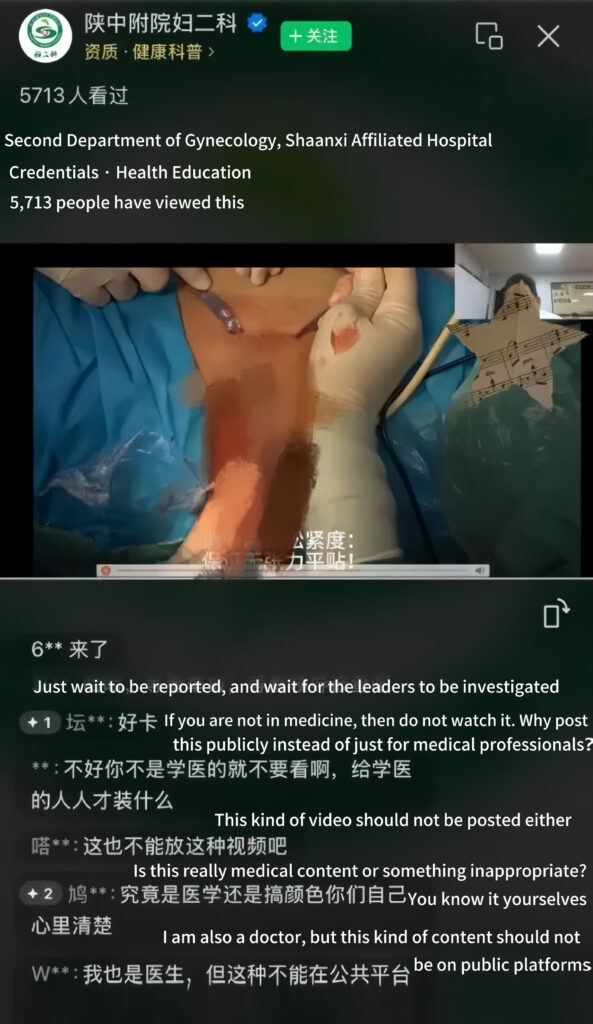
According to a commentary published by People’s Daily Online, reactions in the comments section of the live stream were mixed.
Some expressed public outrage, arguing that the authorities should be reported and held accountable with severe penalties.
Others made sexualised jokes; still others believed that it was merely a routine surgical livestream, suggesting that non-medical audiences should be excluded, but it shouldn’t have been broadcast on a live streaming platform.
Some even questioned whether the female patient had given informed consent, but argued that even if she had, such sensitive personal data should not be broadcast publicly.
When the livestream was shut down and those responsible were punished, the matter seemed to be reduced to a mere mistake. But the real question is, was it simply an operational error?
Did the patient truly give her consent?
While under general anaesthesia, did she still have the capacity to consent?
This is a moment of informed consent we witnessed:
people were angry, reported it, and the live stream was stopped.
But in the digital age, before this, how many moments went unseen and unreported? How many instances of forced consent were ignored?
In the data age, Is privacy simply about whether something is seen or not?
In the era of traffic, all industries are livestreaming. The government encourages doctors to do science communication in order to increase people’s knowledge of public health.
But which ones can be broadcast and which ones cannot?
A doctor who dares to broadcast a surgical procedure live on camera must have a high level of surgical competence, because any technical error or improper operation during the procedure will be exposed under the spotlight.
However, this does not mean that a patient’s private body parts can be spectated via livestream.
Nissenbaum (2018) argues that privacy concerns do not stem from control or secrecy, but from inappropriate flows of information. The same piece of information can carry entirely different meanings in different contexts.
Gynecological surgery involves women’s most private bodily information. To broadcast it live without consent, without even bothering to blur the surgical procedure, raises serious questions about the protection of patient privacy.
Under the camera’s gaze, doctors can clearly choose other methods.
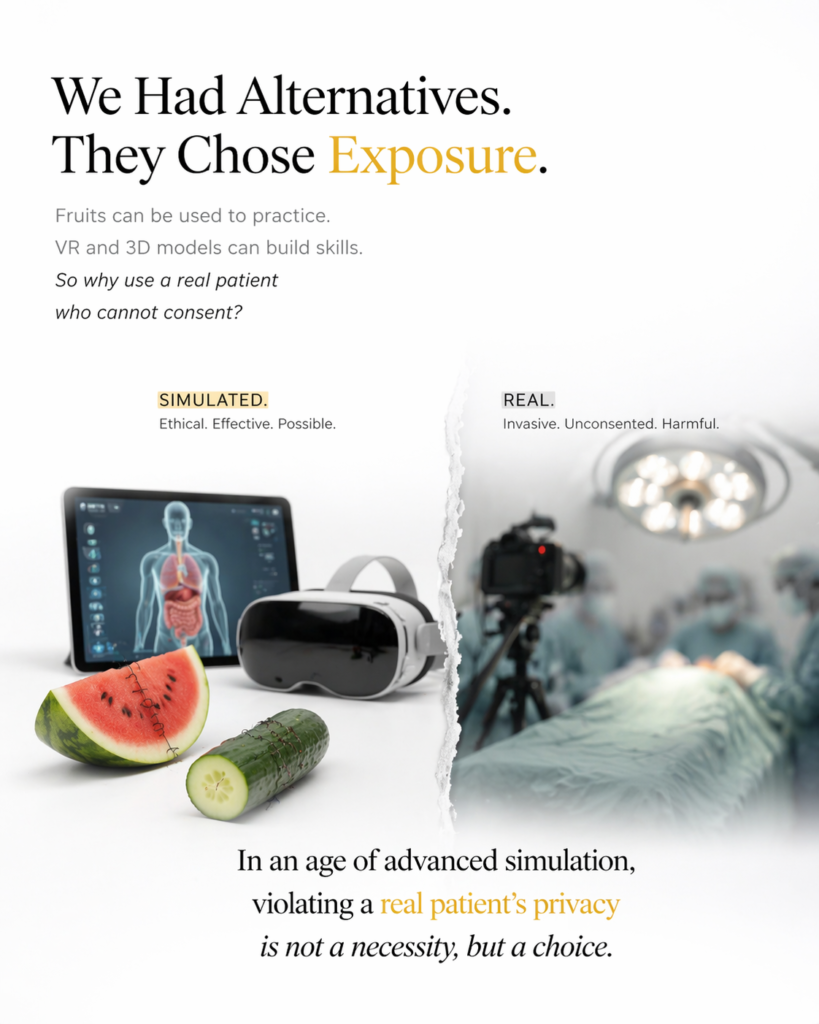
Previously, some content creators have chosen to simulate human organs using fruits, such as watermelons and cucumbers, to simulate the liver and kidneys, practicing basic surgical operations like cutting and suturing. Alternatively, they can use advanced bionic models and specialized simulation materials.
In today’s technologically advanced world, we can even use digital technologies such as virtual reality (VR) and 3D modeling to provide a teaching environment, instead of choosing to violate the privacy of an unconscious patient lying on an operating table.

Some people believe that doctors don’t perceive gender and consider these videos to be instructional videos confined to the medical field. They see the professionalism inherent in medicine but fail to recognize that the context in which the information is presented has changed.
Privacy is possible because every social context has a set of default information flow rules.
In different scenarios, people have different expectations about how information is collected, used, and circulated: in hospitals, information should be kept confidential and used only for diagnosis and treatment. Between friends, information is based on trust; in political voting, information should be anonymous.
While both involve bodily information, in a hospital, it’s normal for a doctor to examine a patient’s body. This is because it’s a “healthcare context,” where the flow of information revolves around diagnosis and treatment, which is socially accepted.
However, if the same images are placed on a public entertainment platform like a livestream room and viewed, even commented on and mocked, by thousands of strangers.
Then they cease to be for therapeutic purposes and become private content that can be viewed, discussed, and even consumed.
When being seen becomes the default: What role does the platform play in this?
The hospital defined the incident as an operational error by an individual, attributing the problem primarily to loopholes in its internal supervision mechanism and inadequate review procedures. But was this truly just an accident?
According to the Beijing Evening News, this kind of patient privacy breach is not an isolated incident.
Many doctors from tertiary hospitals across the country have opened science communication accounts on various platforms. They often use a combination of professional interpretation and case sharing, drawing on real clinical settings to make their content more engaging and credible.
Some of these accounts have a large number of followers, and their case videos often garner thousands of likes and comments.
However, there are still serious problems regarding patient privacy protection.
On social media platforms, many patients with similar experiences have expressed their dissatisfaction online. As the primary subject in the video, their rights to informed consent was not fully respected.
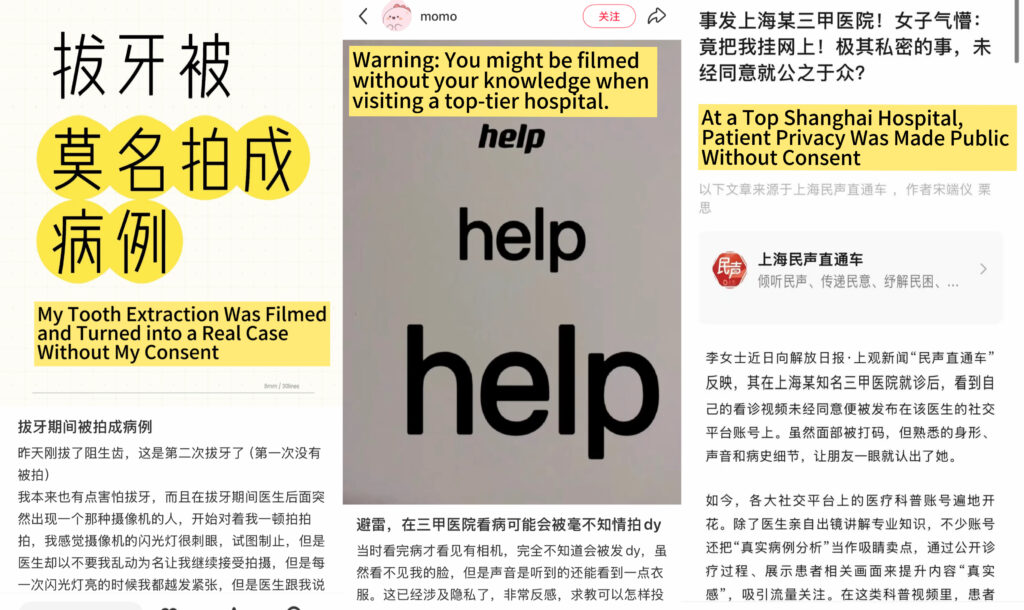
For example, some people were filmed during tooth extractions, and the doctors used the footage online as a case study without prior notice. Someone saw a camera during their medical consultations, but the person filming did not clearly explain the purpose of filming.
And some people were completely unaware that they were being filmed, and the video was directly posted on social media platforms, only to be taken down after the patient discovered it or filed a complaint.
Why is this kind of content so easily seen and spread?
Platforms are not neutral intermediaries, but rule-makers that shape what users can see and do (Suzor, 2019). They actively shape the visibility of information and the modes of participation of users through its interface design, recommendation algorithm, and interaction structure.
In the case of the gynaecological livestream, the reason why the livestream was able to quickly attract so many viewers was not only because it involved privacy-related content and aroused people’s voyeuristic curiosity, but also closely related to the platform’s recommendation algorithm.
On the one hand, platforms prioritize content that is more likely to generate interaction, giving it higher exposure.
On the other hand, interactive features such as real-time comments, likes, and interactions transform viewing behavior into a form of public participation that can be continuously amplified.
In other words, this is not only a privacy breach, but also a production of visibility amplified by the platform architecture (Zhang, 2026).
Many platforms actually live on emotion.
The stronger the emotion, the easier it is for the content to spread.
Whether this emotion is anger, curiosity, or vulgarity—these so-called good or bad—the platform doesn’t care. What it cares about is the user’s retention time and the user’s attention.
When Traffic is King: How Platforms Reshape What We Believe

In an era where traffic is king, platforms are subtly changing people’s original perceptions.
When platforms turn patients into content that attracts traffic, when the number of viewers keeps rising, when live comments flood the live stream room, and when the popularity or online attention is continuously amplified, the originally serious medical setting is gradually recoded into a consumable experience.
This also explains why vulgar comments appear in live stream rooms. This is not merely a matter of individual viewers’ conduct, but rather because viewers are no longer understanding the visuals as patients, but rather consuming them as audiences.
Once this transformation occurs, the patient’s body is no longer an object that needs to be respected and protected, but is more likely to be treated as something that can be evaluated or even entertained.
At the same time, the doctor-patient relationship, which was originally based on trust, has been quietly replaced by a relationship between content producers and audience.
In this relationship, the platform has made being watched a default and reasonable state.
From Content to Data: When Digital Rights Are Undermined
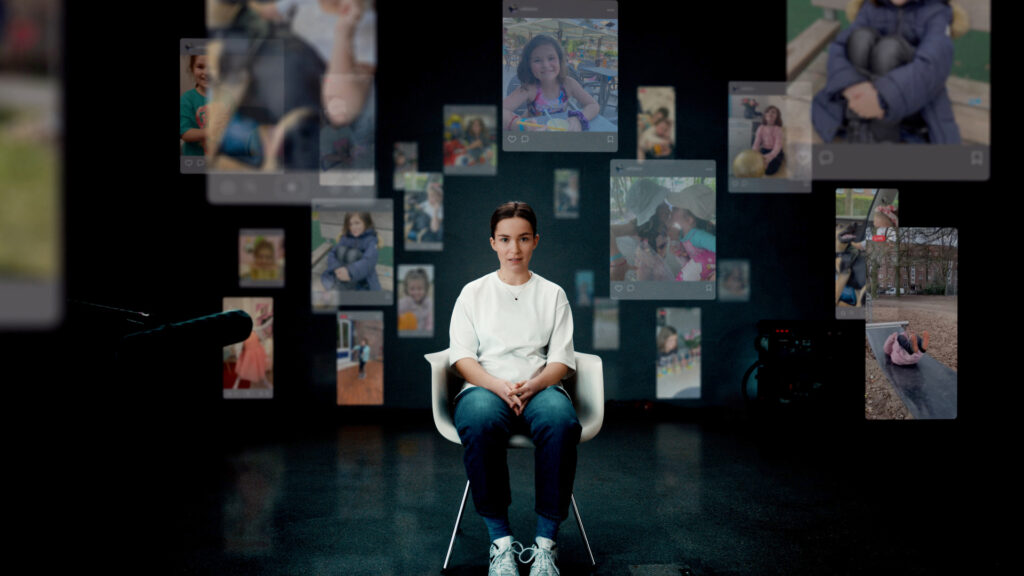
In addition to privacy breaches, we have also discovered that more and more life scenarios that should not have been made public are being incorporated into the logic of the platform and redefined under the drive of traffic and data.
However, medical care is precisely one of the fields that should least be contentified.
In the medical setting, patients are often in a state of extreme vulnerability, they may lose consciousness and be unable to express their will. They are forced to entrust their bodies to others due to illness and risk.
It touches upon human dignity. And this is why medical ethics places particular emphasis on confidentiality, respect, and informed consent.
But when all this happens on algorithmic platforms, besides adhering to medical ethics, do people truly have control over their own information?
Bodily data is uploaded, private images are taken, and all of this, referred to as data, flows into big data.
Data and platforms, which are meant to serve people, are instead infringing on human rights.
Is this right or wrong?
From a legal perspective, Article 1226 of the Civil Code of the People’s Republic of China stipulates that medical institutions and their medical personnel shall keep patients’ privacy and personal information confidential. Anyone who discloses a patient’s privacy and personal information, or publishes their medical records without the patient’s consent, shall bear tort liability.
The United Nations Human Rights Council has also pointed out that the right to privacy is one of the important fundamental rights in the digital age.
Karppinen (2017) believes that digital rights are actually an extension of human rights in the digital age.
However, these rights are not fixed, but rather a continuously evolving process. In this process, people need to negotiate and debate the ethical frameworks and principles for regulating emerging digital technologies.
As society advances, digital technologies continue to evolve. But as technology advances, we should also pay more attention to the real people behind these algorithms and data, their rights, their privacy, and their dignity
We should pay attention to the legal regulations and review mechanisms related to data and platforms.
We should focus on applications that infringe upon individual rights and force users to consent.
At the same time, we need to care about vulnerable groups within the digital age.
Ultimately, we should ensure that real people in this rapidly evolving digital age have the right to consent and the right to say no.
References
Karppinen, K. (2017). Human rights and the digital. In H. Tumber & S. Waisbord (Eds), The Routledge Companion to Media and Human Rights (pp. 95–103). https://doi.org/10.4324/9781315619835
Nissenbaum, H. (2018). Respecting Context to Protect Privacy: Why Meaning Matters. Science and Engineering Ethics, 24(3), 831–852. https://doi.org/10.1007/s11948-015-9674-9
Suzor, N. P. (2019). Lawless: The Secret Rules That Govern Our Digital Lives. Cambridge University Press. https://doi.org/10.1017/9781108666428
United Nations Human Rights Council. (2023). The right to privacy in the digital age (A/HRC/RES/54/21). United Nations. https://docs.un.org/en/A/HRC/RES/54/21
Zhang, B. (2026). Affective counterpublics under constraint: emotion, platform governance, and AI ethics discourse on Chinese social media. AI & Society, 41(1), 595–609. https://doi.org/10.1007/s00146-025-02437-0
Be the first to comment