
Weibo censorship placeholder indicating removed content
Source: Weibo
A Strange Asymmetry
In March 2026, a postgraduate student surnamed Sun from Xiangya Hospital, Central South University, died after jumping into a river, sparking widespread public attention and debate on Chinese social media. Screenshots of what were alleged to be her final messages circulated online, functioning as a form of suicide note. These messages identified specific harms inflicted on her: academic exploitation by the supervisor, collusion by hospital administrators, pressure from the academic affairs office, and the experience of being forcibly admitted to a psychiatric ward. These details constitute verifiable allegations against specific institutions and individuals.
However, while discussions initially emerged on Weibo (China’s largest microblogging platform), the dissemination of these screenshots was rapidly restricted, leaving only the trending topic “Xiangya student river incident” visible. As a result, public discourse was stripped of crucial contextual information, reducing the event to a decontextualised headline.
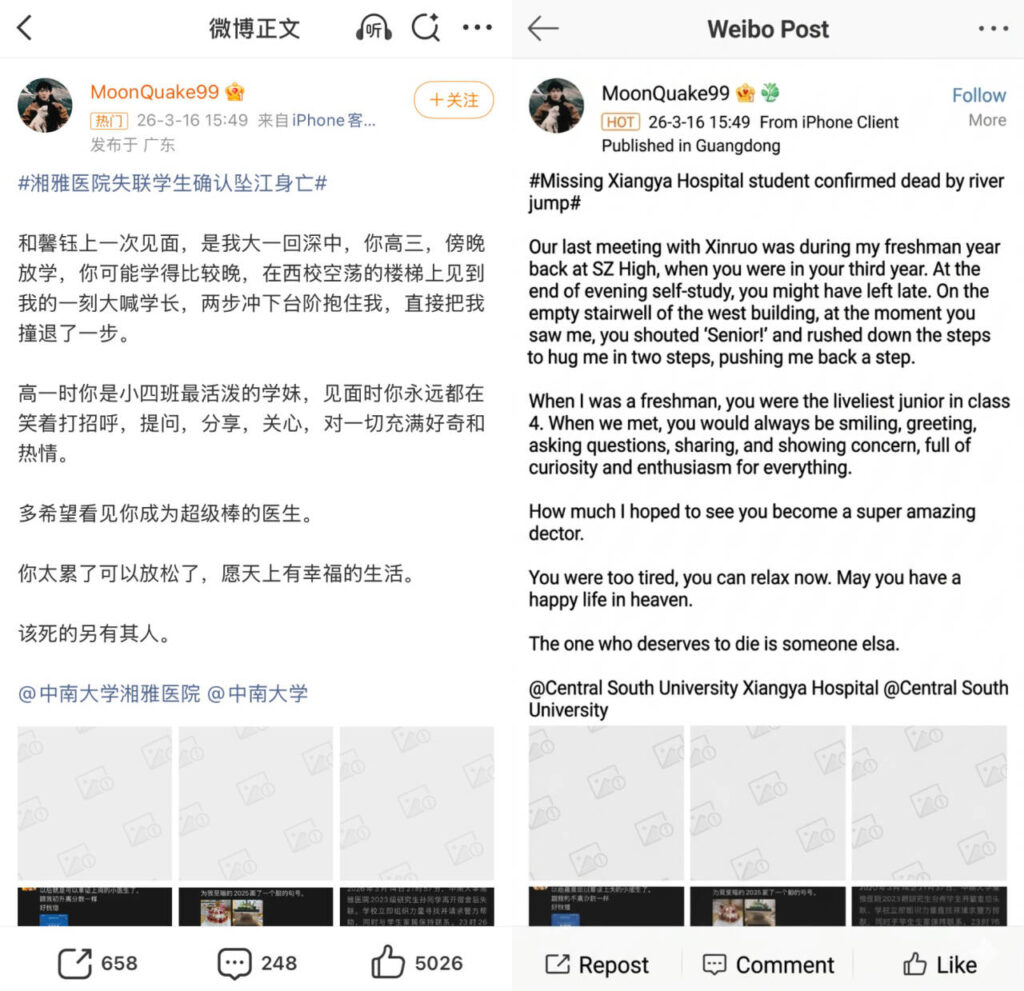
A post by Sun’s classmate containing the suicide note; the note is no longer visible.
Screenshot by the author from Weibo; English version is translated by Gemini.
Where is the suicide note? Is this simply a matter of “post deletion”?
Or let me take a step further: how do social platforms in China decide what you get to see about a tragedy, and who benefits from those decisions? To put it more plainly, when something awful happens and millions of people search for answers, what forces are quietly shaping what those people find? This essay explores how social platforms in China reinterpret a public tragedy and redistribute its visibility through algorithms, content filtering, and risk management.
How? Weibo’s Algorithm Governance Mechanism
Hard Deletion: Automated Systems That Erase
In recent years, Weibo has adopted AI-driven censorship tools as assistance to human reviewers. These systems employ natural language processing, machine learning, sentiment analysis, and image-recognition technologies to scan vast amounts of text, photos, and videos in real time. They can automatically remove or block sensitive content, shift censorship from reactive deletion to proactive suppression, and reduce the time needed to enforce government directives (Law, 2026).
It is particularly effective in thematic public spheres like anniversaries of the Tiananmen Square protests, but sudden events and unanticipated public reactions leave censors no time to prepare. The speed of publishing and distributing content on social media, and especially on Weibo with its large numbers of participants, makes it impossible at times to prevent. In these cases, censors can only react ex post, with delays and often only after an event has become broadly known (Rauchfleisch & Schäfer, 2015). Approximately 30% of sensitive posts get deleted within 30 minutes of publication, and after one day 90% of them have been removed (Zhu et al., 2013). The same was true in the Xiangya case: it wasn’t until a day after the incident made it to the top search queries that the suicide note was restricted.
But deletion is only the bluntest tool in the box. What makes Weibo’s governance machinery so effective, and so difficult to challenge is that it doesn’t always need to erase a story. It just needs to make the inconvenient version of it harder to find.
Soft Suppression: Algorithms That Bury
Attention is drawn to certain things at the expense of others. Algorithmic selection shapes the construction of individuals’ realities, that is, individual consciousness, and as a result affects culture, knowledge, norms, and values of societies, that is, collective consciousness, thereby shaping social order in modern societies (Just & Latzer, 2017, p.246).
When millions of users searched for the Xiangya case, they weren’t staring at a blank screen. State media outlets appeared at the top of every search.
Weibo’s search algorithm technically prioritises content from blue-verified and gold-verified institutional accounts, most of which are state media. Their posts simply framed the incident as a personal tragedy or a reflection of the universal pressures faced by residents in China, tacitly sidestepping the question of who, specifically, was responsible for this student’s death. Meanwhile, a repost of the suicide note from a grieving classmate of Sun was buried at the bottom of the search results.
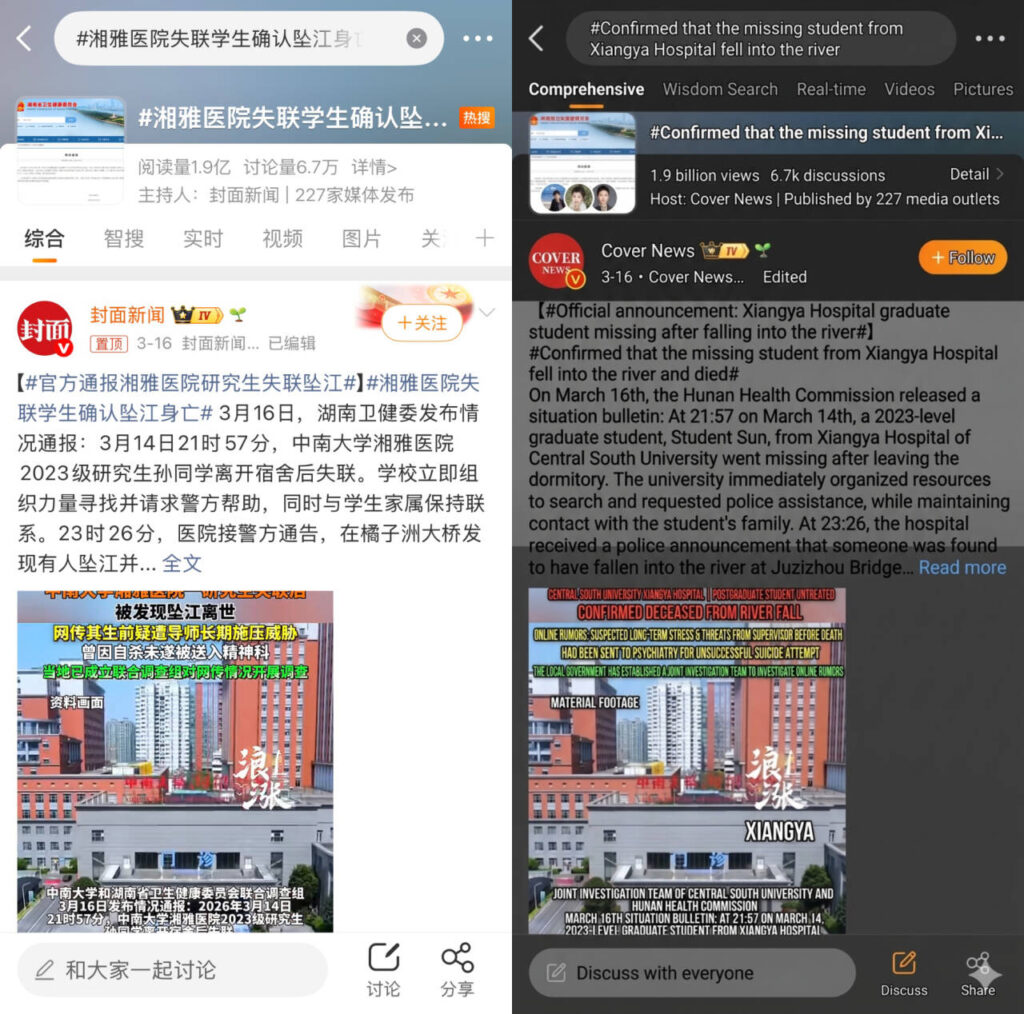
State media outlets appear at the top of the topic.
Screenshot by the author from Weibo; English version is translated by Gemini.
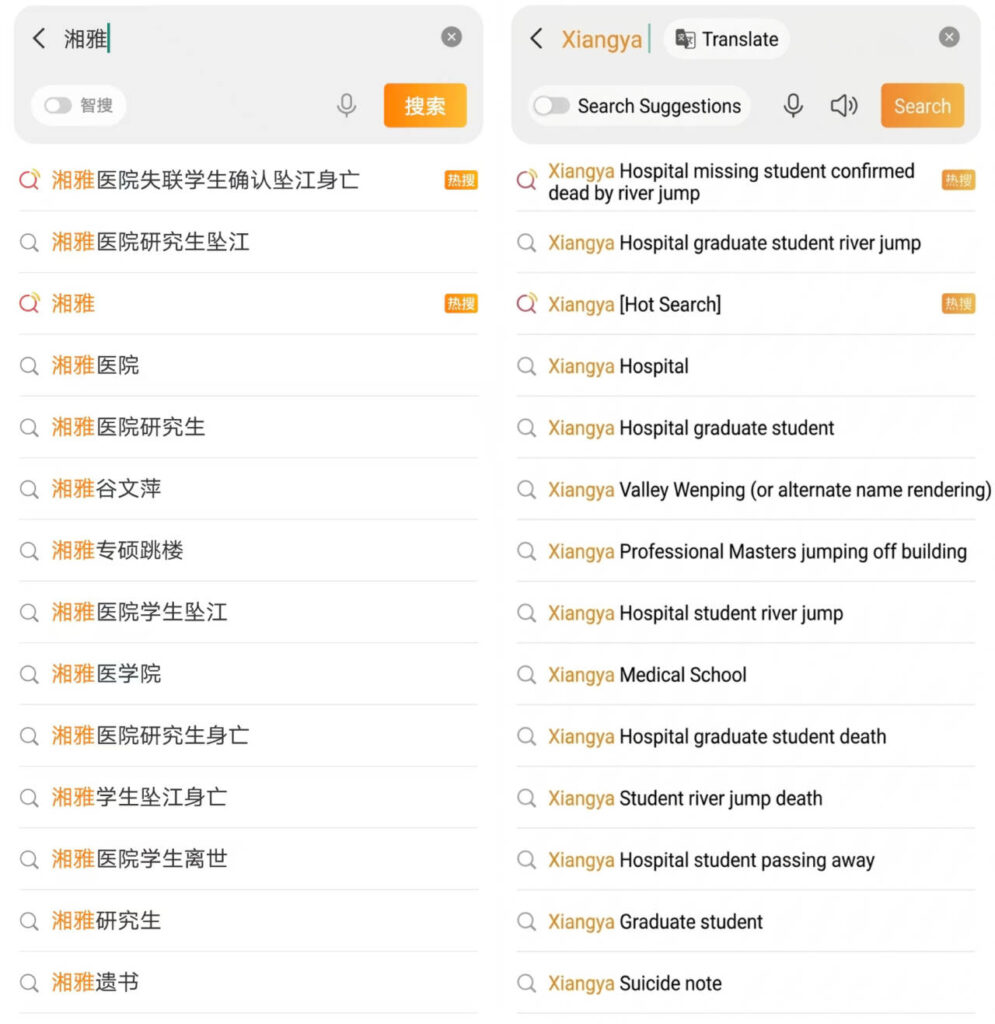
Weibo search results for “Xiangya”; “suicide note” appears at the very bottom.
Screenshot by the author from Weibo; English translation by Gemini.
Margaret Roberts, in Censored (2018), elucidates the three main mechanisms of censorship: fear, friction, and flooding. Of these methods, friction refers to increased costs, which means the information is not impossible to circumvent, but prevents the majority of citizens from accessing it by costing them more time, money, and energy. Think of it like a library where the book you need isn’t banned but has been reshelved in an unmarked basement room three floors down. Most people simply give up before they find it. The suicide note doesn’t disappear on Weibo; it was simply subjected to enough friction that the average user could no longer reach it by simply searching.
When the first things to appear and the easiest to find are official announcements and generalized narratives, the public is initially led to focus on “tragedy” and “pressure”. When the accusations in the suicide note against the supervisor, the hospital, and the residency training system are downplayed, it becomes even harder for the public to interpret the incident as systemic violence. Therefore, by using algorithmic recommendation systems, the platform can effortlessly shift the public’s attention.
This is what scholars call agenda-setting: the idea that the media doesn’t tell us what to think, but tells us what to think about (Cohen, 1963). In everyday terms, it is the difference between a news broadcast that leads with a student’s death and one that leads with who caused it. The sequence, framing, and prominence of stories train audiences to ask certain questions and forget others. In the platform era, algorithmic selection takes on a powerful secondary agenda-setting and (secondary) gatekeeping roles through news aggregators, ranking algorithms, and social networks like Facebook, leading to the assessment that algorithms considerably affect the way public opinion is formed, that they govern the public agenda (Just & Latzer, 2017).
The algorithm reduced the visibility of certain interpretations while amplifying “safer” narrative frameworks, making sure the note exists but cannot be seen, and the death exists but cannot be traced.
WHY? Weibo’s Ambiguous Role
Conditional Public Sphere
This eerie phenomenon, where the incident was visible but the suicide note was not, to some extent reflects Weibo’s contradictory attitude toward public opinion. To understand this, we can start from the perspective of the public sphere.
The public sphere, originally coined by German philosopher Jürgen Habermas, is an area in social life where individuals can come together to freely discuss and identify societal problems, and through that discussion, influence political action (“Public sphere” 2019). Communications with various topics on Weibo can be categorized into different types of public spheres. Among these, local public spheres exhibit several distinct characteristics: They are often tolerated by the government because the local public sphere often does not directly challenge the state party and they tend to be limited in their thematic and geographic scope, as well as in the number of their participants. As soon as the respective issues become influential, and, as a result, they become visible to censors and are potentially dealt with differently by the central government (Rauchfleisch & Schäfer, 2015). In fact, most news (including the Xiangya case) on Weibo falls into this category: While the collective concerns can be discussed, their openness, sustainability, and participatory nature are all subject to certain constraints.
It is evident, therefore, that Weibo occupies a unique position. It is not a Habermasian public sphere, nor is it a propaganda machine that completely suppresses free discussion. It’s a conditional public sphere, hosting a variety of limited, short-term public spaces that fall somewhere between the two, as well as acting as an “intermediary” between commercial competition and policy regulation.
Intermediaries’ Dilemma
In social media practices and research across most democratic countries, social media algorithms tend to prioritize the distribution of polarizing, controversial, false, and extremist content in order to maximize user engagement and revenue (Andrejevic, 2019). In its early stage (around the 2010s), Weibo closely monitored the occurrence of breaking incidents and actively created buzz to attract more users in the fierce competition with Tencent’s microblogging service, which demonstrates that the operation of social media is fundamentally driven by commercial logic.
However, the opposite is true in authoritarian countries. Governments have the capacity to effectively steer and limit public debates on the Internet, including all social platforms such as Weibo (Gerhards & Schäfer, 2010; see also Zheng & Wu, 2005). In this environment of speech control, Weibo finds itself caught in an “intermediaries’ dilemma” (Han, 2018, p. 65): Weibo’s pursuit of attention-grabbing controversies and the need to manage political risk strengthened the trend of obstructing sustainable discussions on public issues, leading to the emergence of those short-term public spaces (Li, 2023). And this pattern also applies to all Chinese internet companies.
So there is a need to strategically downplay Weibo’s intervention by highlighting its technological features (Li, 2023). Weibo’s solution has been to invite grievance while containing accountability. The platform actively surfaces breaking events, but simultaneously shapes discourse toward what researchers describe as an “event-based and manageable direction,” one that dissipates emotional energy without enabling sustained political pressure. The result, in this Xiangya case, was a public that mourned loudly and demanded accountability from no one in particular.
Who? Weibo as Conspiracy of Power
“It is obvious that technologies can be used in ways that enhance the power, authority, and privilege of some over others (Winner, 1986, p.25).”
Now, you might wonder who exactly is responsible for the disappearance of the suicide note? The uncomfortable answer is that there is no single villain to identify, and that is precisely what makes this kind of power so difficult to challenge.
Frank Pasquale (2012), in The Black Box Society, describes what political operative Jeff Connaughton once called “the Blob”: “a shadowy network of actors, who mobilize money and media for private gain, whether acting officially on behalf of business or of government.” In the Xiangya case, the Blob is the collusion among the platform, medical institutions (Xiangya Hospital), and policymakers. The platform’s self-censorship, the institution’s reputational interests, and the state’s investment in social stability all pointed in the same direction, and the algorithm carried out the work without anyone needing to issue an order.
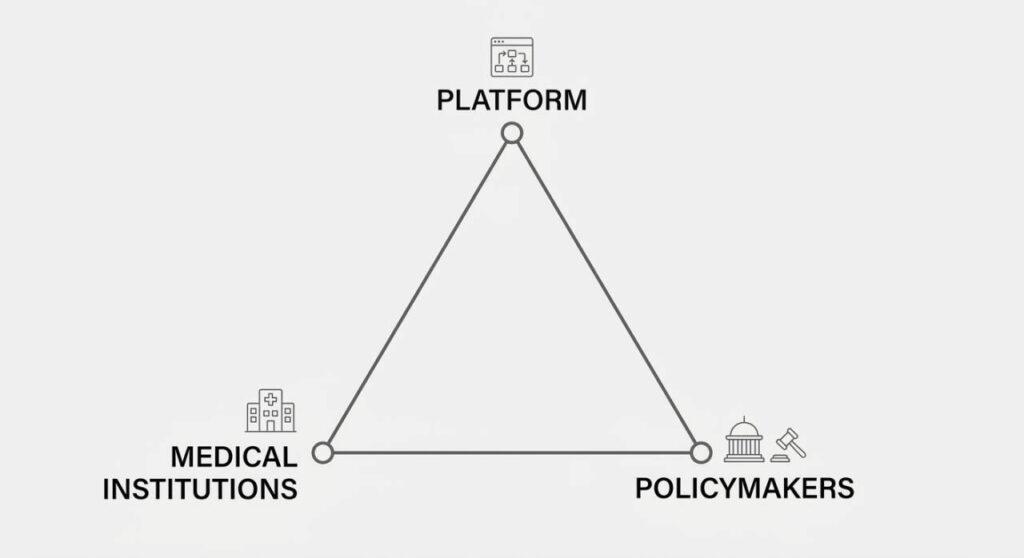
The Blob.
Image by the author.
Before that, let me ask you a question: Are platforms neutral?
From the Xiangya case, we can learn that algorithms embody values by both affording and impeding certain practices, behaviors, and activities (Nissenbaum, 2011). When Weibo’s architecture systematically elevates verified institutional accounts and buries individual testimony, it is not making a technical decision; it is making a political one. It encodes into its infrastructure the assumption that official voices are more trustworthy, more relevant, more worthy of amplification. Under such algorithms, the public is allowed to know what happened, but it becomes more difficult to persistently ask why it happened. The individual narratives of victims are less likely to endure over time, while the safer institutional versions are more likely to remain in the spotlight.
What’s more, algorithms on the Internet can also be seen as governance mechanisms, as instruments used to exert power and as increasingly autonomous actors with the power to further political and economic interests on both the individual and collective level (Just & Latzer, 2017). When platforms consciously align themselves with power, authority, and privilege in society, algorithmic governance reinforces not only the power of the platforms themselves, but also social and institutional inequalities. As Safiya Umoja Noble (2018) writes about how search algorithms reinforce racism, she makes a point that applies equally here: The structural inequalities that exist in society do not disappear when they enter a platform.
Are platforms neutral? What Tarleton Gillespie (2018) says might be the best answer: Platforms actively shape public discourse through their design choices while simultaneously claiming the mantle of neutral infrastructure.
Conclusion
The phenomenon in the Xiangya case, where the incident was visible but the suicide note was not, was not simply a matter of content deletion. Rather, it represents a form of algorithmic visibility governance implemented by Chinese social media platforms, shaped by the interplay of state policies, institutional constraints, and commercial logic.
Algorithms influence not only the flow of information but also public understanding and the attribution of responsibility. When search, ranking, and moderation are dominated by black-boxed systems, platforms are more likely to reinforce existing power structures rather than correct them. Platforms do not function as neutral public spheres; instead, by reshaping the public agenda and the attribution of responsibility, they reinforce the inequalities inherent in society’s power structures.
Weibo did not completely suppress public discussion; instead, it retained the death as a news event while suppressing the parts of the suicide note that addressed the power of the supervisor, the hospital system, and the residency training system. This redefined what could have developed into a public event involving structural criticism as a controllable individual tragedy.
The next time you read about a tragedy on social media and find yourself thinking “what a sad story,” it may be worth pausing to ask: is that the whole story? Or is it simply the version the platform decided you should see?
“Should you find yourself contorting to fit a system, dear reader, stop and ask if it’s truly you that must change or the system (Erickson & Stiller, 2022).”
A scene from Severance (Season 1, Episode 5).
Screenshot from Apple TV+; copyright 2022 by Apple Video Programming.
RIP孙鑫钰 (Xinyu Sun)
Reference
Andrejevic, M. (2019). Automated Media (1st ed.). Routledge. https://doi.org/10.4324/9780429242595
Cohen, B. C. (1963). The Press and Foreign Policy. Princeton University Press.
Connaughton, J. (2012). The Payoff: Why Wall Street Always Wins. Easton Studio Press, LLC.
Erickson, D. (Writer), & Stiller, B. (Director). (2022, March 11). The grim severity of abandonment (Season 1, Episode 5) [TV series episode]. In B. Stiller, N. Weinstock, J. Alter, & D. Erickson (Executive Producers), Severance. Red Hour Productions; Endeavor Content; Apple TV+.
Gerhards, J., & Schäfer, M. S. (2010). Is the internet a better public sphere? Comparing old and new media in the USA and Germany. New Media & Society, 12(1), 143–160. https://doi.org/10.1177/1461444809341444
Gillespie, T. (2019). Custodians of the Internet: Platforms, Content Moderation, and the Hidden Decisions That Shape Social Media (pp.24-44). Yale University Press. https://doi.org/10.12987/9780300235029
Han, R. (2018a). Censored: Distraction and Diversion Inside China’s Great Firewall. Princeton University Press. https://doi.org/10.1017/S1537592718002608
Han, R. (2018b). Contesting Cyberspace in China: Online Expression and Authoritarian Resilience. Columbia University Press. https://doi.org/10.7312/han-18474
Just, N., & Latzer, M. (2017). Governance by algorithms: Reality construction by algorithmic selection on the Internet. Media, Culture & Society, 39(2), 245–249. https://doi.org/10.1177/0163443716643157
Law, N. (2026, March 10). China’s AI-Empowered Censorship: Strengths and Limitations. Carnegie Endowment for International Peace. https://carnegieendowment.org/research/2026/03/chinas-ai-empowered-censorship-strengths-and-limitations
Li, M. (2023). Promote diligently and censor politely: How Sina Weibo intervenes in online activism in China. Information, Communication & Society, 26(4), 730–745. https://doi.org/10.1080/1369118X.2021.1983001
Nissenbaum, H. (2011). From Preemption to Circumvention: If Technology Regulates, Why Do We Need Regulation (and Vice Versa)? Berkeley Technology Law Journal, 26(3), 1367–1386.
Noble, S. U. (2018). Algorithms of oppression: How search engines reinforce racism. New York university press.
Pasquale, F. (2016). The black box society: The secret algorithms that control money and information (First Harvard University Press paperback edition). Harvard University Press.
Public sphere. (2026, Apirl 4). In Wikipedia. https://en.wikipedia.org/wiki/Public_sphere
Rauchfleisch, A., & Schäfer, M. S. (2015). Multiple public spheres of Weibo: A typology of forms and potentials of online public spheres in China. Information, Communication & Society, 18(2), 139–155. https://doi.org/10.1080/1369118X.2014.940364
Winner, L. (2001). The whale and the reactor: A search for limits in an age of high technology (Nachdr.). Univ. of Chicago Press.
Zheng, Y., & Wu, G. (2005). Information Technology, Public Space, and Collective Action in China. Comparative Political Studies, 38(5), 507–536. https://doi.org/10.1177/0010414004273505
Zhu, T., Pridgen, A., & Wallach, D. S. (n.d.). The Velocity of Censorship: High-Fidelity Detection of Microblog Post Deletions. http://arxiv.org/abs/1303.0597
Be the first to comment