Your future, decided in milliseconds. Algorithmic sorting is the new gatekeeper of opportunity.
The Two-Second Rejection: Why You Are Invisible
Imagine that you spend weeks meticulously polishing your resume for a long-coveted position. You have conducted a study on the company culture and precisely quantified your achievements. And then you clicked “Submit” on a platform like SEEK, LinkedIn or Boss Zhipin (China’s leading recruitment App), brimming with confidence. Then, in less than one seconds, a rejection letter would arrive in your inbox – or even worse, it would be followed by weeks of silence.
You might think it’s because of your lack of ability, but the reality is even more chilling: The human resources department didn’t even look at your resume at all. In the blink of an eye, your career destiny has already been determined by a piece of code running on a remote server.
Today, we have entered the era of Automated Decision Making (ADM). Our career paths, social mobility, and economic survival are no longer solely determined by individual abilities; they are controlled by an opaque “black box” that generates a “match score” before any human recruiters intervene.
This blog explores the intersection of dataization, privacy erosion, and algorithmic bias. By integrating the core theories of digital governance and combining real-life failure cases of Amazon and BOSS Direct-Hiring, we will reveal how “hidden rules” are reshaping our society, and why we must strive to build a “people-oriented” digital future.
Datafication: Why You Are the ‘New Oil’ (and Why That’s a Problem)
AI, Automation and Algorithmic Governance
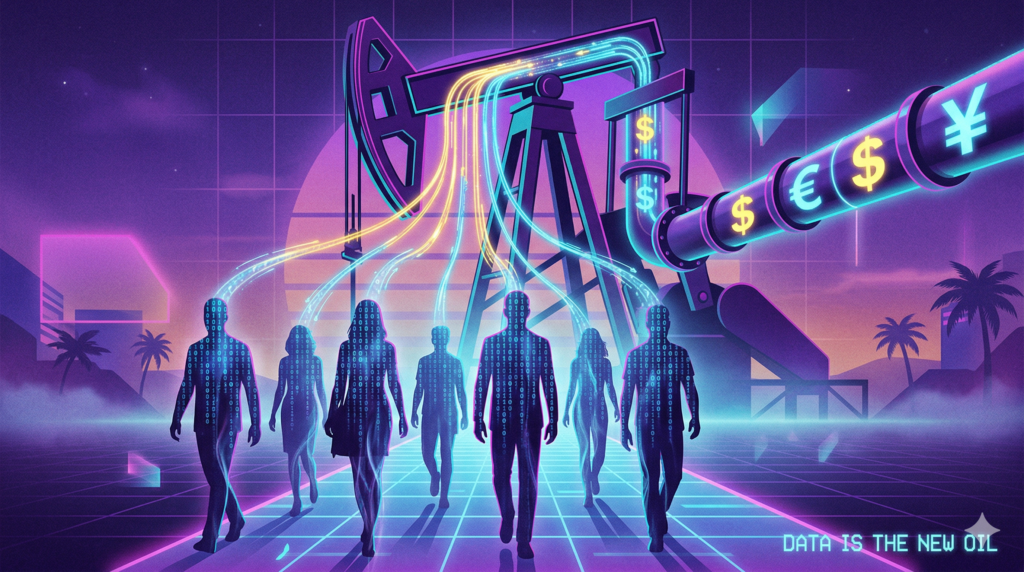
Datafication: We are no longer individuals, but “digital shadows” to be mined and refined for algorithmic profit.
The core of this issue lies in “dataization”, which refer to the process of converting all aspects of human life into traceable and quantifiable data points. In the early 2010s, the World Economic Forum once said: “Data is the new oil.”, meaning that data is a raw material that has yet to be refined to generate huge profits. However, for job seekers, this “oil” is extracted from their own identities. Even though oil is an inanimate substance. Data, on the other hand, are closely intertwined with human identity, emotions and dignity.
Crawford, Kate (2021) in her landmark work “The Atlas of AI” pointed out that artificial intelligence is not a neutral, cloud-based “intelligence”, but rather a predatory industry. Crawford challenged the definition that artificial intelligence is “non-material”. In fact, it relies on poorly paid human labor for data annotation and conducts large-scale collection of human behaviors. When your facial expressions, the “likes” on social media, and even those “active” verbs in your resume are all converted into 0s and 1s, you cease to be a complex human being. What will you become? – You have become a “data point” that is pending processing and for sale. On the recruitment platform, every tag you select and every salary expectation you set will be collected and used to predict your “value”.
This is precisely what Couldry, N., & Mejias, U. A. (2019) referred to as “data colonialism”. To give an analogy, just as colonialism in history established empires by seizing land and resources, today’s tech giants are “seizing” our digital shadows.
This platform “colonizes” your career history, converting your hard-earned experience into a standardized score. The danger lies in the simplification of human complexity: if your talents cannot be incorporated into the data fields, the algorithm effectively erases your existence. Crawford reminds us that the “map” of artificial intelligence is actually a map of power; and currently, this power is concentrated in the hands of those who control the data infrastructure.
The ‘Lawless’ Frontier: Who Really Makes the Rules?
Privacy, Security and Digital Rights
In our real life, if a human manager discriminates against you, you can take clear legal remedies according to labor laws. But what if this kind of discrimination is embedded in some opaque algorithm? What should we do then? If a certain algorithm shows discrimination against you, why can’t you see why? This is what is known as the “black box” problem. Transparency is not merely a technical feature; it is also a human right.
In his 2019 book “Lawless”, Suzor, N. P. revealed a shocking truth: Our digital lives are being governed by “secret rules”. While governments around the world are still debating privacy regulations, the “real law” is actually the platform architecture and service terms (ToS) written by engineers. These are the platform architectures and service terms that we blindly click “agree” to every day.
Flew, T. (2021) emphasized the concept of “privacy trade-offs” that we have to hand over sensitive information in order to survive in the modern economy.
In order to obtain a job, you must disclose sensitive information. However, although you are transparent to the platform, the platform remains opaque to you. You might even be completely unaware of the platform. Unlike the EU’s General Data Protection Regulation (GDPR) which provides “explanatory rights”, many users, including those subject to the Australian Privacy Act, lack the power to audit the code that determines their future. We are actually being constrained by private entities that have no obligation to be accountable to the public.
Case Study A: The Scientific Proof of Bias ( The Amazon Failure)
Critical Analysis: How AI Learns Prejudice
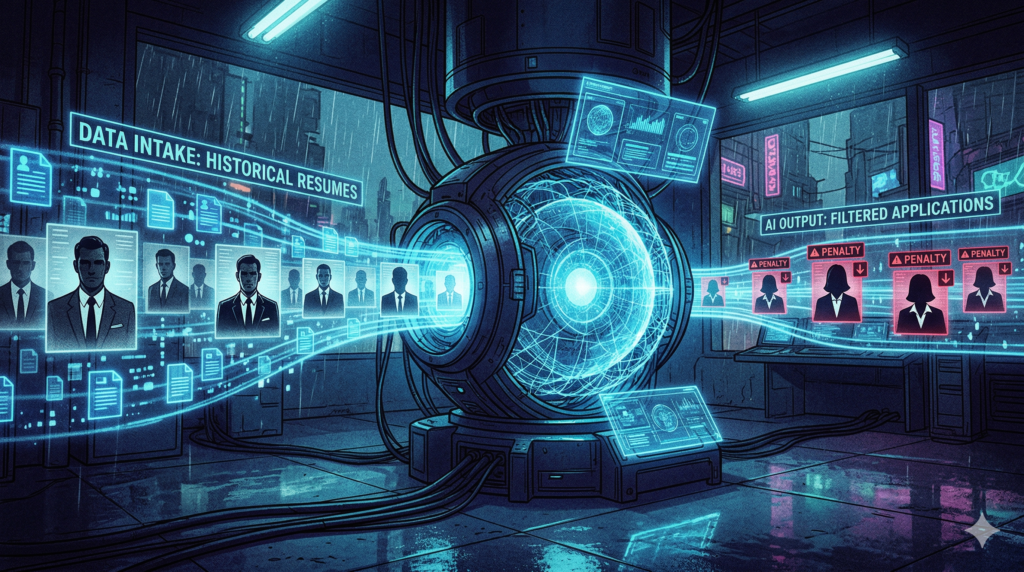
The Mirror of the Past: How Amazon’s AI learned gender bias from a decade of male-dominated hiring data.
That notorious Amazon AI recruitment tool has provided us with scientific evidence for our concerns. A few years ago, Amazon developed an artificial intelligence that could identify “top talents” by analyzing resumes submitted over the past decade. The aim was to eliminate human biases in the recruitment process. However, the result was exactly the opposite.
As the technology industry has traditionally been dominated by men, artificial intelligence has drawn a flawed conclusion: “Male identity” is a necessary condition for success.
Automatic Penalty: This AI begins to deduct points from resumes that contain the word “women’s” (for example, “Chairperson of the Women’s Chess Club”). And belittled the graduates of women’s colleges.
Bias Amplification: As Noble, S. U. (2018) revealed in her book “Algorithms of Oppression”, algorithms not only reflect biases but also automate and scale them up. Amazon AI, by applying this bias to thousands of resumes within just a few seconds, effectively excluded the entire gender group from the talent pipeline. During this process, no one ever made even a single “conscious” decision based on gender discrimination.
The Mirror effect: Artificial intelligence examined the past filled with inequality and concluded that the future should be exactly the same as it was. It examined the unequal past and concluded that the future should be exactly the same as that past.
This case provides conclusive evidence that data is not neutral. Even Amazon, a company worth trillions of dollars, was unable to solve this “data pollution” problem and eventually had to abandon the project. Because they cannot guarantee that artificial intelligence will not discover other “proxy” variables and continue to discriminate against certain groups.
Case Study B: BOSS Zhipin and the “Invisible Wall”
Current Analysis: The Black Box of Exposure
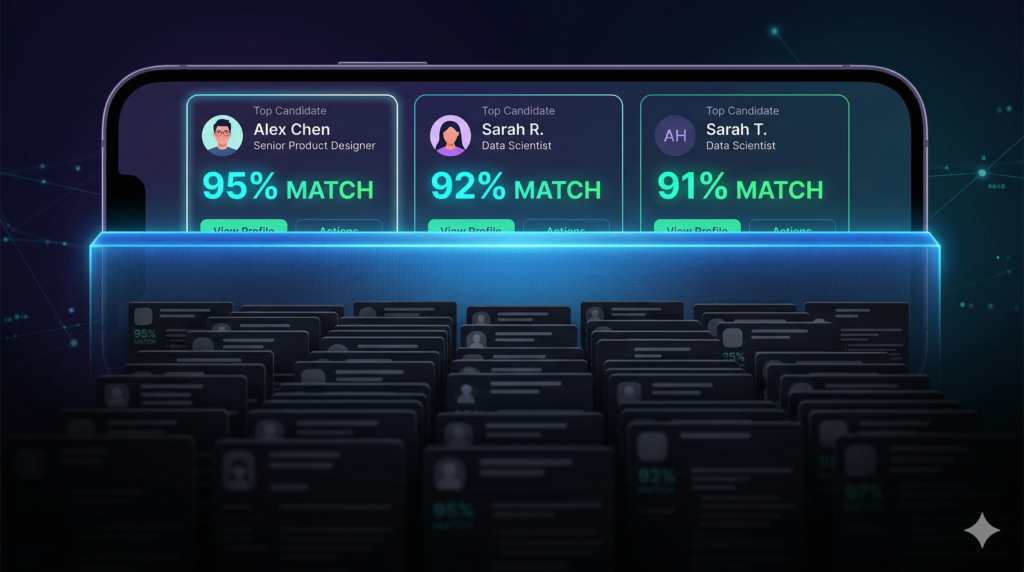
The Invisible Wall: How the “Exposure Order” on platforms like BOSS Zhipin shadows qualified candidates with lower “matching scores.”
Amazon demonstrated how AI thinks, while Boss Zhipin showcased how AI regulates “visibility”. On this platform, “match quality” determines your “exposure priority”. This has given rise to a new type of digital inequality: “Shadow Ban” in the workplace.
The “Shadow Ban” of Employment:
When HR manager opens the dashboard, the candidates they see may not be arranged in chronological order. The algorithm will sort you. If your “matching score” is determined by the system to be low, your resume will be pushed to the bottom. Not only will you be rejected, but you will also completely disappear from view.
The “black box” logic here is even more dangerous because it forms a feedback loop. If the algorithm is pre-set to favor candidates from “985/211” universities (this elite designation specifically refers to China’s top research-oriented institutions, similar to the “Go8” in Australia) or candidates under the age of 30, it will systematically exclude qualified candidates with diverse educational backgrounds or those from older age groups. You will never have the chance to prove that the algorithm is wrong, because the human HR might not even be aware that you have submitted your resume. The “black box” logic here constitutes a dangerous vicious cycle.
The Social ‘Bellows’: Online Harm as Structural Exclusion
Hate Speech and Online Harms
On platforms such as BOSS Zhipin, the logic of “efficiency” often undermines fairness. How does the platform architecture support a specific culture? Massanari, A. (2017) pointed out that design choices can lead to “toxic technological culture”.
In the field of recruitment, this “toxicity” manifests as an extremely competitive and highly automated “rat race”, resulting in the disappearance of the subtle aspects of human nature.
Just as Sinpeng et al. (2021) pointed out, the platform prioritizes its algorithmic goal, which is to maintain the engagement of recruiters, over social harm. By determining who gets “exposure”, the algorithm acts as the “bellows”, fueling the flames of age discrimination and reputation bias, as these are precisely the patterns that the machine is most capable of recognizing. This is far from the utopian vision of freedom of speech and equal access that Barlow, J. P. (2019) envisioned. Barlow envisioned a digital world free from privileges and prejudices based on race or background. On the contrary, this “black box” has created a new system of inequality.
Reclaiming Control: A Manifesto for Digital Citizens
Policy Recommendations: The Way Forward
We cannot simply “exit” the digital world, our livelihoods depend on these platforms. However, we can move towards the “people-oriented” approach to automated decision-making as proposed by Lomborg et al. (2023). To safeguard our digital future, we hereby solemnly call for:
The Right of Explanation: The platform must be legally compelled to show candidates their “match score” and the factors behind the decision. We must prohibit “black box” defense in key areas of people’s livelihood such as employment and banking.
Algorithm auditing: The government must enforce mandatory third-party audits These audits should specifically examine whether there are any “proxy variables” that might unintentionally lead to discrimination based on age, gender or socioeconomic status. To ensure that recruitment algorithms do not use discriminatory “proxy variables”, such as using the year of graduation to infer age.
Human-in-the loop: Major life decisions should never be entirely left to unverified machines. Humans must always serve as the ultimate arbiters to ensure that empathy and context do not get lost in the cold logic of interaction metrics.
Conclusion: Don’t Let the Code Decide Your Worth
Digital policy and governance are not only about technical regulations, but also about power. When you hear “The computer says no”, please remember: It was human beings who wrote that code. We must fight for a future like this: in this future, our potential will be evaluated by human eyes, rather than being reduced to a single score within a “black box”.
Just as we have seen through the theories of Suzor, Crawford and Noble, this “lawless” digital frontier area urgently needs a new charter – a charter that places human dignity above algorithmic efficiency. Our professional values are extremely complex and cannot be defined merely by “compatibility”. It’s time to place “people” back at the core of human resources.
References
Barlow, J. P. (2019). A Declaration of the Independence of Cyberspace. Duke L. & Tech. Rev., 18, 5.
Couldry, N., & Mejias, U. A. (2019). Data colonialism: Rethinking big data’s relation to the contemporary subject. Television & new media, 20(4), 336-349.
Crawford, K. (2021). The Atlas of AI: Power, Politics, and the Planetary Costs of Artificial Intelligence. Yale University Press.
Flew, T. (2021). Regulating platforms. John Wiley & Sons.
Lomborg, S., Kaun, A., & Scott Hansen, S. (2023). Automated decision‐making: Toward a people‐centred approach. Sociology Compass, 17(8), e13097.
Massanari, A. (2017). # Gamergate and The Fappening: How Reddit’s algorithm, governance, and culture support toxic technocultures. New media & society, 19(3), 329-346.
Noble, S. U. (2018). Algorithms of oppression: How search engines reinforce racism. In Algorithms of oppression. New York university press.
Sinpeng, A., Martin, F. R., Gelber, K., & Shields, K. (2021). Facebook: Regulating hate speech in the Asia Pacific. Facebook content policy research on social media award: Regulating hate speech in the Asia Pacific.
Suzor, N. P. (2019). Lawless: The secret rules that govern our digital lives. Cambridge University Press.
AI Acknowledgement
I acknowledge the use of Artificial Intelligence (Gemini) for translation assistance and initial brainstorming. These tools helped me structure my ideas and translate specific source materials. I reviewed and edited all AI-generated content. The final analysis and writing remain my original work.

Be the first to comment