Nowadays, more and more people are addicted to social media. If you spend enough time on social media, sooner or later you will encounter hate-filled content. It may take the form of racist remarks, sexist jokes, anti-immigrant stereotypes or aggressive comments in the comment section. Sometimes this hate content is obvious, and sometimes it is not so obvious. But in any case, it is hard to ignore. This is one of the reasons why online hate is always an important topic in discussions about the governance of digital platforms.
Meanwhile, large social media companies usually claim that they are working hard to address this issue. They will introduce various platform mechanisms and allocate resources to establish review teams. Meta, which owns Facebook and Instagram, is one of the most obvious examples. Over the years, Meta has always positioned itself as a company that attempts to balance freedom of speech and security through detailed rules and enforcement systems. However, harmful content continues to spread on its platforms, and public criticism has not disappeared.
This raises a bigger question: if companies like Meta have rules, moderators, and years of experience, why is online hate still so common?
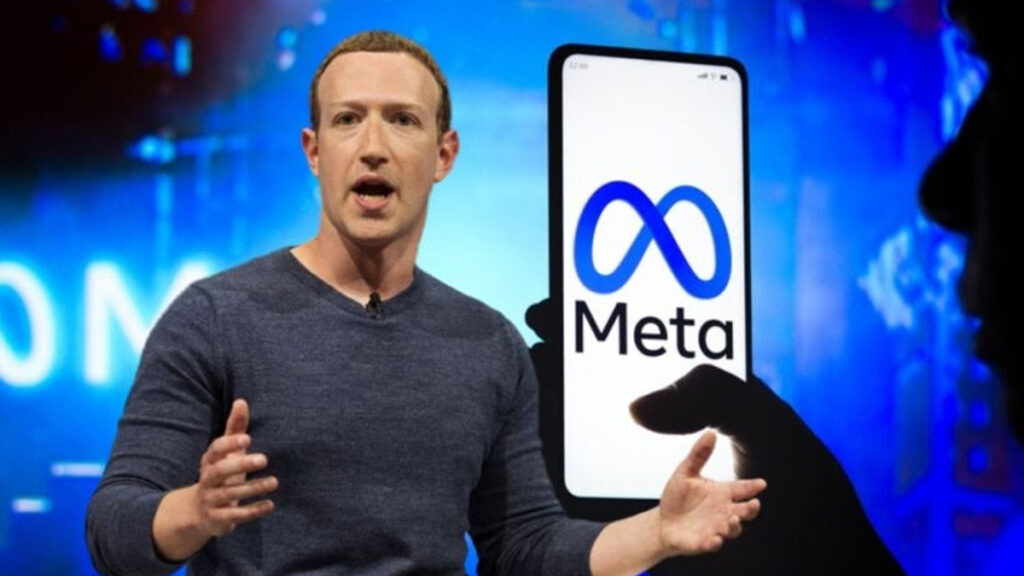
This news report on Meta’s 2025 policy reversal highlights why many critics remain sceptical about the company’s ability or willingness to address harmful content online.
According to the arguments presented in this blog post, social media companies like Meta cannot resolve online hate completely, and in many ways, may be unwilling to do so. Not because they lack speed, resources, or anything else like that – it goes far beyond that. Firstly, hate speech cannot be clearly defined in different societies and cultural contexts. Secondly, Meta is also a corporation pursuing its profit; therefore, regulation of speech is not the only function of the platform. Moreover, there is only so much that can be regulated, and some recent policy shifts indicate that Meta may be taking a different stance regarding hate speech. Overall, Meta presents a perfect case study for discussing the issue at hand.
One of the recent policy decisions of the company demonstrates this point perfectly. Meta decided to shut down its third-party fact-checking program in the United States, move toward a new Community Notes approach, relax some limitations on certain controversial topics, and cease proactively scanning some forms of harmful content (apart from high-severity cases).
Firstly, one of the issues with online hate speech is that it is not so easy to define. Traditionally, hate speech is regarded as insults and derogatory statements directed at others based on the aforementioned identity factors. Yet despite the existence of various regulations, many gray areas exist in this sphere.
Some forms of hate speech are obvious, with hate speech being direct and clearly defined. However, there are numerous cases of indirect hate speech, with sarcasm, coded language, stereotypes, hints, and other methods being utilized. For example, an article or a statement may not contain prohibited words, yet be filled with hate speech nonetheless.
That is when the divide between theory and the platform governance becomes apparent. According to Sinpeng et al. (2021), there is often a distinction between the general definition of hate speech and its narrower version used in platform regulation. In order to enforce the regulations, companies tend to focus on those types of hate speech that are easier to identify, thereby leaving numerous forms of hate content with the potential to go viral. Thus, one of the key problems is that the definition is too narrow to be properly enforced, making any attempt seem insufficient.
As evident from the company’s official policy language, Meta follows the above-mentioned pattern in its moderation efforts. According to the “Transparency Center” of Meta, the company deletes non-humanitarian remarks, insulting language, serious crimes or immoral accusations, as well as some forms of harmful stereotypes, yet still attempts to ensure expression and freedom of speech. In other words, the platform takes away one type of hate speech in order to preserve other types of content. Such an approach seems logical, but it creates a significant amount of ambiguity.
Meta’s own policy language shows this tension. In its “Hateful Conduct” policy, Meta states that it removes dehumanising speech, slurs, allegations of serious immorality or criminality, and some harmful stereotypes. On paper, this looks quite detailed. However, having formal rules does not automatically make moderation clear or consistent in practice, especially when hateful meaning is indirect or culturally specific. (Meta, n.d.)
Meta is not just a platform. It is a regulator.
In addition to the above-defined problem with definition, there is a more substantial issue of regulation itself. According to Flew (2021), digital platforms increasingly assume the role of governing speech by introducing, interpreting, and enforcing rules within large-scale audiences. In essence, such companies decide what forms of speech are allowed, and what must be taken down along with the consequences of breaking the rules. In turn, it means that platforms perform regulatory functions, although in a corporate manner.
However, the thing is that companies like Meta are not neutral public institutions. Rather, they are private businesses focused on their commercial gain. This is why Meta must simultaneously try to promote itself as a safe space for discussing issues as well as minimize the negative impact on users. In addition, it must keep users satisfied, avoid backlash from political opponents, satisfy regulators, and protect its reputation. These goals are conflicting, which creates additional complications.
Consequently, the inconsistency of moderation processes is hardly surprising. Some content gets banned while the similar content remains active. The enforcement of policies may look weaker in certain languages and regions compared to other places. The policies may appear random for some people. However, in reality, such inconsistencies emerge due to the platform trying to find a balance between all competing objectives. Rather than focusing on what gets banned, Meta must figure out what gets banned without compromising the company.
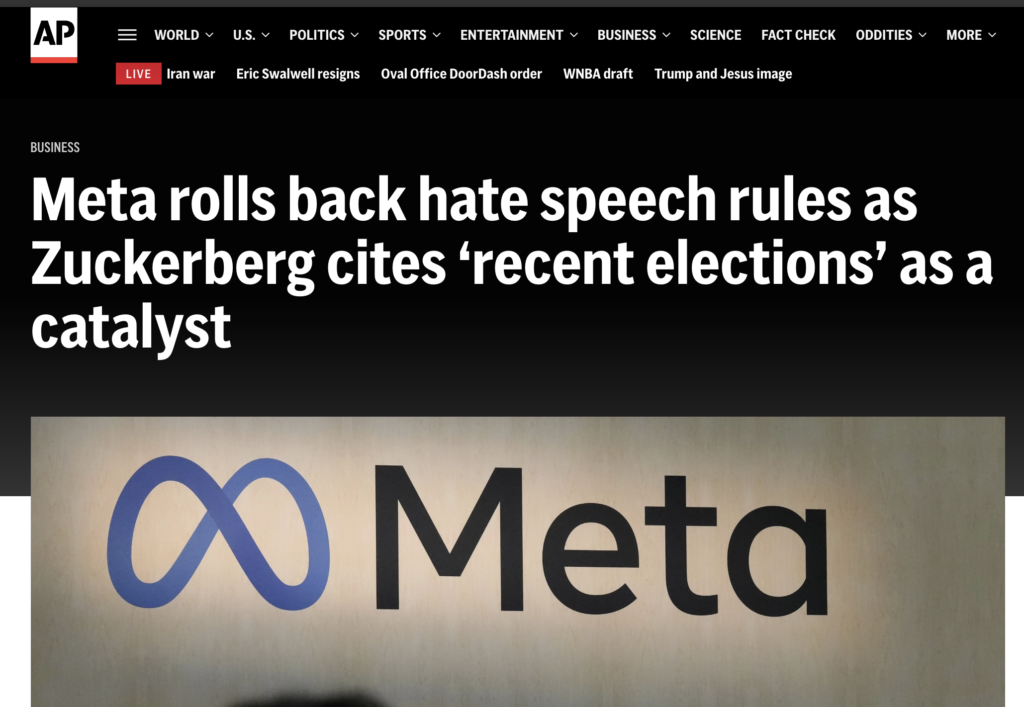
For example, one of the recent policies introduced in January 2025 can serve as an illustration of the problem at hand. As Meta claimed in relation to its new approach, it wanted to reduce its mistake rate by promoting discussion of various socially relevant topics. However, according to AP news, the changes in the moderation system mean that Meta now offers deregulation of political content. Namely, the company will only monitor the most severe violations of its policy. (AP News, 2025)
Image source: (AP News, 2025)
This concern became even more visible in early 2025. AP News reported that Meta rolled back parts of its hate speech rules, with Mark Zuckerberg saying the company would remove restrictions on topics such as immigration and gender that were “out of touch with mainstream discourse.” Critics argued that this shift could create more space for harassment and discriminatory speech, especially against already vulnerable groups. This suggests that Meta’s moderation choices are shaped not only by safety concerns, but also by changing political and reputational calculations.
A global platform cannot easily manage local hate
On top of the above-defined issues, one can also add the difficulty of regulating speech on the global scale. Meta operates internationally and deals with numerous languages and political environments, which means that it cannot treat hate speech in the same way. Different societies have different conceptions of what can constitute a threat to people, and different historical and cultural contexts imply various definitions of hate speech.
Some forms of hate speech can be expressed using local slang, making such content incomprehensible to moderation algorithms. Some narratives of hate speech may incorporate racism and local political conflicts. In other words, the forms of hate speech can significantly differ in different regions of the world. This fact alone poses a significant challenge to platform regulation.
This was clearly stated by Sinpeng et al. (2021) in their research on Facebook in the Asia-Pacific region. They showed that the platform’s policies do not always match the cultural and political realities where hate speech occurs. In fact, the regulatory system may not be able to identify the forms of harmful expressions in local contexts, especially when these forms are not clear. This means that even if Meta has established policies on hate behavior, it is much more difficult to consistently implement these policies globally than to write them down.
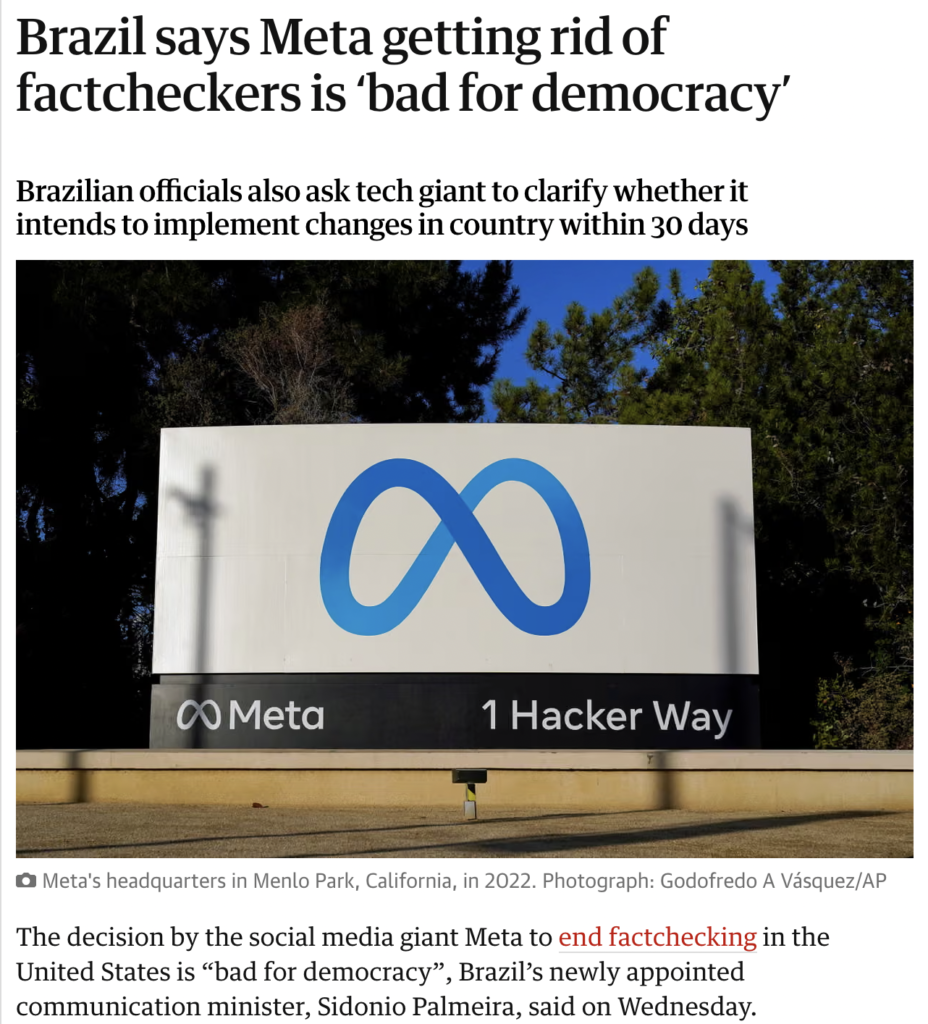
This contradiction is also reflected in the response to Meta’s policy changes in 2025. According to The Guardian (2025), the Brazilian government expressed serious concerns about Meta’s improved approach to handling hate speech, believing it does not comply with Brazilian laws and societal expectations. This example demonstrates that platform governance is not isolated. (The Guardian, 2025). Governments, legal standards, and local publics may have very different views on the content that platforms should allow. A company may hope to adopt a certain policy framework, but society does not all agree on the same standards for the threshold of harm.
Image source: (The Guardian, 2025)2025, January 8)
Moderation still has real limits
Apart from the above-defined problems with policy formulation and application, it should also be recognized that no matter what, there will always be difficulties with moderation in terms of practical implementation. One of them has to do with the scale of operation. Meta handles millions of posts, comments, and messages per day via various moderation methods (human and computer-assisted), and none of the approaches guarantee a perfectly efficient outcome.
Automated moderation systems can miss the meaning of a certain statement or underestimate cultural implications. Moderators simply cannot process the sheer volume of content generated daily, and user complaints are unlikely to come in before the content is seen and circulated. Thus, the problem is not only that moderation requires effort but that it can hardly be comprehensive.
Meta’s recent policy shift indicates reluctance towards stronger moderation
As evident from the discussion above, the problems discussed cannot explain everything about Meta’s policy shift in January 2025. After explaining its desire to reduce restrictions on speech, Meta received criticism. According to Reuters (2025a), its new approach allowed some topics (e.g., immigration and gender identities) to remain free of restriction. In addition, Reuters reports that Meta decided to stop proactively enforcing many types of moderation rules.
Zuboff (2019) argues that digital platforms are shaped by a broader logic of surveillance capitalism, where user activity and behavioral data are central sources of value. From this perspective, the platform is rewarded for keeping users active, not necessarily for creating a calm or healthy public sphere. This does not mean hate speech is good for business in every case, but it does mean there may be limited incentive to remove every borderline or emotionally charged form of harmful content.
The criticism became even louder when the Meta’s independent oversight board openly condemned its policy shift in April 2025. According to Reuters (2025b), the board criticized the company for rushing to make decisions on changing policies without prior human rights assessments. The board members also warned of possible consequences of this approach in crisis contexts. It is important to note that the criticism emerged from a Meta-related body.
Overall, the developments described show that it is not only about Meta being unable to address the problem. Rather, the platform apparently has no interest in implementing the current moderation strategy.
Conclusion
The Meta case shows that online hate is not a problem that platforms can easily solve through moderation alone. Moderation systems have practical limits, especially at global scale, and recent policy changes suggest that Meta may not always be moving toward stronger enforcement. At the same time, business and political priorities shape what kind of safety the platform is willing to provide.
For these reasons, platform self-governance is not enough. If online hate is going to be addressed more effectively, stronger public accountability, greater transparency, and broader debate about platform responsibility will still be necessary.
AP News. (2025, January 8). Meta rolls back hate speech rules as Zuckerberg cites recent elections as a catalyst.
Flew, T. (2021). Regulating platforms. Polity Press.
Meta. (n.d.). Hateful conduct. Meta Transparency Center.
Meta. (2025, January 7). More speech and fewer mistakes. About Meta.
Reuters. (2025a, January 7). Meta shelves fact-checking in policy reversal ahead of Trump term. Reuters.
Reuters. (2025b, April 23). Meta’s oversight board rebukes company over policy overhaul. Reuters.
Sinpeng, A., Martin, F., Gelber, K., & Shields, K. (2021). Facebook: Regulating hate speech in the Asia Pacific. Media International Australia, 179(1), 24–39.
The Guardian. (2025, January 8). Brazil says Meta getting rid of factcheckers is “bad for democracy”.
Zuboff, S. (2019). The age of surveillance capitalism. PublicAffairs.
Be the first to comment