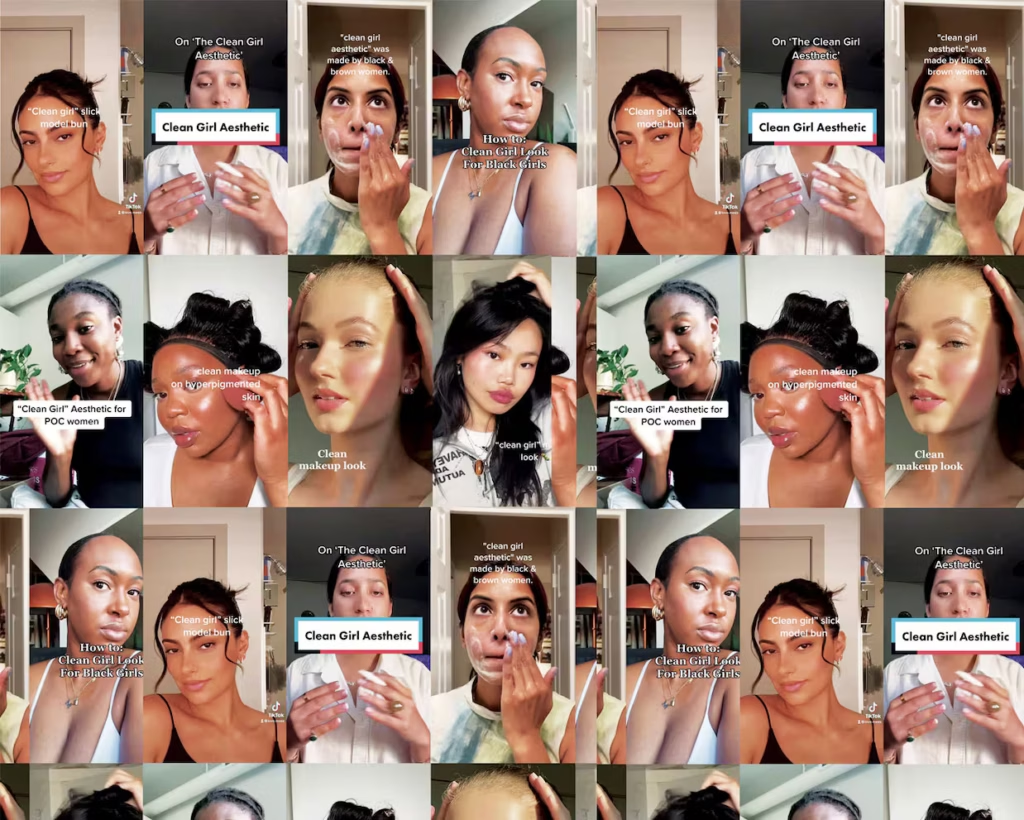
Nowadays, we feel that these platforms know us better than we do. Just spend a few minutes on TikTok, and your recommendation page will start to change. You watched some videos about skin care and stayed in the skin care process in the morning. Suddenly, your whole page is full of soft light, neutral tones and minimalist lifestyle, which is the so-called “clean girl aesthetic” This change happens quickly and naturally, as if the platform reacts directly to something very personal to you.
This is usually explained by personalization. The platform uses your behavior to show you more relevant and attractive content, showing only what you like. In everyday language, this is often positively described as a pleasant, efficient and even powerful experience.
But there is something important missing in this explanation.
The question is not why you see this kind of content, but why it is so conspicuous. Why are some beauty trends, specific styles and lifestyles, will provide more to users? In order to answer this question, we must go beyond the concept of personalization and think about building a platform that can realize our own vision.
Personalization or Amplification?
- Usually, the recommendation system is described as a negative way to connect users with relevant content. However, this view ignores an important mechanism: algorithms not only process content, but also actually recommend a certain type of content over other content. This highly personalized process is actually an exciting process. The platform will give priority to recommend visually attractive, coherent, easy-to-copy and attractive content. In this way, the platform itself creates visible and popular content. This process is not superficial, but integrated into the design and function of the platform.
- According to Terry Flew (2011), digital platforms not only play a negative role in acting as intermediaries; they also actively participate in the media structure through screening, classification and publishing processes. In this case, the recommendation system not only shapes the user’s behavior, but also affects the content they can see and process. Similarly, Dalton Gillespi (2018) emphasized that the platform not only passively provides safe space for activities, but also actively creates these spaces in an organized and efficient way. This means that what users see is not a neutral reflection of collective expression, but the results of the organization and screening process. Therefore, personalization may be misleading; because it gives people a sense of personal control, but it covers up the overall dynamics behind it.
Attention Economy
Another way to understand this process is based on the concept of the attention economy. The platform not only provides relevant content, but also tries to maximize users’ usage time, improve their visibility and promote interaction. According to Tim Wu and some other researchers, attention has become a valuable economic resource in digital media, and the platform system is committed to attracting and retaining this attention.
It helps to explain why certain types of content become popular. Visually attractive, easy-to-use and emotional materials can attract attention. “Clean Girl Aesthetic” is especially in line with this model. Due to its simplicity, repeatability and clarity, it is easy to consume quickly, and users’ high attention prompts them to continue to look for similar content.
In this case, it is reasonable to regard distribution as a way to improve attention. The platform does not need to know the detailed preferences of users, but should decide what they should do. We emphasize that this is important because it shows that the recommendation system is more based on tracking interactions than understanding users.
Why the “Clean Girl Aesthetic” Spreads So Easily
“Clean Girl Aesthetic” clearly shows the real-life example of this process. It seems that its popularity reflects the interests of users: simple makeup, orderly daily life and regular lifestyle are all reflected, because people like these contents. However, this interpretation ignores the role of algorithms and assumes that the dissemination of content is only because users want to see it.
In the work itself, not all types of content can get the same attention. “Clean Girl Aesthetic” is easy to identify through algorithms because of its structural characteristics. Its visual appearance is easy to recognize, and users can find and interact with it in seconds. Its structure is highly reusable, allowing creators to easily reuse and adapt. The information disseminated is inspiring and uncontroversial, which makes the content popular and often shared among different groups.
These features are very suitable for the content that the recommendation system tries to present: content that encourages users to watch, interact with and visit again. According to Zuboff (2019), digital platforms are not limited to tracking user behavior, but also predict and influence their behavior to achieve their own goals. In this case, exposure to a specific type of content is not random: it is part of a system designed to control attention and interaction. Therefore, the trend of “Clean Girl Aesthetic” is not only disseminated, but also continuously displayed, strengthened and utilized through the platform mechanism.
From Trend to Norm: The Power of Repetition
Repetition will bring important results. When the same content is presented many times, it will make people feel that this is exactly what they expect. The initial experience will gradually become a standard. The boundary between popularity and expectations becomes blurred, because repeated exposure will change users’ perception of certain things or ideas.
At the same time, users usually do not see other personal expressions that are not clear, not strict enough or not suitable for the platform architecture. The absence of these expressions is not necessarily because they do not exist, but more likely because they are rarely seen. This creates a one-sided impression of reality: some lifestyles are highlighted as the mainstream, while others are ignored.
Flew (2021) pointed out that the power of the platform lies in its ability to shape users’ ideas and values, which in turn affects users’ understanding of what is normal, relevant or socially acceptable. Therefore, repetition is not a secondary product in the information system. It is the basic mechanism for creating rules.
Algorithmic Bias
We must realize that this process is not neutral. Certain types of content will be prioritized, which reflects the possible biases in the platform design.
The algorithm will give priority to displaying the most relevant content according to certain indicators, such as the size of members, user stay time and interaction. However, these indicators tend to reinforce certain specific patterns, expressions and models. Those content that is slow-paced, complex or visually less attractive are more difficult to perform well, so they are less likely to spread.
According to Safia Noble’s analysis of search engines (2018), computerized systems reinforce inequality by prioritizing the display of certain content characteristics while restricting other content. Although Noble’s research mainly focuses on racial issues, this view has a wider applicability: computerized bias may be manifested in different areas, such as style, identity and lifestyle.
This means that the dominance of trends such as “pure desire” is not only the result of collective preferences, but also the structural priorities built into the platform system. In this case, the data not only reveals what content users interact with, but also reflects what content the platform design aims to promote.
The Illusion of Choice
When browsing content, users may feel that these contents reflect their personal interests. But this feeling arises in an environment where some types of content are more prominent than others, which may create the illusion of personal preferences, although in fact it is the result of the algorithm systematically displaying a specific type of content. Over time, this experience will bring heat, and heat will generate preferences. The boundary between choice and influence is becoming more and more blurred.
The platform does not directly control the behavior of users, but affects the selection process. This is consistent with Flew (2021)’s point of view. He believes that the power of the platform is used as a specific form of control, in which user activities are not directly formed, but constructed through the structure of digital media.
Similarly, Taina Bucher (2018) emphasized how users experience algorithms in their daily interaction with the platform. Users’ personal choices are often determined by potential visual systems, and they may not be fully aware of or understand these systems.
Hypernudge and Behavior Design
This dynamic can also be understood through the concept of “Hypernudge”. For example, Karen Yeung (2017) proposed that digital media aims to cleverly guide users’ behavior through data-driven feedback systems. The platform does not give instructions directly, but shapes the behavior of users according to the content they see, the frequency they see and the difficulty of interacting with the content. This is in line with what Cass Sunstein said about “promoting”, that is, environmental design affects decision-making without exerting direct pressure (Sunstein, 2015).
On TikTok, this is reflected in functions such as infinite scrolling, automatic playback and quick sorting of content. These design decisions reduce resistance, promote continuous participation, and make certain behaviors natural and easy. The platform does not force users to act in a specific way, but users will be guided by an environment that makes some behaviors more likely to happen than others. This effect is particularly powerful because it works at the subconscious level.
Platform Power and Cultural Influence
Understanding algorithms helps us understand why some cultural patterns appear on the Internet. The formation of these models depends not only on the user’s preferences, but also on the structural driving force of the platform. Due to the tendency to choose content that is easy to control, copy and disseminate, these contents may not consider diversity or depth when organizing. This forms a feedback loop, and some cultural patterns will be permanently trapped in this organization.
According to David Beer (2017), algorithms use social power because they have the ability to organize and classify information. This power is not always obvious, but it greatly affects the formation and shaping of social culture.
Therefore, the platform is not a neutral intermediary. It plays a positive role in the emergence, dissemination and organization of cultural significance. In other words, the power of the platform is not only limited to the dissemination of content, but also contributes to shaping its own cultural characteristics.
Cultural Consequences
These integrations have also raised a wide range of questions about cultural diversity and how it is presented. If information systems always give priority to content that is easy to replicate and globally attractive, there is a risk that freedom of cultural expression will be restricted. Aesthetic concepts such as “clean girl aesthetic” not only become stronger because of their global popularity, but also bring structural advantages to the platform system.
According to José van Dijck (2013), the platform creates a cultural ecosystem by controlling the production, distribution and evaluation of content. These impacts are not only limited to users’ personal experiences, but also involve a broader level of cultural production, dissemination and understanding. Some lifestyles, identities and values have become more prominent and are therefore more acceptable to society, while others are relatively marginal. In other words, digital expansion not only affects what users see, but also shapes the cultural form in digital space.
Counter-Argument
We must realize that the recommendation system is not completely negative. They can help users find content that could not be found and make browsing easier on digital platforms. From this perspective, personalization can be regarded as a way to improve user experience rather than limit the experience.
For many users, algorithm recommendation provides convenience and efficiency, reducing the need to find suitable content. In this sense, the platform does provide value.
The problem is not the implementation of the algorithm, but how to set priorities for specific topics. Although users can benefit from the platform’s recommendations, these benefits are based on a system that relies on participation, repetitiveness and clarity rather than diversity and depth. Understanding these contradictions is crucial to understanding the scope and real impact of the platform.
Conclusion: What Feels Personal May Not Be
This coincides with the description of life experience by Tina Bucher’s algorithm (2018), in which users understand and browse the platform according to the presentation of the content and its priority. These seemingly personal decision-making behaviors are actually the result of these basic visual systems.
This does not mean that the freedom of users has disappeared. People can still choose what they want to see, process and create. But these decisions are made within a system that can actually filter and classify the displayed content.
The power of the algorithm lies precisely in this precision. They do not directly define priorities, but increase some possibilities and lower others.
In general, the problem is not that the algorithm shows us what we like. More importantly, alternative options should be selected in the right place from the beginning.
Reference List
Bucher, T. (2018). If…then: Algorithmic power and politics. Oxford University Press.
Flew, T. (2021). Issues of concern. In Regulating platforms (pp. 72–79). Polity.
Gillespie, T. (2018). Custodians of the Internet: Platforms, content moderation, and the hidden decisions that shape social media. Yale University Press.
Noble, S. U. (2018). Algorithms of oppression: How search engines reinforce racism. New York University Press.
Seaver, N. (2019). Knowing algorithms. In J. Vertesi & D. Ribes (Eds.), DigitalSTS: A field guide for science & technology studies (pp. 412–422). Princeton University Press.
Sunstein, C. R. (2015). Choosing not to choose: Understanding the value of choice. Oxford University Press.
Wu, T. (2016). The attention merchants: The epic scramble to get inside our heads. Knopf.
van Dijck, J. (2013). The culture of connectivity: A critical history of social media. Oxford University Press.
Yeung, K. (2017). ‘Hypernudge’: Big data as a mode of regulation by design. Information, Communication & Society, 20(1), 118–136. https://doi.org/10.1080/1369118X.2016.1186713
Zuboff, S. (2019). The age of surveillance capitalism. Profile Books.
Be the first to comment