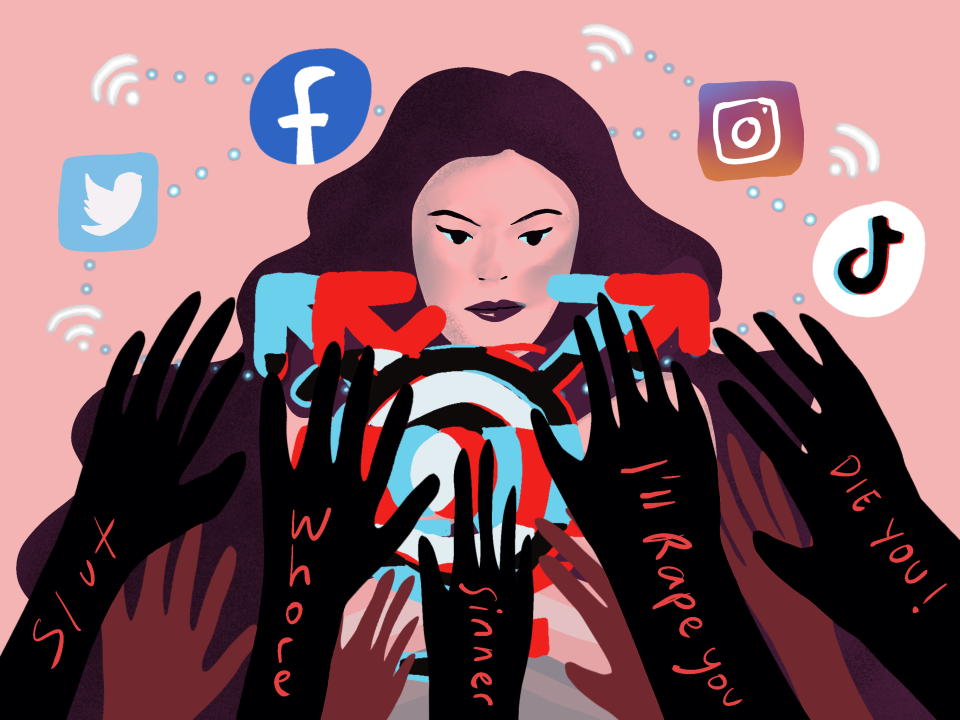
In an age when social media is widely used, online harm has become a serious social issue. Within this discussion, one very common misunderstanding is that many people see online misogyny as simply rude language online or a toxic comment section. In fact, this broad and casual understanding weakens the seriousness of the issue.
The real problem is that digital misogyny is not just a matter of some users being rude. It is also a form of online harm that is continuously spread and amplified by platforms. Digital misogyny should be seen as online harm not only because it makes people feel uncomfortable, but because it causes real harm to women. An Australian government report shows that women are far more likely than men to feel technology-facilitated abuse threatens their safety, with 26.3% of women reporting this experience compared with 12.6% of men.
As Flew (2021) points out, hate speech and the way it is amplified through digital platforms and social media have become a major and growing social problem. Therefore, digital misogyny should not be understood simply as offensive speech. It should be seen as a structural harm is spread by platforms and has real effects on everyday life.
How Digital Misogyny Moves from Speech to Real Harm
To truly understand how digital misogyny moves from hate speech to real harm, we first need to see why it is different from ordinary rude comments.
Hate speech is often defined as speech that expresses, encourages, or stirs up hatred against a particular group, such as groups based on race, ethnicity, gender, religion, nationality, or sexual orientation (Flew, 2021).
From this point of view, digital misogyny is clearly more than just rude language used by a few individuals online. It does not only target one person. Instead, it treats women as a gender group and subjects them to repeated disrespect, humiliation, and hostility.
The effects of this kind of speech are also much more serious than simply making people feel upset. Digital misogyny makes it more likely women will face shame, attacks, and hostile responses when they take part in online activities, such as commenting, posting, or sharing opinions. Over time, this can reduce women’s willingness to speak in online spaces, and some may choose to stay silent or participate less. For this reason, its impact goes beyond emotions. It also raises the cost of women’s participation in online spaces, making it harder for them to express themselves freely.
However, the harm of online misogyny is often underestimated, because it does not always appear in a direct or obvious form. In many cases, it is presented as jokes, memes, or even as rational analysis and advice. It is exactly this light and harmless appearance that makes online misogyny easier to accept, spread, and normalise.
Australia Teen Boys and The Manosphere
Digital misogyny is not a sudden or isolated problem, and it is not just a few rude comments online. It is better understood as a form of online harm keeps moving through social media, spreading wider and wider, and eventually becoming part of everyday culture.
Recently, ABC News reported a worrying trend: teenage boys in Australia are being heavily exposed to misogynistic content online, and this influence is starting to enter schools and classrooms.

One Australian high school teacher said she had faced more and more gender-based abuse in class. This included comments about women’s bodies, resistance to female teachers’ authority, and open sexist remarks. The report suggests this trend is closely linked to social media figures like Andrew Tate and the wider content culture of the “manosphere.”
To understand this case, it is important to know the manosphere is not just one influencer, one short video, or one forum. It is more like a digital space made up of different types of content, communities, and stories. In this space, there is a lot of anti-feminist discourse, male grievance narratives, and red pill thinking. Massanari (2015) shows that platforms such as Reddit can become gathering spaces for anti-feminist activism, where these views connect with each other, grow stronger, and slowly form a networked culture.
What makes this kind of digital misogyny especially dangerous is it does not always appear as obvious hate speech. Very often, it does not directly insult women. Instead, misogynistic ideas are packaged into content seems reasonable, educational, or even attractive. It may appear as advice about male self-improvement, success, or dating. This makes the content easier to spread and harder to recognise as harmful.
When content moves into a new context, its meaning can also change. (Baym & Shah, 2011)
Once misogynistic ideas are placed inside these ordinary or even positive-looking frames, they are more likely to avoid platform moderation and lower users’ sense of caution.
The problem is that once this content is watched, liked, shared, and copied again and again, platform algorithms help it spread even further. Its effects also do not stay on the screen. The ABC report makes it clear female teachers being targeted by sexist behavior from teenage boys is not an isolated case. It is a growing pattern is becoming harder to ignore.
Even more seriously, digital misogyny keeps repeating negative ideas about women, such as calling women “gold diggers” or “manipulative.” When these stories appear again and again, they slowly shape how people understand women, gender relations, and even gender equality itself. Once this kind of content enters group culture, it is no longer just private viewing. It becomes memes, jokes, and a form of social performance that makes misogyny seem normal.
When misogynistic expression becomes common, funny, or even “reasonable,” women are the ones who pay the price. It becomes harder for them to speak freely, and they are more likely to lose the sense of safety needed to take part in public discussion.
How Platforms Amplify Digital Misogyny
Digital misogyny does not keep spreading only because users continue to produce this kind of content. It is also closely linked to the visibility logic of platforms, or in other words, how platforms decide what is easier to see.
Social media platforms are not neutral spaces that display all content equally. Instead, they use a whole set of systems to decide what is more likely to appear in front of users and what is more likely to be hidden. Here, Matamoros-Fernández’s (2017) idea of platformed racism is useful for understanding a similar process. This concept shows:
Hateful expression does not appear separately from platforms. It is shaped by platform design, functions, business models, and user culture.
This idea also applies to digital misogyny. Platform algorithms rely on recommendation systems, ranking systems, and engagement data. This means the content users see is not random. It is the result of platform filtering, ranking, and pushing. In other words, platforms do not simply carry content. They also actively shape what becomes visible.es visible.
For this reason, misogynistic content does not spread only because platforms openly support hate. It also spreads because platform systems help hidden and more disguised forms of hate speech move more easily. Although platforms usually have community rules and content policies, this does not make them neutral. Even though platforms often describe themselves as open and neutral spaces, they still shape public discussion through ranking, recommendation, and governance systems (Matamoros-Fernández, 2017).
The problem is platforms often reward content that is more controversial, emotional, and likely to create interaction. Digital misogyny fits these features very well. Compared with calm and reasonable discussion, provocative gender content is more likely to get clicks, comments, and shares. Even when users criticise or repost this content because they dislike it, these actions may still help it spread further.
Platforms often care less about the social value of content and more about whether it can produce interaction data. From this view, platform design and governance are not just passively carrying harmful content. They can also become the conditions that allow toxic techno-cultures and hate speech to grow and spread.
Why Platform Governance of Digital Misogyny Often Fails
Platform governance often fails to deal with digital misogyny because of several structural limits working together.
First, this failure is closely linked to the huge size of platforms themselves. On large social media platforms, the amount of user-generated content is enormous and continues to grow. Faced with such a large volume of content, moderation is very hard to carry out in a timely, accurate, and complete way (Roberts, 2019). In other words, it is not simply that platforms do not want to manage it. In many cases, they simply cannot keep up.
Second, although many platforms now use AI and algorithmic review systems, automated moderation cannot truly solve a problem like digital misogyny, which is often hidden and indirect. Misogynistic content does not always appear in an obvious form. It is often packaged in language seems harmless. This means asking machines to sort content into simple categories like “acceptable” and “unacceptable” goes beyond what algorithms can do well. Many cases still need human review and careful judgment in context (Roberts, 2019).
More importantly, the basic logic of platforms means that governance is often one step behind. Most social media platforms work on a “upload first, review later” model. This means harmful content often enters circulation before it is checked more carefully. By the time it is removed, it may already have spread through likes, shares, comments, and imitation. Repeated exposure can also make this content seem more normal.
Finally, even when platforms offer reporting tools, these do not always close the gap. Reporting systems are often slow and unclear. Users do not know whether their reports are taken seriously, or what standards the platform uses to make decisions. Over time, this weakens the reporting system and leaves users feeling tired and powerless after reporting harmful content again and again without results (Sinpeng et al., 2021). Worse still, many users feel that platforms are shifting responsibility onto ordinary users, and even onto victims themselves.
The failure of platform governance is not only about weak rules. It is also about platform scale, the limits of automated moderation, the speed of content circulation, and the weakness of reporting systems. Digital misogyny cannot be solved simply by deleting a few posts. It is a deeper structural problem tied to how platforms work and how they are governed.
Conclusion
Digital misogyny should not be simply reduced to the malicious behaviour of a few users. It continues to exist and even spreads further because platforms themselves reward visibility, engagement, and shareability. The case of Australian teenagers being influenced by manosphere content shows misogynistic ideas are not just isolated comments in online spaces. With the help of platform systems, they can gradually produce real social effects.
If we want to truly respond to this kind of online harm, we cannot rely only on users being self-aware or using reporting systems. Digital platforms must take responsibility for improving their moderation and governance systems. They also need to recognise that the logic of online circulation itself can continue to amplify harm and threaten user safety.
References
Flew, T. (2021). Issues of concern. In Regulating platforms (pp. 91–96). Polity.
Sinpeng, A., Martin, F. R., Gelber, K., & Shields, K. (2021). Facebook: Regulating Hate Speech in the Asia Pacific. Department of Media and Communications, The University of Sydney. https://hdl.handle.net/2123/25116.3
Massanari, A. (2017). Gamergate and The Fappening: How Reddit’s algorithm, governance, and culture support toxic technocultures. New Media & Society, 19(3), 329–346. https://doi.org/10.1177/1461444815608807
Roberts, S. T. (2019). Understanding Commercial Content Moderation. Behind the screen : Content moderation in the shadows of social media. (pp. 33-72). Yale University Press. https://doi.org/10.12987/9780300245318
Sinpeng, A., Martin, F., Gelber, K., & Shields, K. (2021). Facebook: Regulating hate speech in the Asia Pacific. Department of Media and Communications, The University of Sydney. https://doi.org/10.25910/j09v-sq57
eSafety Commissioner. (n.d.). Online risks for women. https://www.esafety.gov.au/women/online-risks-for-women
Baym, G., & Shah, C. (2011). Circulating struggle: The on-line flow of environmental advocacy clips from The Daily Show and The Colbert Report. Information, Communication & Society, 14(7), 1017–1038. https://doi.org/10.1080/1369118X.2011.554573
Be the first to comment