A cruel comment online can be easy to dismiss as a single act of bad behaviour. But cyberbullying on social media rarely stays at the level of one comment, one user, or one moment. On social platforms, humiliation can be repeated, shared, captured in screenshots, forwarded, and turned into a public performance. What might begin as a personal attack can quickly become collective ridicule. For this reason, online harm is not simply a matter of individual cruelty. It is also shaped by the digital environments in which that cruelty becomes visible, repeatable, and difficult to escape.
This matters because online harms are now a major part of digital public life. While hate speech and abusive content are often discussed as problems of offensive expression, research shows that online harm can be more persistent and damaging when platforms fail to respond effectively or when their systems intensify exposure to abuse (Sinpeng et al., 2021). A platform’s role, then, is not limited to hosting user content. As Woods and Perrin (2022) argue, the more important question is how platform design, reporting systems, and safety processes shape the circulation of harmful behaviour.
This blog argues that cyberbullying on social media is intensified not only by hostile users, but also by platform systems that reward visibility, repetition, and participation, making online harm more public, more persistent, and harder to escape.
Why This Issue Matters Now
Cyberbullying is not new, but the conditions that intensify it have become more deeply embedded in everyday digital life. Social media platforms are no longer secondary spaces where users simply post occasional thoughts. They are now major environments for social interaction, identity performance, entertainment, and public judgment. This matters because harmful behaviour online can spread quickly through ordinary platform functions such as sharing, forwarding, liking, reposting, and commenting. In other words, what makes online harm especially urgent today is not just the existence of abusive speech, but the way platform systems can extend its reach and repetition.
This shift also helps explain why current debates are moving away from asking only whether a specific post should be removed. Increasingly, the more important question is how platforms are designed, what kinds of interaction they encourage, and whether their reporting and safety systems are capable of reducing foreseeable harm. As Woods and Perrin (2022) argue, online harm should not be understood only as a content problem. It should also be understood as a systemic issue shaped by platform design, business choices, and risk management. That is why cyberbullying matters now in a different way: it is no longer just a problem of rude behaviour online, but a problem of how digital environments are built to circulate and intensify harm.
What Makes Cyberbullying Different from Ordinary Conflict
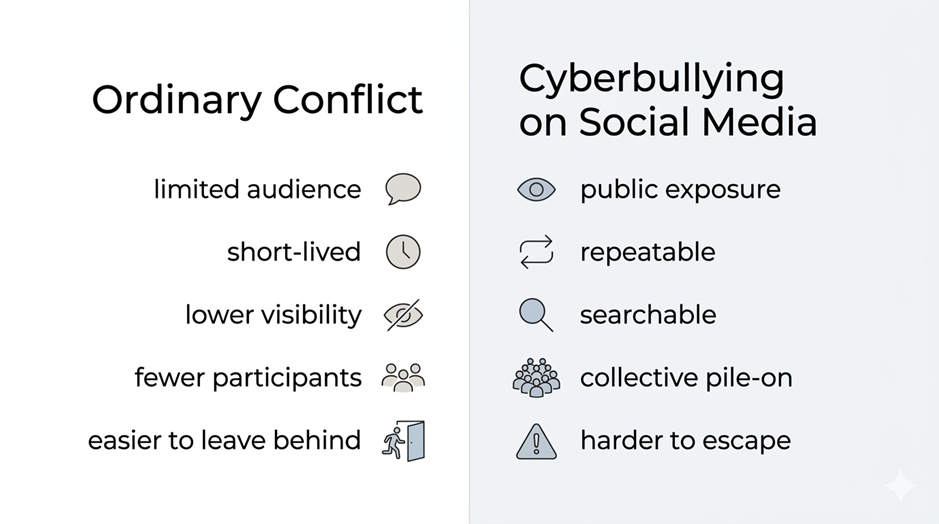
Not every negative online interaction is cyberbullying. Disagreement, irritation, and even conflict are normal parts of public communication. What makes cyberbullying different is not simply the presence of unkind language, but the conditions under which that harm is produced and repeated. On social media, attacks can become public very quickly. A hostile comment is often no longer directed only at one person. It can be liked, repeated, echoed by strangers, and turned into a visible pile-on. This changes the scale of the harm. The target is not only insulted; they are also publicly exposed, watched, and reduced to an object of collective reaction.
Cyberbullying is also harder to escape than ordinary interpersonal conflict. In offline life, a cruel remark may end when the conversation ends. Online, however, the same attack can remain visible, return through screenshots and reposts, or reappear in new comment threads. The target may leave one conversation but still remain searchable, open to discussion, and vulnerable elsewhere on the platform. This makes online abuse feel less like a single incident and more like an environment.
Another important difference is participation. Cyberbullying often attracts spectators as well as direct aggressors. Some people join the attack, some reward it with attention, and others help circulate it without necessarily seeing themselves as responsible. As a result, online harm can be created not only by intention but by accumulation. That is why cyberbullying should be understood not simply as rude speech, but as a form of public and repeated harm shaped by digital visibility and collective participation.
How Platforms Amplify Harm
If cyberbullying is more public, more persistent, and more difficult to escape than ordinary conflict, then platform design is a large part of the reason why. Social media does not merely host harmful interactions after they happen. It actively shapes how far they travel, how long they stay visible, and how many people are invited to join in.
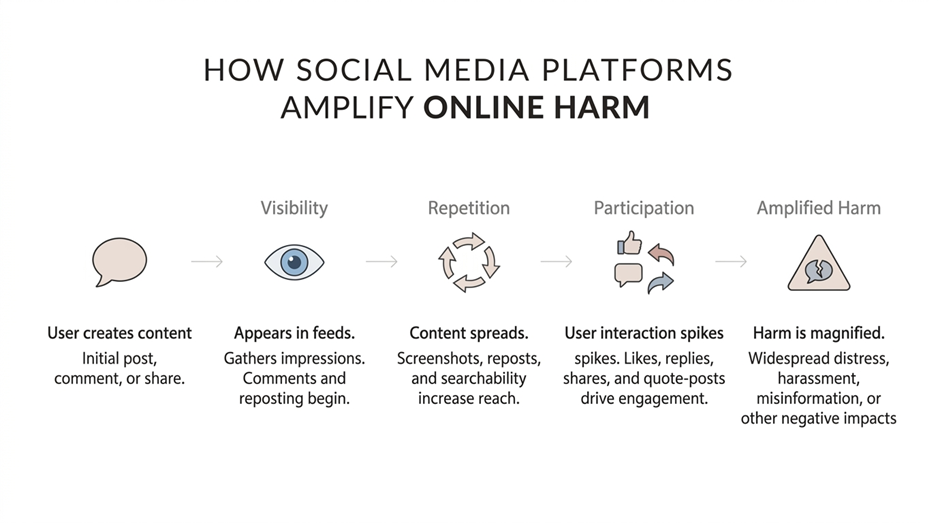
One way platforms amplify harm is through visibility. Content that attracts attention is often pushed further through feeds, comment sections, and reposting functions. This does not mean that platforms intentionally promote abuse in every case. However, systems built to maximise engagement do not always distinguish between attention generated by humour, interest, outrage, or humiliation. As a result, harmful content can gain momentum simply because many people react to it. The more visible the attack becomes, the more public the target’s humiliation becomes as well.
A second mechanism is repetition. Social media allows the same insult, image, or accusation to circulate across multiple formats and spaces. It can appear in comments, be captured in screenshots, reappear in reposts, and resurface through searchability. Even when an original post is deleted, its social life may continue elsewhere. This is one reason online harm often feels much larger than the first message that triggered it. Platforms make repetition easy, fast, and low-cost, which means a moment of abuse can be extended far beyond its original context.
A third mechanism is participation. Platform features such as likes, replies, shares, stitching, forwarding, and quote-posting make it easy for users to move from watching to joining. In this environment, cyberbullying can become a distributed activity. Some users attack directly, while others escalate the situation by rewarding, repeating, or circulating the attack. Harm is therefore not only produced by one aggressor, but by a system that makes collective participation frictionless.
For this reason, online harm should not be reduced to a problem of simply having “bad users”. As Woods and Perrin (2022) argue, the central issue is also structural: platforms shape information flows through design choices, user tools, and safety processes. When those systems reward visibility and participation more strongly than protection and restraint, cyberbullying becomes easier to spread and harder to contain.
Why Moderation Alone Is Not Enough
At first glance, it may seem that social media platforms are already dealing with online harm. Many users do not constantly encounter explicit abuse in their everyday feeds, and clearly abusive content is often removed after being reported. But this does not mean the problem has been solved. It may simply mean that online harm is unevenly distributed, temporarily visible, and often experienced most intensely by those directly targeted.
This is one reason moderation alone is not enough. Removing a post after it has already circulated does not undo the attention, humiliation, or stress it may have caused. By the time a harmful comment or post is deleted, screenshots may already have been saved, replies may have multiplied, and the target may have already experienced the damage. In this sense, moderation often works after the key moment of harm has already taken place.
Another limitation is that platform rules tend to focus on clearly recognisable violations, while many forms of online harm are more contextual, indirect, or cumulative. A single comment may not seem severe in isolation, but repeated exposure, public mockery, and coordinated attention can still produce serious effects. Harm online is not always created by one dramatic post. It can also emerge through accumulation, repetition, and the target’s growing sense that the platform cannot or will not protect them.
Research on platform governance in the Asia Pacific helps explain this problem. Sinpeng et al. (2021) show that hate-related harm is often shaped by language, culture, and context, which makes it harder for standardised moderation systems to identify and address effectively. This suggests that the issue is not simply whether platforms remove enough content, but whether their systems are capable of recognising how harm actually operates in practice.
Why the Public Should Care
Cyberbullying matters not only because it hurts individuals, but because it changes the conditions of public participation. When humiliation, ridicule, and coordinated attacks become common features of social media, some users do not simply feel offended. They withdraw, self-censor, or choose not to speak at all. In this way, online harm affects who feels safe enough to participate in digital public life and whose voice becomes easier to silence.
This broader impact has already been observed in research on online harm. Carlson and Frazer (2018) found that Indigenous users in Australia often experienced racism, threats, and hostile interactions online, and that some responded by limiting their self-expression or avoiding engagement. Their findings suggest that harmful online environments do more than damage individual wellbeing. They can also narrow the space for visibility, confidence, and participation. This is why online harm should be understood as a social and democratic issue, not just a personal one.
The problem is also not limited to one country or one platform. Guan and Chen (2026) show that hateful and exclusionary discourse in China’s digital sphere is shaped by threat perception, otherness, and identity-based hostility. Their work reminds us that harmful online communication is not an isolated cultural accident. It is part of a broader digital environment in which attention, emotion, and group antagonism can easily combine.
If social media platforms remain central spaces for public discussion, then the quality of those spaces matters. Online harm is not just about mean comments. It is about what kinds of participation platforms make possible, reward, or quietly push people away from.
Conclusion
Cyberbullying is often dismissed as a problem of individual behaviour, as though the solution were simply for users to be kinder or for platforms to delete the worst comments more quickly. But this view misses the deeper issue. On social media, harm is not only produced by what one person says to another. It is shaped by systems that make attacks visible, repeatable, shareable, and easy for others to join. What begins as a personal insult can become a collective performance of humiliation, and once that process starts, the damage is often much harder to contain than a single deleted post might suggest.
This is why online harm should be treated as more than a matter of rude speech or bad manners. It is a structural problem connected to platform design, moderation systems, and the kinds of interaction digital spaces reward. Visibility, repetition, and participation may be useful for growth and engagement, but they can also turn cruelty into momentum. When this happens, the effects are not limited to emotional distress. People may withdraw, self-censor, or decide that speaking in public is no longer worth the risk.
If social media platforms want to present themselves as central spaces for communication, then they cannot treat cyberbullying as a minor side effect of online participation. The real question is not only whether harmful content is eventually removed, but whether platforms are built in ways that prevent harm from spreading so easily in the first place. Cyberbullying matters because it reveals something larger about digital life: who gets heard, who gets worn down, and what kinds of public participation social media actually makes possible.
Reference list
- Carlson, B., & Frazer, R. (2018). Social media mob: Being Indigenous online. Macquarie University.
- Guan, T., & Chen, X. (2026). Threat perception, otherness and hate speech in China’s cyberspace. Journal of Contemporary China, 35(158), 1337–1352.
- Sinpeng, A., Martin, F., Gelber, K., & Shields, K. (2021). Facebook: Regulating hate speech in the Asia Pacific. University of Sydney & The University of Queensland.
- Woods, L., & Perrin, W. (2022). Obliging platforms to accept a duty of care. In M. Moore & D. Tambini (Eds.), Regulating big tech: Policy responses to digital dominance (pp. 93–109). Oxford University Press.
Be the first to comment