
For the past few decades, people have been made to believe one thing:
that automation will take their jobs in the future.
Well, automation is no longer something of the distant future. It is here now. But when you look around, people still have jobs. So, was the big fear warranted? Or has something happened and changed the trajectory of the predicted job losses? However, automation should not only be understood as a technological development. It is also a form of control shaped by data, algorithms, and corporate decision-making. This means the real issue is not simply whether jobs will disappear, but who has the power to decide how automation is used and who it benefits.
While these might seem like dumb questions to ask in the first quarter of the 21st century, they can be justified by the fact that there used to be a massive hype around automation. Even today, many people still believe that automation is progressing rapidly, fueled by the emergence of artificial intelligence. Agreed, AI is fast becoming mainstay in modern life, especially with over 70% increase in roles requiring AI literacy in recent years. For example, today, content writers or even researchers can automate their tasks. All they need is an AI agent, a decent prompt, and their work will be done for them in a matter of seconds.
So, let’s demystify the concept of automation. First, it is true AI has fueled automation, with many tasks requiring human intelligence now being as easily automated as the manual ones. Second, automation is a choice, not a destiny. What this means is the notion of automation being inevitable is grossly misleading. While technology advances rapidly, how it is used and who benefits from its use is often a matter of human choice.
Defining Automation
What is automation?
It the everyday use, automation simply implies the use of machines or equipment to replace human labor. For example, a tractor plowing a field can be viewed as replacing humans with a tractor. According to the Cambridge Dictionary, automation means using machines and computers that operate without human control.
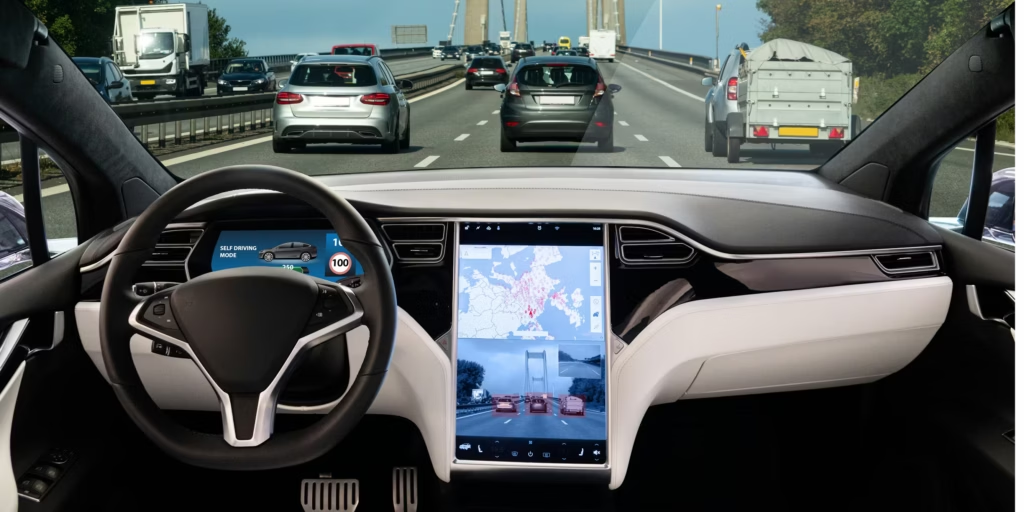
This seems like a more advanced view where the performance of the tasks does not require human input. A tractor does require a human driver. However, self-driving vehicles, a rapidly growing concept, means cars drive without human drivers. This is the ultimate notion of automation, where machines and computers perform tasks without human input.
Automation will mostly be synonymous with the use of computers and robotics with increasingly sophisticated capabilities that make it possible for them to function without human intervention (Petersen et al., 2022).
Automation is all about computers giving machines the capacity to perform human-like tasks. It is all about intelligent machines working without humans.
AI, computers, and automation. How are they connected? Let’s deconstruct this nexus, from an academic perspective. Automation 2.0. I understand some people may wonder what this is and what it entails. You can refer to this text by Thakur (2024) describing Automation 2.0 as a technology that
“combines traditional automation technologies with AI and machine learning to create a new generation of intelligent automation systems” (p. 17).
In this case, AI and machine learning represent computational capabilities and a paradigm shift in how automation works. More importantly, these systems do not simply assist human decision-making. They increasingly replace it. In many cases, decisions about hiring, performance, and productivity are shaped by algorithmic systems rather than human judgement. It is the automation of the digital age.
Therefore, we cannot mention automation today without thinking smart computers. And what makes computers smart? AI and, specifically, machine learning. By definition, machine learning is the AI technology that makes it possible for smart computers and machines to think and make informed decisions. Consider machine learning as a data-driven decision-making technology.
This is because machine learning entails computers learning from data to develop the intelligence needed for decision-making (Schmitt, 2023). https://doi.org/10.1016/j.iswa.2023.200188
This is widely applicable in areas like predictive modeling, where machine learning uses past data to make projections, just as a human would.
How Far have We Come in the Automation Journey?
How can this question be best answered? Consider that years ago experts and scholars promised that automation will take over the entire labor market. Consider, also, that today many jobs are still being done by humans. Therefore, the best response is that the automation journey has been rapid, yet we are still far from full, transformative automation. To demonstrate the rapid pace of automation, recent stats indicate that as of 2025, about a third of individuals in the OECD countries were already deploying AI tools in their everyday life (OECD, 2026). However, this stat does not apply evenly across populations. This is because the usage is particularly high among students from the age of 16 years, most of whom report using AI generating tools. In the job market, the usage is also notably high:
41.1% of employed people versus 36.7% unemployed reporting extensive use of AI (OECD, 2026). https://www.oecd.org/en/about/news/announcements/2026/01/ai-use-by-individuals-surges-across-the-oecd-as-adoption-by-firms-continues-to-expand.html
These stats say one thing very loud: automation has indeed become a new reality.
We can go a step further and examine how companies and businesses deploy automation. Furthermore, it is the corporations that drive automation adoption, purposely to boost accuracy, efficiency, and cost advantages when it comes to labor costs. Let’s consider some stats offered by Park (2026).
In 2024, about 40% of large firms (250 employees and above) were actively using AI. For smaller and medium firms (50-249 employees), only about 20.4% report using AI. https://www.libertify.com/interactive-library/oecd-ai-adoption-smes/
This is quite a drop. An even bigger drop is when you consider that even smaller firms (10-49 employees) record only 11.9%. This is quite an interesting picture.
Let’s deconstruct the picture painted by the above stats. There seems to be a significant likelihood that larger firms with more elaborate processes and operations find automation more advantageous. Alternatively, it could also mean that these firms have the resources needed to invest in automation. Given that automation can be a capital intensive undertaking, especially since hefty funds are needed to finance the acquisition of equipment or new technologies, it follows that only financially-endowed companies can afford to invest. We can demonstrate this scenario by using a case study of a manufacturing plant, for instance, where vehicles are made. To automate processes, heavy investments in robotics equipment and proprietary technology. What if a small bakery wanted to automate various processes, for instance, packaging? Can it afford to purchase the equipment needed? Possibly no, and this implied that the more logical and prudent course of action is to just hire a few people.
I firmly believe that the manufacturing industry gives the base use case for automation. I can argue that we live in an era of digital transformation and Industry 4.0. In this light, manufacturing companies frequently use technologies such as sensors, industrial roots, and programmable devices (Papulová et al., 2022). Digital transformation through advanced techniques such as robotic process automation, AI, and machine learning constitutes hyper-automation. From the view of scholars such as Haleem et al. (2021), this is the true digital transformation.
Despite being the best use case, manufacturing is not the only sector where automation is advancing rapidly. Let’s consider a sector that has often been anonymous with the human interaction: the service sector- taking hotels as an example.
There is a growing scholarly attention on the use of robotics to automate service delivery (Gong et al., 2026). https://doi.org/10.1016/j.actpsy.2025.106121
Recent studies indicate that this advancement is experiencing some positive results, especially with regard to customer satisfaction. Such empirical evidence suggests one key thing:
that even service delivery where human contact is vital could soon be replaced by automated robots. Most worrisome with this advancement is the fact that consumer satisfaction from these robots could surpass human service deliver.
Consider this as serious blow to the service sector, where people might have felt a bit safer.
Why Are People Still Employed?
This is a valid question, especially given what we’ve all been told about AI and automating taking over all our jobs. Don’t be surprised that even bloggers and content creators are now relying heavily on AI. Consider the Chinese propaganda machine and its heavy use of social media bots (Bolsover & Howard, 2019). Who thought that posting on social media could be done by robots?
One of the best explanations is, as outlined earlier. However, this “choice” is not equally shared. In most cases, it is large corporations and organisations that decide whether to automate, based on profit, efficiency, and strategic goals. Workers themselves have very limited influence over these decisions. Another plausible explanation from the earlier assessment is that not all firms can afford automation. That is to say maybe smaller companies lack the resources to automate and invest in related technologies. When you combine these two reasons, the picture that emerges is that companies do not automate merely for the sake of it. Rather, they must have a sufficient business case. Let’s go back to the use case of the manufacturing and service sectors. In these examples, the companies have trended the automation path for several reasons:
improved process efficiency, reduced labor costs, or improve accuracy. In this case, automation is not merely a “nice-to-have” feature (Perez, 2023). Rather, it is a core part of corporate strategy guided by the benefits of automation. https://hbr.org/sponsored/2023/04/how-automation-drives-business-growth-and-efficiency
Therefore, people are still employed because firms choose to have people rather than machines in certain areas where automation is yet to make a proper business case.
What does the labor stats suggest regarding this question?
Well, in many empirical studies, stats show a significant reduction is employment with the onset of automation. The most notable and relevant stat is that about half of all work activities across all occupations has been automation. This aligns with previous predictions that indeed about 50% of all work can be automated (Petersen et al., 2022).
Does it mean that there is another half that cannot be automated? And if so, what could that work entail?
Perhaps these estimations were made in the era of AI, where automation was only possible with manual repetitive tasks with AI, the focus of automation is not more on intelligence, meaning that virtually all intelligent tasks can be automated. Does it mean that AI has just come for the other half of work previously deemed impossible to automate? Possibly so.
Based on this assessment, the questions should perhaps not be why people are still employed but rather, for how long will they lose their jobs
Automation is a journey, not a destination
Years ago, machines came to replace manual labor. Today, AI has come to replace intellectual labor. So, Automation is better understood as an ongoing process, where new technologies are continuously introduced and integrated into existing systems. Firms do not automate for the sake of it. Rather, they do so as a means of taking steps towards stated goals.
Let’s put it in another way. Automation often involves an ongoing and iterative process where continuous improvements are made. Today, a company could install a conveyor belt to feed containers to the filling machine. Tomorrow, a new technology could be installed to automatically detect leaks in containers once filled. The next day, automated labeling may be installed. In this illustration, one aspect after another get automated, all depending on the available technologies of the time.
Conclusion
Automation is already here. We can no longer speak of it as a something still to come, something of the future. What makes it even more real is that automation has taken a new turn. In earlier days, manual and routine tasks were threatened by automation. Today, tasks requiring intelligence are being automation. It is true to state that the emergence of AI has given automation a new dimension. It has also fueled the process of automation, which is not moving more rapidly than before. Years back, experts predicted that half of all jobs can be automation. One could argue now that the other half is now being automated, all because of AI.
So, why are people still employed?
The best answer is that automation is a choice, not a destiny. In other words, if businesses chose to automate the jobs now being done by humans, there is sufficient technology and capability to achieve this goal. Therefore, the better question to ask is how long these people can remain employed. For instance, how soon will people embrace self-driving cars? If you answer this question, then you also answer the question of how soon drivers lose their jobs to automation.
References
Bolsover, G., & Howard, P. (2019). Chinese computational propaganda: Automation, algorithms and the manipulation of information about Chinese politics on Twitter and Weibo. Information, Communication & Society, 22(14), 2063-2080. https://doi.org/10.1080/1369118X.2018.1476576
Gong, Y., Guo, Y., Zhang, T., Zhu, X., & Wang, L. (2026). The influence of hotel service robots on customers’ consumption intention: Combination theory of planned behaviour and technology acceptance model. Acta Psychologica, 262. https://doi.org/10.1016/j.actpsy.2025.106121
Haleem, A., Javaid, M., Singh, R., Rab, S., & Suman, R. (2021). Hyperautomation for the enhancement of automation in industries. Sensors International, 2. https://doi.org/10.1016/j.sintl.2021.100124
OECD. (2026, January 28). AI use by individuals surges across the OECD as adoption by firms continues to expand. OECD.org. https://www.oecd.org/en/about/news/announcements/2026/01/ai-use-by-individuals-surges-across-the-oecd-as-adoption-by-firms-continues-to-expand.html
Papulová, Z., Gažová, A., & Šufliarský, L. (2022). Implementation of automation technologies of Industry 4.0 in automotive manufacturing companies. Procedia Computer Science, 200, 1488-1497. https://doi.org/10.1016/j.procs.2022.01.350
Park, D. (2026, March 20). OECD: AI adoption by small and medium-sized enterprises. Liberty. https://www.libertify.com/interactive-library/oecd-ai-adoption-smes/
Perez, J. (2023, April 12). How automation drives business growth and efficiency. Harvard Business Review. https://hbr.org/sponsored/2023/04/how-automation-drives-business-growth-and-efficiency
Petersen, B., Chowhan, J., Cooke, G., Gosine, R., & Warriah, P. (2022). Automation and the future of work: An intersectional study of the role of human capital, income, gender and visible minority status. Economic and Industrial Democracy, 44(3), 703-727. https://doi.org/10.1177/0143831X221088301
Schmitt, M. (2023). Automated machine learning: AI-driven decision making in business analytics. Intelligent Systems with Applications, 18, 1-7. https://doi.org/10.1016/j.iswa.2023.200188
Thakur, I. (2024). Automation 2.0: The impact of artificial intelligence. International Journal of Research In Computer Applications and Information Technology, 7(2), 17-23.
Be the first to comment