Image source: https://www.michigandaily.com/opinion/your-phone-in-bed-time-is-just-revenge-bedtime-procrastination/
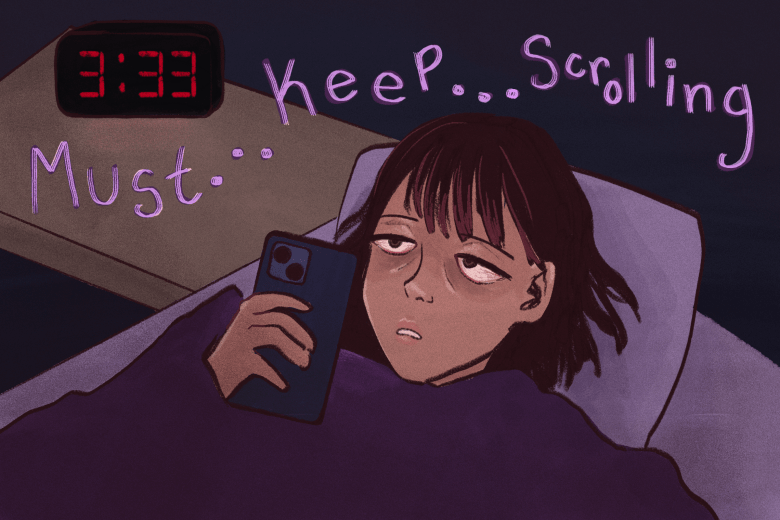
You probably scroll through social media every day without thinking about it at all. You send messages on WeChat, post stories on Instagram, scroll through TikTok, and like the photos of your friends before going to bed. These things have no “technical sense”, just like … life itself. Just chatting and hanging out.
More importantly, it feels private.
Social media packages itself as a warm extension of your daily life: a space where you decide what to share, who to talk to and how much exposure you want.
But that’s the problem.
That sense of comfort is exactly what makes social media so persuasive. It will not introduce itself and say “I am a surveillance system”, but will appear as a friend. It doesn’t look like a data harvester, but more like entertainment, convenience, self-expression and, of course, funny cat videos that you can’t stop watching.
Therefore, the privacy issue on social media is so difficult to understand. When most people open these platforms, they don’t think, “Okay, now I’m going to hand over my private data to a large enterprise”. They just walked into a familiar, social and even reassuring space.
So the core point of this article is that social media sells you an illusion of privacy, not real privacy.
Users really think they have the initiative. You can choose the audience, edit the home page and delete old posts. It feels like managing your own business, doesn’t it? But take a closer look. The platform is still making rules, controlling infrastructure, and controlling how your data flows behind the scenes. Even if users know that there are risks, they will continue to send content, brush the platform and share information. Researchers call this phenomenon The Privacy Paradox (Chen & Cheung, 2018).
If we continue to investigate more deeply into how these platforms work and why they are so widely used, we can discover that the problem of privacy on social networking sites is not merely an individual choice matter, but it is also shaped by how platforms are designed.
Why Does Social Media Feel So Private?
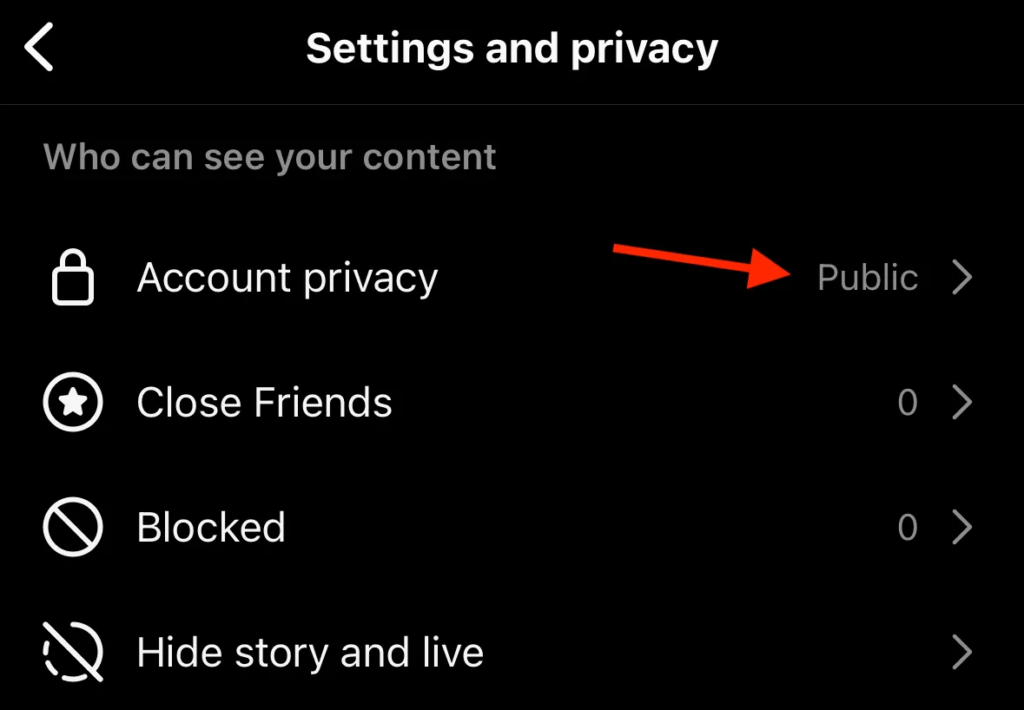
Image source: https://www.aura.com/learn/social-media-privacy-settings
One extremely significant factor is because the interface of the platform itself has been created this way. The homepage, personal messages, follower lists, friends-only settings, temporary features like disappearing stories, and blackout mode all contribute to making individuals feel very much in control, as though this virtual world belongs to “me”.
Therefore, when you can decide who can read your content, it is easy to further feel that even the information behind the content is under your control. But this feeling is actually only superficial.
What users can really manage is more just the “outer layer” of the platform. You can set the visible range, delete content and turn off comments, but the backstage of the platform will continue to record your behavior, such as how long you watched, how to scroll, who you interacted with, what you searched, what equipment you used, your location, and your social relationship.
That’s why privacy is not just “who can see what I send”. More importantly, who is collecting your data, who is analyzing, saving, inferring, and then continuing to use it. Many platforms make you feel private here, and at the same time extract data efficiently, which is actually very common.
Nicolas Suzor(2019) pointed out that the platform will deliberately make users feel that these spaces are “their own”, but in fact, they are still controlled by the company’s rules and commercial interests. Words like “my home page”, “my account” and “my fans” do enhance the sense of ownership, but this feeling does not mean that you really have the ability to decide how the platform works.
What’s Really Happening Behind the Interface?
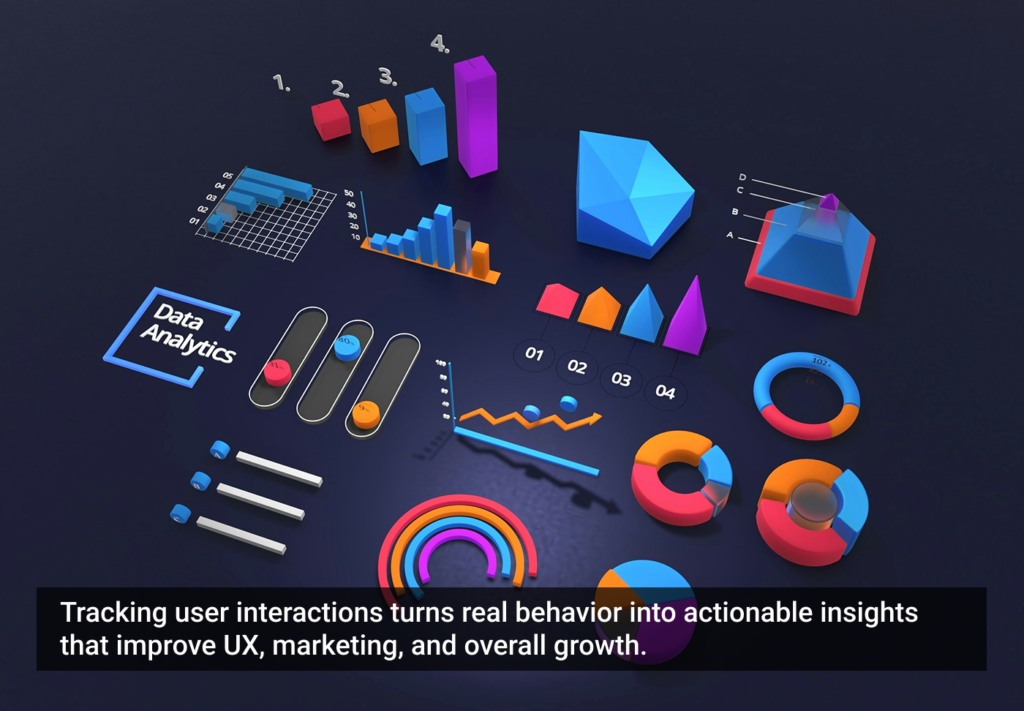
Image source: https://uxmag.medium.com/the-power-of-interaction-data-tracking-user-behavior-in-modern-web-apps-15149ca6d464
As long as you see through the beautiful interface on the surface of the platform, its real operation mode is very clear. You are not entering a truly open public space, but a place controlled by private individuals. Rules are determined, interpreted and implemented by the platform, and can be modified at any time. In reality, users have very limited choices: accept the terms or stop using the platform.
Suzor(2019) also directly illustrates this point: the platform is not a public forum in the traditional sense. Legally and structurally, it is more like the space of enterprise management. This means that users are not citizens with stable rights, but more like consumers, who can only accept a contract that they have neither written nor changed.
This contract is usually hidden in the Terms of Service and privacy policy, and most people will not read it completely at all. Even after reading it, the problem is still there. The key is not whether you understand it or not, but that you have no right to negotiate terms at all. You can’t say to the platform, “I want to use this, but only accept different data rules.” As long as you use it, it means accepting it all.
Moreover, the platform does not only carry your communication content, but also continuously turn these exchanges into data. Flew and Martin(2022) pointed out that data is the core of platform governance and business operation. Whether it is content recommendation, accurate advertising or content review, it depends on a lot of collection and analysis of user behavior. The platform not only wants you to speak, but also wants you to continuously produce behaviors that can be recorded and calculated.
Therefore, social media companies never only care about what you send, but also how you act. What will stop you? What will you forward? Can it predict your next step? From this perspective, the privacy issue is not just “who can see my post”, but “What can the platform learn from me and what can it do”.
A real-world example: The Cambridge Analytica Scandal
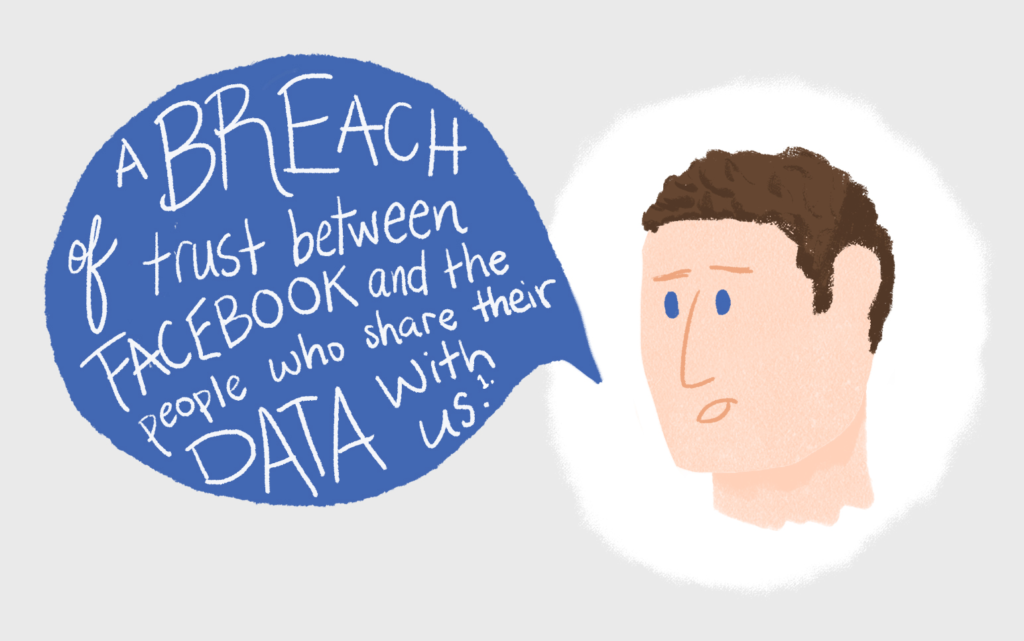
Image source: https://overthinkgroup.com/facebook-cambridge-analytica/
Cambridge Analytica scandal is a typical example if you want to see clearly what users think the platform is doing and what the platform is actually doing.
In 2018, it was reported that the data of tens of millions of Facebook users were collected through a third-party personality test application, and then handed over to Cambridge Analytica, a political consulting company, for political advertising and voter portrait analysis (The Guardian, 2018). The number of people affected is about 87 million.
There are three most noteworthy points in this matter. First, the “consent” on the platform is often just a process. Although some users agree when using the application, it doesn’t mean that they really know what happened. Most people don’t know the scope of data collection, and they don’t know that third parties will participate, and they don’t think that these data will be used for political purposes in the end. Therefore, this kind of “agreement” is more like being forced to check a box than really having the right to choose.
Additionally, this incident shows that social media privacy is not just a personal matter. This app not only takes users’ own data, but also their Facebook friends’ data. In other words, one person’s operation may expose other people’s information together. This shows that privacy is not completely controlled by yourself, and the social network you are in will also affect your privacy.
Third, once the data is handed over to the platform, it often doesn’t just stay in the original scene. You may just want to share content in a social environment, but the platform may transfer this information to commercial, political or data analysis purposes. Users usually think that their information will only stay in the original context, but the reality is that the platform often takes the data to other places for repeated use.
Hence, the issue of the Cambridge Analytica scandal does not merely consist of an individual breach; rather, it highlights a much broader issue within the platform, namely that the platform itself enables the transferability and reuse of information on a massive level. Similarly, later issues related to the TikTok app have surfaced.
The Privacy Paradox: Why Don’t We Just Leave?

Image source: https://www.hrsolidarity.org/the-struggle-is-real-overcoming-digital-dopamine-addiction/
Having said that, many people will ask a question:
Since everyone knows that social media has privacy risks, why can’t we live without it?
This is the so-called privacy paradox. People will verbally say that they care about privacy, but in practice, they will continue to provide personal information and stay on those platforms that continuously collect and use data (Chen & Cheung, 2018).
It does not have to be so that users are always inconsistent. The better explanation would be that such a platform has been integrated into their lives for a long time. Studies done by Chen and Cheung (2018) on WeChat could support this view. While privacy concerns would surely bother the users, they cannot simply stop using WeChat because, in addition to its messaging functions, the app offers payment services, working conversations, and general socializing. Quitting WeChat would cost much more than uninstalling an application.
To understand this gap, we need to look at why people continue using these platforms. Firstly, it is social dependency. Once becoming a routine way to connect with each other, abandoning the platform also means cutting off contacts within the circle. Secondly, the understanding of profits and risks is unequal. The feeling of liking, news, entertainment, and company is immediate, but the damage to one’s data is usually delayed, distant, and hard to discover at first sight. In addition, the choice itself is also limited. No matter what one might think of personal privacy and data protection, it is found that major platforms on the market don’t differ much in terms of data processing rules. Last but not least, the strength of habit cannot be ignored. The recommendation algorithm, automatic play, pull-down, and push of personalized content was originally meant to prolong the user experience. It’s a vicious cycle, with more usage generating more data and thus making the platform better know how to retain users.
It’s Not Just You, It’s the System
It is actually unreasonable to push all social media privacy issues to users. Many people will say that users can change their settings, send less sensitive content and give less permissions to the App. Yes, these practices are of course useful, but their effects are actually limited. Because as long as the platform itself operates according to the logic of “collecting data by default”, no matter how careful individuals are, it is difficult to fundamentally change anything.
The real issue lies in how platforms are designed. Since the platform depends on the activity of its users and their constant data production, it is bound to drive them toward “being online all the time, interacting all the time, and exposed all the time.” Privacy risks are therefore not merely individual mistakes but elements of the entire design process.
In this context, Flew and Martin (2022) emphasized that platform governance relates to the broader economic and political system. While governance cannot be limited to deleting certain material, it also concerns visibility, processing of data, and the ultimate distribution of power. This is because the platform will always know more about you than you do about the platform. It means that information asymmetry can be seen as power asymmetry.
What Does This Mean for Privacy?
Most people will be aware that social media expression is “your own site,” since you have the freedom to choose what you post and represent. However, your ability to do so is very much limited to only surface-level information. This is because it will always be the platform that chooses how the data is gathered and distributed.
This can clearly be seen in the case of the Cambridge Analytica scandal. In this incident, it is evident that the data that you initially provided for a particular scene could be moved to another scene by the platform and used to conduct activities that you were not anticipating. Similar issues have been reported in the study on the privacy paradox in WeChat. Studies have shown that despite knowing that the platform poses certain risks, users will still utilize it due to their extensive integration into their everyday lives.
Thus, the issue becomes whether users know about their privacy awareness or whether the platform itself operates on certain logics. In case the basic logic of operations within the platform involves constant extraction and exploitation of data, then it will be hard to create any kind of privacy within such a system. Thus, the concept of digital privacy should not only include whether individuals use the platform with their privacy in mind but also platform governance itself. What really matters is this: what is true control, informed participation, and actual online privacy. In the end, the crucial aspect here is not whether social media looks like it is private but whether it was created for the purpose of being private.
Reference List
Chen, H., & Cheung, A. S. Y. (2018). The privacy paradox in the digital era: The case of WeChat. Journal of Information, Communication and Ethics in Society, 16(3), 262–277. https://doi.org/10.1108/JICES-01-2018-0001
Flew, T., & Martin, F. (2022). Digital platforms, regulation and governance. Polity Press.
Suzor, N. (2019). Lawless: The secret rules that govern our digital lives. Cambridge University Press.
The Guardian. (2018, March 17). Revealed: 50 million Facebook profiles harvested for Cambridge Analytica in major data breach. https://www.theguardian.com/news/2018/mar/17/cambridge-analytica-facebook-influence-us-election
Be the first to comment