ARIN6902: Digital Policy and Governance
By Yutong Zhang, 18 Apr 2026
Social media platforms usually describe content review as a universally applicable technical solution. But when online harm depends on local language, politics and history, global rules allow the most vulnerable groups to bear the consequences.
In April 2025, a Kenyan court ruled that Meta may be sued in Kenya for posting on Facebook related to ethnic violence in Ethiopia. This case is important because it highlights the widespread problem of a platform: once harmful content is spread on the Internet, its harm will not be limited to cyberspace. According to the case’s report, the plaintiff claimed that Facebook’s system amplified hatred and violence during the Tigray conflict and caused harm in the real world, including the murder of the plaintiff’s father after being threatened on Facebook.
This is not just about a platform or a region, it points to a more ambitious digital policy and governance issue. As Australian media and communication scholar Terry Flew said, the largest digital platforms are increasingly functioning as public infrastructure, but they are still private companies in nature, so the term “neutral host” is increasingly difficult to establish. Once the platform becomes the core communication space, their moderation decision-making is no longer just a small technical choice, but a public decision about visibility, participation and protection.
When Online Harm is Local But Moderation is Global
Many people often see content moderation as a simple process: identifying harmful posts, deleting them, and then making the platform more secure. But in reality, harmful speech is hard to identify. A phrase, an image, a joke or accusation may be common to external observers, but in a specific place, conflict or cultural context, it may be obviously threatening.
According to the Asia-Pacific Facebook hate speech report by Aim Sinpeng, Fiona Martin, Katharine Gelber and Kirby Shields. According to the report, the language- and context-dependent characteristics of hate speech are not effectively captured by Facebook’s classifiers, global Community Standards or editorial policies. According to the report, to truly identify hate speech, we must rely on local knowledge and consulation with target groups to understand the harm they suffer.
Platforms often promise consistency, but when the same set of rules is applied to cultural and political environments with great differences, consistency may become a weakness. What constitutes dangerous speech cannot always be seen at the level of keywords alone. Harm may be encoded, indirect, historically burdened, or closely related to a conflict that external observers can hardly really understand.
Fink pointed out that by 2018, Facebook has been deeply integrated into the daily communication of Myanmar people, so that “Facebook is the internet for most people in Myanmar.” In this environment, Facebook is more than just one of many websites, but a core communication infrastructure. This makes the spread of harmful speech faster, wider and more difficult to contain.
She stressed that Facebook needs local experts to judge the context and identify those influential people who make dangerous remarks, instead of relying mainly on artificial intelligence to search for keywords. This is highly consistent with the views of Sinpeng and others: content review is not only about the rules, but also about whether these rules can really interpret the local environment.
When One Case Points to a Bigger Problem

Cases related to Ethiopia and Kenya show this broader problem in a recent and concrete way. According to the lawsuit report, the plaintiff believes that Facebook not only failed to delete harmful content, but also its system also contributed to the spread of hateful and violent content during the Tigray conflict. This shifts the problem from simple hosting to platform responsibility. The key question is no longer just what content users post, but how the platform helps to spread, what content is recommended and which content is still visible.
This is crucial because the global platform does not operate in a neutral environment. In some places, a post may be just an inflammatory speech with limited impact; in other places, it may further exacerbate already highly tense conflicts and exacerbate fear, exclusion and even violence. The willingness of the Kenyan court to accept this case is of great significance because it admits that even transnational platforms may be directly related to highly localized hazards.
In this sense, the Ethiopian case is not an exception to the common problems of the platform, but only a typical example that highlights the larger governance problem. When the global content review system cannot understand the local conflict, the consequences may be far beyond the screen.
Why this Harm is More than “Offense”
A common misunderstanding in public discussion is to simply understand harmful speech as “offending” others. The research of Katharine Gelber and Luke McNamara put forward the opposite view, pointing out that the hate speech law is not only designed to respond to the feelings of an individual being insulted, but also to focus on broader marginalisation, discrimination and social harm. The harms they specifically mentioned include psychological distress, emotional symptoms, restricted freedom of movement and association, and impaired self-esteem.
This is especially important for digital platforms, because online harm tends to accumulate. A hate speech may be underestimated as rude or offensive, but continuous exposure to stigmatising, threatening or exclusional speech may gradually squeeze people out of the online world. Harmful content will make the platform unsafe and hostile and even make it impossible for people to continue to use it with peace of mind. It will also normalise extreme hostility and make discrimination seem commonplace.
Sinpeng and others also put forward similar views. They pointed out that the reason why hate speech needs to be dealt with by policies is precisely because the harm it causes is not only abstract but also feels “like receiving a slap in the face,” and even threatens personal safety and life. Therefore, the real question is not only whether the platform allows uncomfortable speech, but also whether its governance system will accumulate damage under the protection of narrow definitions.
When Reporting System Fail the People they are Supposed to Protect
When responding to criticism, the platform often emphasises its own reporting tools: users can report harmful content. This seems reasonable; but in fact, this logic often shirks too much responsibility on those who have been hurt.
The Facebook report in the Asia-Pacific region is particularly convincing in this regard. The report found that all the LGBTQ+ page administrators interviewed had encountered hate speech, and many of them were actually serving as volunteer moderators. More importantly, all the respondents said that Facebook failed to delete some of the content they reported. The report calls this situation “reporting fatigue” – that is to say, users are increasingly reluctant to continue reporting abuse due to slow or ineffective responses.
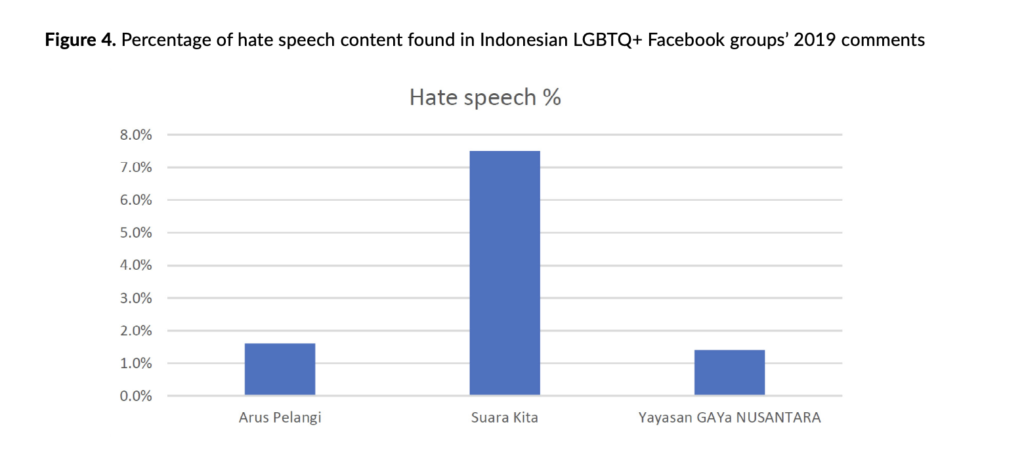
Source: Sinpeng, A., Martin, F., Gelber, K., & Shields, K. (2021). Facebook: Regulating hate speech in the Asia Pacific, Figure 4.
Gelber and McNamara’s research further explains why this constitutes a serious governance defect. In a study of Australia’s civil hate speech law, the author found that although a complaint-based system can provide some remedies, it will also impose a heavy enforcement burden on the target group. This view also applies to the platform: if the system mainly relies on user complaints, it is easy to shift the responsibility from the platform itself to the most affected people.
This is one of the key reasons why content review often fails in practice. Even if the platform claims to have rules and processes, these systems may make those who need protection the most feel tired, neglected, and continue to be under additional mental stress.
Why this is a Governance Problem, not just a Moderation Problem
Now, this problem is no longer just a moderation failure, but more like a governance problem. The platform will not only delete the content, but also decide which content is more prominent, which content will be amplified and disseminated, how to deal with complaints, and which harms will continue to be covered up. These are governance functions, even if they are carried out by private companies rather than the government.
Flew’s framework is particularly important at this moment. He believes that problems such as hate speech and online abuse are not isolated scandals, but major issues related to the public concern, revealing the core contradiction of the platform era that large platforms have a status similar to public power, but still mainly rely on self-regulation. Flew also further pointed out that the discussion on platform content is increasingly focusing on who supervises, how to define the boundary between harmful content and illegal content, and how to combine self-regulation, multi-party participation in governance and state regulation.
That’s why the statement “neutrality” is so misleading. Moderation is not a neutral service process, but a series of decisions on values, priorities and acceptable risks. If platforms regard hateful or dangerous remarks as just a content detection issue, they are likely to ignore the broader inequality system and local history that affect the user’s harm experience.
In the systematic review of Matamoros-Fernández and Farkas, we can also see similar reminders. They pointed out that research and policy discussions often simplify racism on social media into a narrow problem of hate speech detection, while ignoring how user behaviour and platform politics jointly shape contemporary racism. They also pointed out that if it can bring user participation, the platform is often too tolerant of racist content disguised as humour. This observation is closely related to this blog, because it once again shows that platform design and platform governance are part of the problem itself, not just the background of the problem.
What should change?
If the failure of the global audit system is that they cannot understand the context, then better moderation does not only mean a higher degree of automation or faster audit speed, but must include deeper local expertise.
According to the research of Sinpeng and others, the platform needs more expertise in local policies, strengthen communication with minorities, provide more support for page administrators, and better understand the specific situation of hate speech in the local area. Fink also made a similar suggestion in the study in Myanmar that Facebook must recruit and maintain contact with local experts, not just rely on technical testing.
The platform also needs to stop treating user reports as the main solution. Reporting tools are necessary, but they should not be a means to transfer the responsibility to the user, especially when the user bears the greatest risk. Rather than just requiring users to continue reporting content, a more transparent complaint mechanism, clearer feedback and stronger proactive support for high-risk communities will be more meaningful.
Finally, the evaluation criteria of the moderation system should not be limited to speed or efficiency, but also to whether it truly protects vulnerable groups. If a platform can quickly review a large amount of content, but still cannot identify the context, relies too much on user reports, and continues to allow harmful content in conflict areas or target communities, then the system cannot be considered effective enough.
Conclusion

The problem of global content moderation is not only that the platform will miss some bad posts, but also that harmful speech itself has social, political and contextual characteristics, and the system used to manage harmful speech is often universal, non-transparent, and distanced from the most affected groups.
The Kenya/Ethiopian case reveals this problem in the latest legal form. Fink’s analysis of Myanmar shows how dangerous speech is normalised when the platform becomes the core communication infrastructure. Research by Sinpeng et al. shows that context, local knowledge and consultation with the target group are crucial. Gelber and McNamara remind us that harm is real, and the coping mechanism often puts a burden on the victim. Combining this information, one thing is very clear that to repair online harm, it is far from enough to delete the content; the more fundamental problem is that we need to reconsider how the platform manages speech – the experience of speech is carefully designed – and in a digital space that is more like public infrastructure, the accountability mechanism should What is it like?
References:
Amnesty International. (2025, April 3). Kenya high court has ruled that it has jurisdiction over case against Meta. https://www.amnesty.org/en/latest/news/2025/04/kenya-high-court-has-ruled-that-it-has-jusridiction-over-case-against-meta/
Clarifai. (n.d.). Meeting the challenge of global content moderation. https://www.clarifai.com/blog/meeting-the-challenge-of-global-content-moderation
DW News. (2023, February 11). Meta faces law suits in Kenya over working conditions, hate content [Video]. YouTube.
Fink, C. (2018). Dangerous speech, anti-Muslim violence, and Facebook in Myanmar. Journal of International Affairs, 71(1.5), 43–52.
Flew, T. (2021). Regulating platforms. Polity Press.
Gelber, K., & McNamara, L. (2015). The effects of civil hate speech laws: Lessons from Australia. Law & Society Review, 49(3), 631–664.
Matamoros-Fernández, A., & Farkas, J. (2021). Racism, hate speech, and social media: A systematic review and critique. Television & New Media, 22(2), 205–224. https://doi.org/10.1177/1527476420982230
Reuters. (2025, April 4). Meta can be sued in Kenya over posts related to Ethiopia violence, court rules.
Sinpeng, A., Martin, F., Gelber, K., & Shields, K. (2021). Facebook: Regulating hate speech in the Asia Pacific. University of Sydney and University of Queensland.
Social Media Victims Law Center. (n.d.). Cyberbullying on social media. https://socialmediavictims.org/cyberbullying/
The Bureau of Investigative Journalism. (2022, December 14). Meta sued for $2bn over Ethiopia hate speech revealed by Bureau. https://www.thebureauinvestigates.com/stories/2022-12-14/meta-sued-for-2bn-over-ethiopia-hate-speech-revealed-by-bureau
Be the first to comment