Will AI replace human jobs? It is a classic question we have been discussed when AI first moves into the public eye. A YouTube podcast interview with Dr. Roman Yampolskiy hosted by The Diary of A CEO (2025) gave us the answer:
First, anything on a computer will be automated. And next, I think humanoid robots are maybe five years behind. So in five years, all the physical labor can also be automated. So we’re looking at a world where we have levels of unemployment we’ve never seen before. Not talking about 10% unemployment, which is scary, but 99%.
…
So we may have a lot more time with jobs and with world which looks like this, but capability to replace most humans in most occupations will come very quickly. (10:40-11:37)
Dr. Roman Yampolskiy has been exploring AI safety issue since 2010 and holds a PhD in Computer Science and Engineering (The Diary Of A CEO, 2025). Put simply, he was already an AI expert long before AI entered public consciousness. When you see the title of the podcast interview, do you feel eager to find out which 5 jobs can survive? Do you wonder if your job falls into these 5 categories? In this blog, I won’t tell you if your job is at risk of being replaced, nor will I discuss Dr. Roman Yampolskiy’s statement about mass unemployment. Instead, I am going to break down the core of this issue. AI is shattering the myth that human jobs (especially jobs require abstract skills like creativity) are safe from automation. In AI era, human cannot rely solely on specialized skills without independent judgement and personal agency. By using Google Stitch, a design-focused AI platform, as a case study, this blog argues the true threat behind AI-driven job displacement is that AI is gradually eliminating the privilege created by skill-based barriers and we must adapt to how AI is reshaping our work.
The Past Safe Zone Is Over. What Is Skill-based Barriers?
We used to believe that one kind of job will not be replaced by AI, which is content creator. Content creator included any specialized occupations that includes the process of producing different forms of contents (Koe, 2025) such as visual designers, videographers, and advertising copywriter. These works shared some common features, and these features are the reasons why we think they will not be replaced by AI.
- They have practical skill-based barrier. Skill-based barrier is created when you become a specialist of the skills in your field. Imagine that you want to become a visual designer, the possible pathway could be you choose a design-related major in college. While learning the design principles and knowledge, you are also enhancing your proficiency in drawing, sketching, and the use of design software (e.g. Adobe Creative Suite).
- These jobs strongly require creativity as the main abstract skill needed. As a visual designer, can you turn imagination into reality? Can you produce original design? Can your design solve real problems? Can you find new inspiration from existing work? Can you keep creating consistently? All your answers to these questions reflect your abilities that fall under the umbrella of creativity. In Wang et al. (2026)’s experiment comparing the creativity ability between human and LLMs (Large Language Models), human shows a general higher level of creativity than LLMs. They can “generate more varied responses” (Wang et al., 2026, p.532) and reflect “unique value of human creativity” (Wang et al., 2026, p.532).
- To truly master your trade, genuine experience is essential. Visual designers must practice consistently and accumulate years of experience to produce high-quality design work and create skill-based privilege.
Content creators rely on their skills and experience to build a safe zone in their working field. However, AI tool like Google Stitch now easily replicates their skills, making human expertise less distinctive and secure.
The Paradigm Shift in Design: A Case Study About Google Stitch
The emergence of Google Stitch represents a significant paradigm shift in UI and UX design. Google Stitch is an online AI platform launched by Google Labs in 2025 (Mitkov, 2026). Google Stitch can generate high-fidelity design outputs like software interfaces, user interfaces and website layouts from descriptive and conversational prompts (Mitkov, 2026). It also supports functional code converting and exporting.
AI platforms like Google Stitch also lower the barriers for non-professionals to entry certain industry. People who are not trained professionals in design can also produce high-quality design contents by using Stitch. Take me as an example, I can’t draw or sketch well and don’t know how to use specific design software. If I want to have a personal blog website, I might not need to hire a website designer. I can simply use Google Stitch to generate the website design as shown in Figure 1 below.
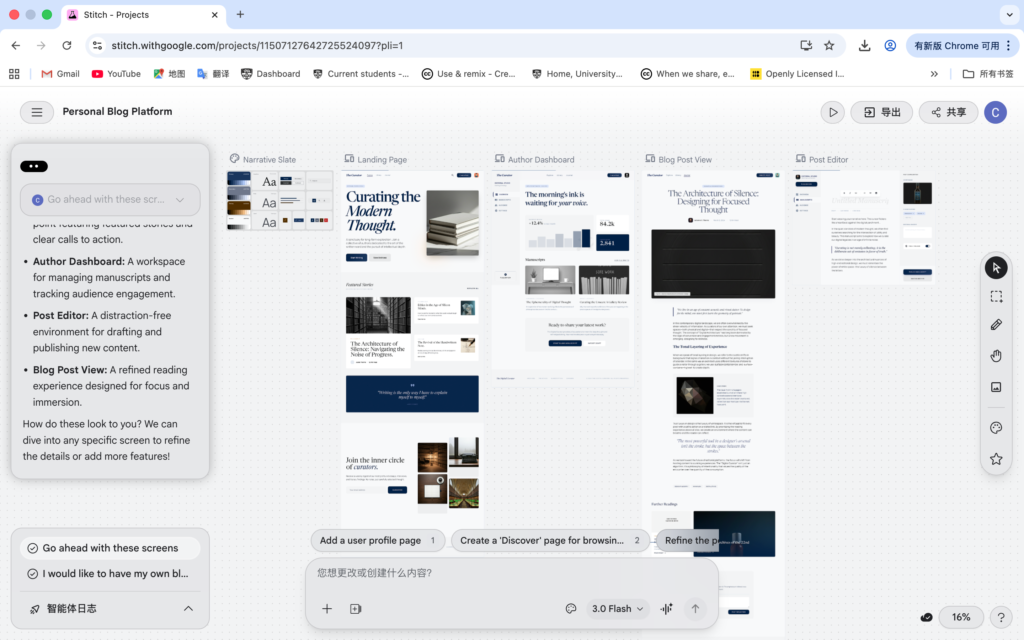
Note. Photo from blogger herself using Stitch to generate a personal blog website.
Google Stitch clearly demonstrates its ability and efficiency to replicate human design skills. As soon as we write the prompt, it instantly generates the design outcome that matches our requirement. This process of design can take several days or even longer depend on the complexity of design work before Stitch launched.
However, the case of Google Stitch reveals a hidden truth about AI’s intelligence. Crawford (2021) claims that “AI is neither artificial nor intelligent” (p.8). Isn’t AI the abbreviation of Artificial Intelligence? I will analyze Crawford’s argument in one conceptual word, which is originality. There are two meanings of originality here.
- AI builds models by training from massive amount of data. AI is “both embodied and material, made from natural resources, fuel, human labor, infrastructures, logistics, histories, and classifications” (Crawford, 2021, p.8). Everything it knows is the results of human knowledge and learning experience in different fields. AI never creates something on its own. It only generates, rearranges, and imitates things it learned from human. Like Google Stitch, the design templates, layouts, style, and narrative slates it produced are based on the vast collection of work from human designers. Its intelligence is derived from human, not itself. AI is not the original content creator.
- The answers provided by AI are grounded in your prompt. We often overlook one thing that if you don’t ask AI a question or specify your requirements, AI will not generate contents. The process you ask Google Stitch to produce output is start from your prompt that express your thoughts on specific design. For example, you might think the classic 5W1H questions before you enter prompt in Google Stitch.
- Who- Who is your target audience?
- What- What kind of design I plan to do?
- Where- What scenario is this design intended for?
- When- When does the design need to be completed?
- Why- What is the purpose of the design?
- How- How does the design solve certain problem?
Once you have thought through these questions, you summarize them into a prompt. Google Stitch does not become a real designer. It simply helps you bring your creative vision and your thoughts to life. AI meets the baseline standard of creativity discussed in Wang et al.’s (2026) research but it fails to demonstrate “emotions and lived experience” (Wang et al., 2026, p.532) because AI does not have “reflexive sense” (Andrejevic, 2020, p.65) to make personal judgement and produce content with human emotion. The quality of your prompt determines the quality of the AI output, and you need to edit, polish, and refine the output to further improve its quality. A prompt reflects your understanding of design, your interpretation of inspiration, your mastery of design principles and elements and your personal aesthetic sensibility. In a real-world workplace, if you can only present others’ design proposal (others’ prompt), you cannot write your own, and don’t know how to infuse your work with emotion and narrative value, you are not a real content creator and you are working in a way like AI because you can only execute prompts. You will be replaced by AI since AI is more capable and efficient than you in executing prompts. And the companies don’t have to pay AI a monthly salary. Some AI tool probably only need a subscription fee to unlock its premium version. The use of AI reflects a truth that human jobs involve low autonomy, repetitive routine tasks, and single skill required only are likely to be replaced by AI.
What Are the Things We Really Need to Learn in AI Era?
The new generation has grown up as digital natives in the age of AI. Learning how to use AI will become a fundamental skill. There is a common misconception about learning AI, that we must learn how to use at least the most popular AI tools. Popular AI tools are constantly emerging. There are too many to master and we cannot keep up with the rapid update. Moreover, no matter what AI tools you use, the content it generates still depends on the prompts you provided. Therefore, the best way to protect your job is to find irreplaceable core skills and value.
Koe (2025) produces a great blog post discussing the skills and abilities people required in their future career.Koe (2025) argues that the only core competency that cannot be replaced by AI is personal agency. I will break Koe’s argument down further in more comprehensible way.
Agency refers to “Not only action, but an undying commitment to iteration” (Koe, 2025). It includes several aspects:
- You are really taking actions. Our brain mechanism doesn’t naturally cord with agency. It is important to not think in the way of perfectionism like finish one task in completely 100%. You might overthink and procrastinate during the process you try to finish the task because you feel pressure due to perfectionism. But it actually more important to accumulate each 1%.All your failure experiences can become part of your life experiment (Koe, 2025). It is important to make mistakes and accumulate experiences and always try again.
- You can set your own life goal and future pathway. As I have discussed before, AI is not content creator because it doesn’t have any original ideas produced. Koe (2025) provides an advanced explanation that we need to become both a content creator and “context creator”. We set themes for content. The contents will reflect personal characteristics. We also set vision and long-term goal before we start a new project. These are the contextual scenarios that AI cannot set for us.
- Become a generalist. Koe (2025) also emphasizes the importance of becoming a generalist in your career. It’s like when you order food sometimes, you don’t just want a burger, you want a meal deal that includes a burger, chicken nuggets, fries, and a Coke. The future jobs require human to provide meal deal, not only a burger. For example, as a visual designer, if you also have a strong understanding of marketing, branding, and visual storytelling, you are more likely to be outstanding with your project.
Takeaway For You
Finally, I would like to summarize some messages for all of you who cares about future career development.
- The trend is clearly toward becoming a generalist. Take the time to get to know yourself better. For example, you need to identify your strengths, assess which specific skills you currently possess and how you can combine the skill with other disciplines or fields.
- Treat AI as your employee. Use AI wisely to assist your work.
- Agency is the core ability. Human brains are not naturally equipped with agency. It must be developed through practice.
Reference List
Andrejevic, M. (2020). Automated Culture. In Automated Media (1st ed., pp. 44–72). Routledge. https://doi.org/10.4324/9780429242595-3
Crawford, K. (2021). The Atlas of AI: Power, Politics, and the Planetary Costs of Artificial Intelligence (1st ed.). New Haven: Yale University Press. https://doi.org/10.2307/j.ctv1ghv45t
Koe, D. (2025, November 12). The most important skill to learn in the next 10 years. Future/Proof. https://letters.thedankoe.com/p/the-most-important-skill-to-learn
Mitkov, E. (2026). Adobe Stock Drops After Google’s Stitch Redesign. In Benzinga Newswires. Accretive Capital LLC d/b/a Benzinga.
The Diary Of A CEO. (2025, September 4). The AI safety expert: These are the only 5 jobs that will remain in 2030! – Dr. Roman Yampolskiy [Video]. YouTube. https://www.youtube.com/watch?v=UclrVWafRAI
Wang, D., Huang, D., Shen, H., & Uzzi, B. (2026). A large-scale comparison of divergent creativity in humans and large language models. Nature Human Behaviour, 10(3), 531–540. https://doi.org/10.1038/s41562-025-02331-1


Be the first to comment