Atlassian’s layoffs have once again made Australian white-collar workers worried about their future in the age of AI. AI may improve efficiency, but it is also increasing the risk of unemployment.
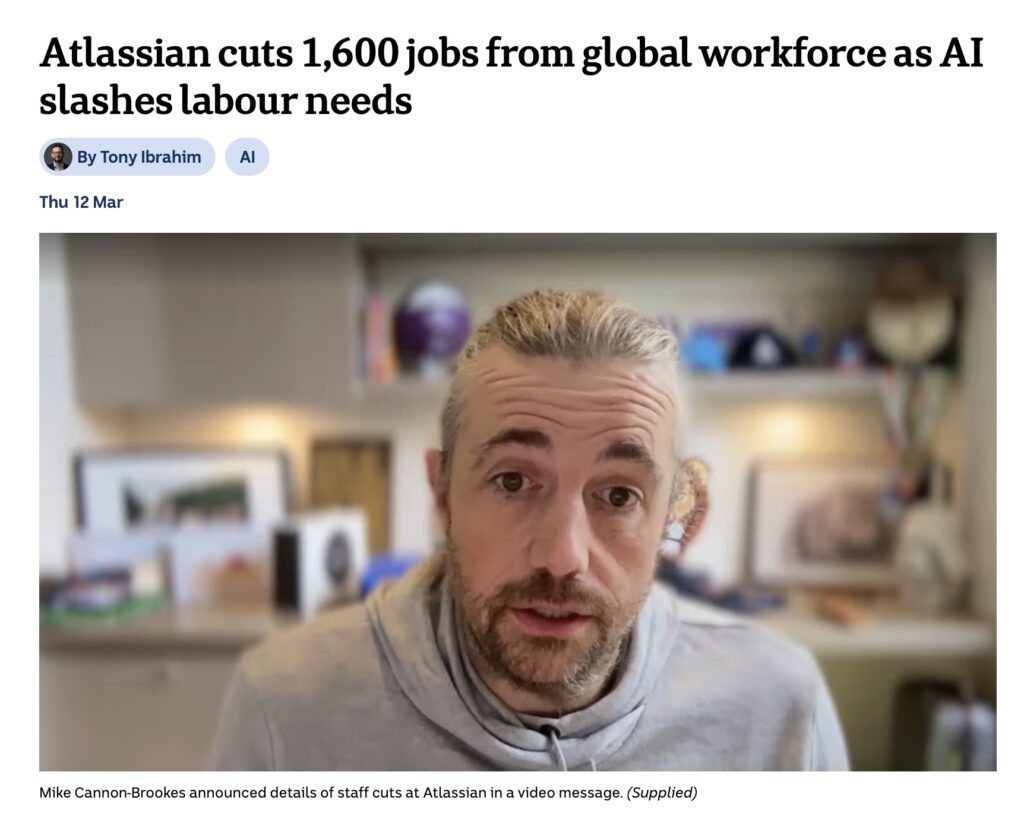
Source: ABC News. (2026, March 12).
AI is replacing our jobs
When was the last time you used the AI tool?
Have you ever used AI tools to assist in office work?
When more and more artificial intelligence enters the workplace, are you worried that you will be replaced?
According to ABC Australia, computer science students were anxious about their career futures after learning that technology giant Atlassian is cutting nearly 500 jobs from its Australian workforce as artificial intelligence reduces its labor needs.
“This is probably the worst time to get into the industry.”
“I’m kind of anxious about whether I can still find a job.”
A website has summarized the number of layoffs at major global companies so far in 2026:Amazon cut 30,000 employees,Microsoft cut 15,000,Dell cut 13,000…
Amazing numbers bring the cruel reality that we have to face.
It’s not a slow shift,it’s a wave.It’s not a future problem anymore.
You and I are both facing the possibility of being replaced by AI one day when we wake up.
Workers Should Not Be Victims of Technological Progress
“Four Tips on How to Avoid Being Replaced by AI”,
“Five Essential Skills for the AI Era: Do You Have the Ability to Survive?”
You must have seen articles or videos with such prominent titles on social media platforms.
When AI enters the workplace rapidly, there is almost only one standard answer given by society: “self-improvement, rapid transformation, don’t be replaced”.
It is the enterprises that take the efficiency that AI provided(Waltersmann et al., 2021),why should poor workers bear the costs of transformation?
The government should regard the unemployment as a public issue that requires serious attention and management, instead of shifting the burden onto individual workers.
Only when the efficiency and the cost are shared more equitably will we, as workers, avoid becoming the victims of technological progress.
Why Are There Still Optimistic Voices?
In this storm, we can still hear some optimistic voices.They believe that new technology will definitely give rise to new jobs(Wilson et al., 2017).
They argued that every time humanity has been pushed to the brink in the history, we would managed to rewrite the rules.
The Industrial Revolution shook the foundations of traditional handicrafts, leading to the emergence of labor unions; the Great Depression hit the global financial system, humanity rewrited the rules of banking.
How can intelligent humans stand idly by and watch the machine crush their livelihood this time?
Optimists firmly believe that what we are facing now is just a short transition period.
Unemployment will not last long, nor is it a problem that humanity cannot solve.
Take it Serious:It’s Not a Future Thing Anymore
But can this wave of layoffs pass smoothly and quickly like other transitional periods did in history?
After receiving a layoff email in early March, a former employee of BLOCK Company (referred to as KK) wrote on Xiaohongshu:”When the company decides that a region or a direction should not exist, personal performance is no longer important.”
His sense of powerlessness actually stems from”automated algorithmic selection”.
“Algorithmic governance is more evidence-based and data-driven than traditional governance.”(Just & Latzer, 2017, p. 245)
When companies analyze massive data with the help of algorithms and clearly distinguish between “efficient machines” and “inefficient humans,”the so-called “improvement in efficiency” becomes the most direct excuse for layoffs.
When the value of an individual is simplified into cold data, KK is not the only one to be screened out and eliminated.
What makes it even more tragic is that people like KK cannot even know the specific reasons for their layoff under the low-transparency governance of algorithms.
On the morning of March 12, Mike Cannon-Brookes, co-founder of Sydney-based tech firm Atlassian, released a video announcing the layoff of approximately 1,600 employees.
The job cuts account for around 10% of the homegrown software giant’s total workforce.
The company described the layoffs as a move to boost efficiency,
“Funds freed up by the workforce cuts will self-fund further investment in AI and enterprise sales.”
Dario Amodei, CEO of Anthropic, argued that white-collar jobs are disappearing faster than anyone anticipated. He noted that 50% of entry level white collar jobs will be disrupted in 5 years.(Amodei, 2026)
Atlassian’s layoffs are not an isolated event, but reflect a widespread wave of layoffs targeting white-collar workers in the labor market.
Workers have no way to be aware of the hidden algorithmic rules, the new jobs also fail to provide a meaningful bridge for the unemployed.
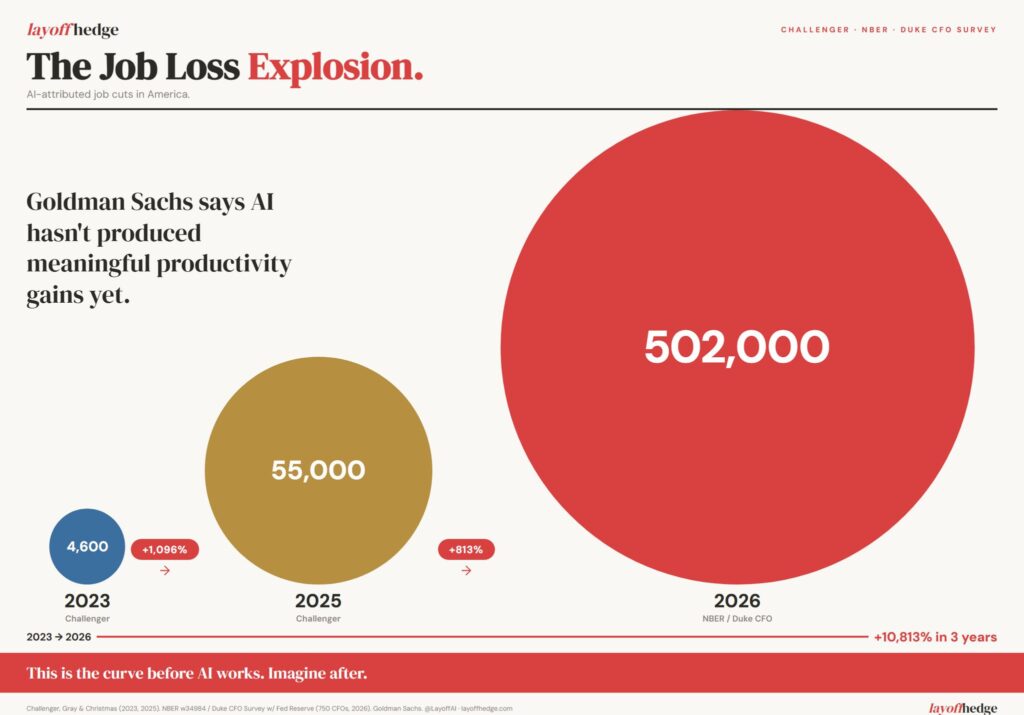
Source: Layoffhedge (2026), based on Challenger, Gray & Christmas; NBER/Duke CFO Survey; Goldman Sachs.
We cannot simply attribute the cause to “the rise of AI”,we should examine the issue from two perspectives:
Algorithm-driven decision-making makes the transparency decreased and there is a mismatch in the labor market regarding both the quality and timing of jobs.
When AI Becomes a Tool of Power, Where Is the Transparency?
“There is no singular black box to open, no secret to expose, but a multitude of interlaced systems of power.Complete transparency, then, is an impossible goal.”(Crawford, 2021, p. 12)
In that video,Mike Cannon-Brookes stated that the company would notify affected employees via email within 20 minutes. Let’s try to empathize with these tech professionals and imagine how anxious they were during the 20 minutes.When the time was up,all they received was a cold, impersonal email delivering their fate.
Why me? Why not someone else? What are the criteria for being let go?
There are no standard answers to these questions.
Even if there is an“answer” , ordinary people like you and me won’t have the right to see.
Layoffs are no longer a management decision that can be discussed and explained,they turn to be systematic and automatic.

Source: TIME (2025)
In the age of intelligence, AI is increasingly becoming a tool of power,“Algorithms are no longer viewed as mere code, they represent the authority of organizations in a variety of domains.”(Lustig et al., 2016, p. 1058)
When algorithms become an authority, even though you don’t get the layoff email this time, you can’t stop thinking when the next layoff will come, and when an unclear decision suddenly takes you by surprise.
This endless anxiety with no clear answer is exactly one of the difficulties for white-collar workers.
Can Workers Realistically Transition to New Jobs?
The second challenge facing white-collar workers lies in two mismatches in the labor market.
New job opportunities do exist, but not everyone is qualified for them, nor is everyone willing to do.
Mismatch in time
Jobs will first be replaced, but new jobs can not appear rapidly. It also takes time for individuals to find jobs again, learn new skills and adapt to new positions.
For people living in a fast-paced era, time is often the most expensive cost.
Each extra day of unemployment just adds more pressure.Car loans and daily basic expenses cannot be covered by Redundancy Pay for a long time.
Layoff compensation may be able to relieve the urgent need, but it is not a long-term plan.
There is a natural time mismatch between the immediacy of unemployment and the slow emergence of new jobs.
Claims like “emerging jobs will take in the unemployed steadily” are easily proven wrong.
At least in the short term, the former idea is more like a comfort than a practical, effective solution.
Mismatch in quality
Emerging positions are roughly divided into two categories: high-threshold jobs and “Faking AI” jobs.
High-threshold can be easily understood as a position that requires extremely high professional skills,such as trainers, explainers, and sustainers(Wilson et al., 2017, p. 14).These positions need to develop and optimize AI systems, and even solve complex core problems in the industry.
The ex-employees of Atlassian may have such ability ,since Atlassian is a tech company.
But can unemployed people in other industries also qualify for such high-threshold jobs?
Even if we ignore whether personal skills match job requirements well, just looking at labor supply and demand is enough to explain the problem.
“The chief designers of the contemporary atlas of AI are a small and homogenous group of people, based in a handful of cities, working in an industry that is currently the wealthiest in the world.”(Crawford, 2021, p. 13)
These high-end jobs are far too few to match the huge number of people losing their jobs.
Neither the numbers nor abilities can such highly skilled positions be a real solution for most unemployed white-collar workers.
Compared with high-threshold jobs, “faking AI”jobs seem much more accessible.
What is “faking AI”?
In The atlas of AI, the authors point out that some companies rely on workers to labor around the clock in order to sustain the illusion that the service was automated and functioning 24/7.(Crawford, 2021, p. 65)

Source: ABC News (2026). Image by Jarrod Fankhauser.
People often ignore these “faking AI” jobs, unlike the high-threshold one,but the fact is that the demand for this type of job is huge.
“One of the less recognized facts of artificial intelligence is how many underpaid workers are required to help build, maintain, and test AI systems.”(Crawford, 2021, p. 63)
The most relevant jobs to our daily lives are content moderators and human customer service.
They seem easy to get into, but these jobs are exhausting and usually very poorly paid.(Crawford, 2021,pp.63,65)
It is not “technological progress brings better works”, but a real labor exploitation.
Even though you manage to get one of these highly repetitive and low-skilled jobs, how can you be sure you won’t be replaced again?
No one wants to experience layoffs over and over.
Enterprises and Governments: Act Now
It is true that AI helps enterprises to improve efficiency and reduce labor costs, but the pain of the white-collar workers is equally real.
What we need is not tiktok videos teaching us how to improve ourselves,but real action from governments and enterprises to address the unemployment crisis.
While Jon Elster(1993)has written in his book Local Justice, there is no perfectly fair way to allocate opportunities,it can’t be the reason for enterprises and governments to shirk their responsibilities.
Both of them are obligated to take action as soon as possible to promote the fair sharing of responsibilities.
Enterprises
Kate Crawford pointed out that behind the huge demand for minerals and energy in the technology industry, the real cost is often not borne by the industry itself.(Crawford, 2021, p. 15)
The “cost externalization” does not only occur in mining areas.
When enterprises use AI to improve efficiency, the cost of transformation, such as unemployment gaps, retraining time and costs and the risk of finding new jobs, are implicitly shifted to workers.
But they should at least bear part of the cost for transformation.
It would be great if they provide paid training plans to fill any gaps in their skill sets so as to qualify them for job openings in growing occupations(OECD, 2016, p. 29).
For instance, allocate 4–8 hours of fixed “learning time” per employee per week and count it as working hours.Ensuring there is no salary reduction during the learning period, and provide employees with a training bonus as much as possible. This avoids turning well-intentioned training into invisible overtime.
If layoffs have become a reality, compensation should not be limited to the minimum level.
Enterprises should provide more realistic transition funds to cover the basic life of the gap period.
Government
But all these promising visions for companies’ new systems cannot be achieved without government support.
Without such policy, profit-driven enterprises will inevitably, as they do now, use excuses like “funding shortages” and shirk their relevant responsibilities.
The government’s supervision has long focused on the legality of data collection and personal privacy protection. But it is also important and increasingly urgent to turn part of the attention of governance to the labor market impacted by AI.
On a broader scale, it affects the quality of the nation’s future economic growth.Because when income becomes unstable, consumption, loans and national taxes will be shaken.
Citrini Research and Shah (2026) proposed an entirely new concept called “ghost GDP” in their report The 2028 Global Intelligence Crisis, defining it as “output that shows up in the national accounts but never circulates through the real economy.”
In simple terms, people with jobs and salaries consume, take out loans, and drive real GDP growth—but AI does not.
Even purely for the sake of macroeconomic development, it is time for governments to take action.
For large enterprises, the government can require them to issue a transparency report on the use of AI and how algorithm works.
When it comes to major decisions such as performance and dismissal, enterprises should form and explain.(Baiocco et al., 2022)
Use policies to enforce algorithmic governance transparency, so employees can understand the process clearly,instead of just waiting for a layoff notice via email ,as those poor Atlassian workers did.
Government can also appropriately raise the minimum level of statutory redundancy pay.
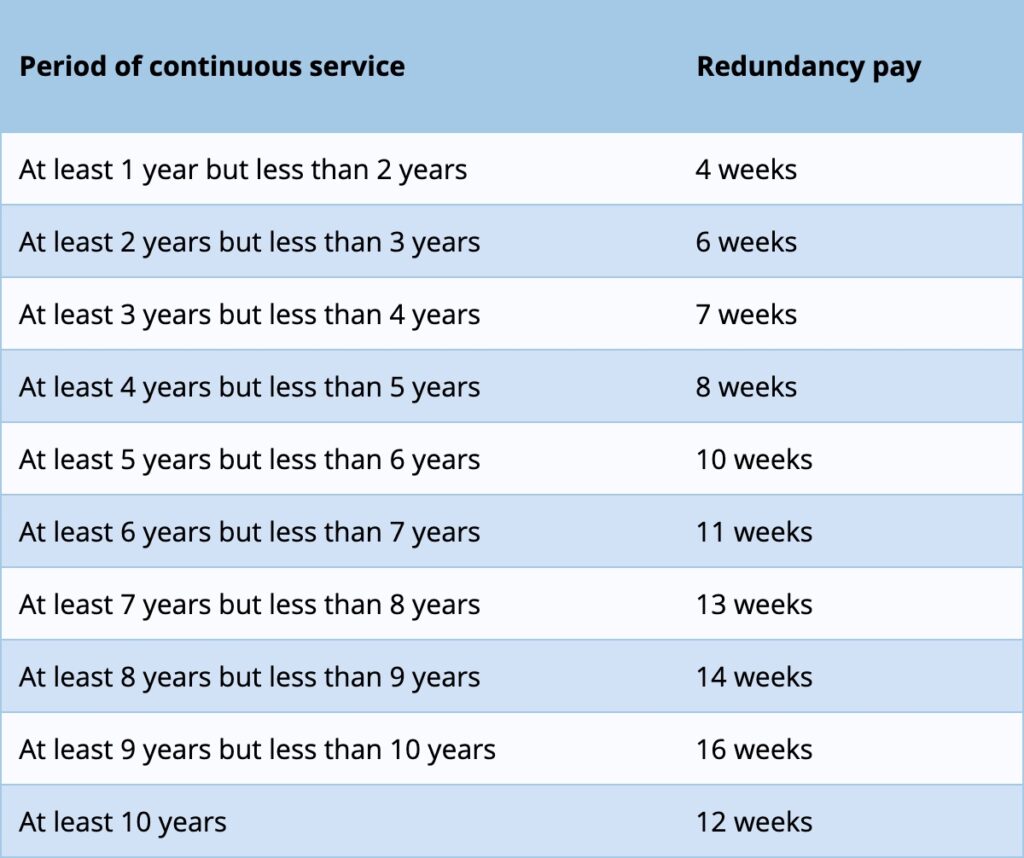
Source: Fair Work Ombudsman .
If the labor market disruptions caused by AI cannot be resolved in the short term,revising redundancy pay to align with current social realities and increasing the minimum number of weeks for compensation will at least give laid-off employees an impactful form of compensation and support.
Conclusion
The massive layoffs at major companies show that this is no longer an individual dilemma of one or two white-collar workers,it is related to the economic trend of the whole country and even the world.
Governments need to do more than just check if AI is legal.They must recognize the problems caused by AI and provide real support for workers facing widespread layoffs.
AI did nothing wrong, but governance must keep pace.
Ordinary people should not become the victims to the technology progress.
Reference
- Waltersmann, L., Kiemel, S., Stuhlsatz, J., Sauer, A., & Miehe, R. (2021). Artificial intelligence applications for increasing resource efficiency in manufacturing companies—A comprehensive review. Sustainability, 13(12), 6689. https://doi.org/10.3390/su13126689
- Wilson, H. J., Daugherty, P. R., & Morini-Bianzino, N. (2017). The jobs that artificial intelligence will create. *MIT Sloan Management Review, 58*(4), 14–16.
- Just, N., & Latzer, M. (2017). Governance by algorithms: Reality construction by algorithmic selection on the Internet. Media, Culture & Society, 39(2), 238_258.https://journals.sagepub.com/doi/full/10.1177/0163443716643157
- Amodei, D. (2026, January). The adolescence of technology: Confronting and overcoming the risks of powerful AI. https://www.darioamodei.com/essay/the-adolescence-of-technology
- Crawford, K. (2021). The atlas of AI: Power, politics, and the planetary costs of artificial intelligence. Yale University Press.
- Lustig, C., Pine, K., Nardi, B., Irani, L., Lee, M. K., Nafus, D., & Sandvig, C. (2016). Algorithmic authority: The ethics, politics, and economics of algorithms that interpret, decide, and manage. In Proceedings of the 2016 CHI Conference Extended Abstracts on Human Factors in Computing Systems (pp. 1057–1062). Association for Computing Machinery. https://doi.org/10.1145/2851581.2886426
- Elster, J. (1993). Local justice: How institutions allocate scarce goods and necessary burdens. Russell Sage Foundation.
- OECD/The World Bank (2016), Enhancing employability: Report prepared for the G20 Employment Working Group, OECD Publishing, Paris, https://www.oecd.org/en/publications/enhancing-employability_1873722f-en.html.
- Citrini Research. (2026, February 23). The 2028 global intelligence crisis: A thought exercise in financial history, from the future. https://www.citriniresearch.com/p/2028gic
- Baiocco, S., Fernández-Macías, E., Rani, U., & Pesole, A. (2022). The algorithmic management of work and its implications in different contexts (No. 2022/02). JRC Working Papers Series on Labour, Education and Technology.https://www.ilo.org/publications/algorithmic-management-work-and-its-implications-different-contexts

Be the first to comment