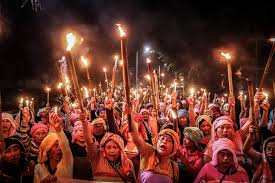
It started with a video, but it didn’t end there.

The Moment Everything Became Visible
In July 2023, a video from Manipur, India, forced the nation and the world to stop and pay attention. It showed two women being stripped, paraded, and assaulted by a mob. Within hours, the footage spread rapidly across national, international, and social media platforms, triggering outrage, protests, and political responses. For many, this was the moment the violence in Manipur became real, where it was no longer distant or abstract, but immediate and undeniable.
But the truth is, the violence did not begin with the video.
For months since the 3rd of May, 2023, violence has escalated, where houses have been burnt, people lynched and assaulted, and aggression has been between the two communities, Meitei and Kuki communities, in the state of Manipur, India, which shares a border with Myanmar. Reports of displacement, arson, and clashes were already emerging. Yet much of this remained fragmented, localised, and unevenly reported. It was only when the video went viral that the crisis entered national consciousness. This distinction matters. The video did not start the violence. It made the violence visible on the scale of where it is heading and, crucially, demonstrated how digital platforms can transform local incidents into national crises.
This blog argues that the Manipur conflict reveals something deeper than communal tension. It shows how digital platforms are not neutral spaces where events are simply shared. Instead, they are active systems that shape what is seen, how it is interpreted, and how people respond. Through algorithmic amplification, weak content moderation, and problematic governance responses, platforms did not just reflect violence in Manipur, but they helped intensify and escalate it. This raises critical questions for digital policy and governance, particularly around how platforms should be regulated as powerful actors shaping public discourse.
The Hidden Build-Up: Violence Before Visibility
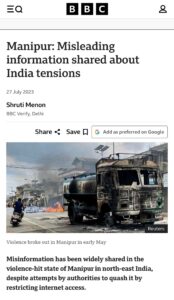
To understand the role of digital platforms in Manipur, it is necessary to look at what happened before the viral video. On the ground, tensions between communities had been building for some time. However, the digital environment was evolving even faster. Social media platforms became key sites where narratives about the conflict were constructed, contested, and circulated.
Reports from The Indian Express (2023) and The New York Times (2023) highlight how misinformation and inflammatory content spread widely across platforms such as WhatsApp, Facebook, and X (formerly Twitter). These included unverified claims of attacks, misleading images taken out of context, and narratives portraying entire communities as threats. What is significant here is not just the presence of misinformation, but its scale and speed of spread, which has allowed communal feelings to be stirred up. Social media platforms are designed to prioritise engagement. Algorithms promote content that users are likely to interact with, such as content that provokes strong emotional responses.
As Just and Latzer (2017) explain, this often results in the amplification of fear, anger, and outrage.
In contexts of existing tension, this creates a feedback loop where the rumours trigger emotional reactions, emotional reactions drive sharing of the content, which leads to an increase in sharing, which increases visibility and reinforces the belief. This cycle can quickly transform uncertainty into perceived truth.
Matamoros-Fernández (2017) describes this phenomenon as “platformed racism,” where digital infrastructures facilitate the circulation and normalisation of discriminatory discourse.
In Manipur, such dynamics contributed to the hardening of group identities and the deepening of mistrust between communities, leading to a communal angle in every altercation and action. In other words, the digital environment did not simply mirror the conflict, but it helped structure it.
The Core Problem: Platforms Are Designed for Outrage
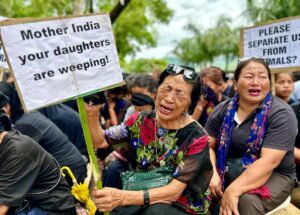
At the centre of this issue is a difficult but necessary recognition and question. Are social media platforms built to maximise engagement rather than to ensure accuracy or social stability? Every interaction for likes, shares, and comments is fed into algorithmic systems that determine what content is prioritised. Over time, these systems learn to favour content that generates strong reactions and triggers responses.
Frank Pasquale (2015) refers to this as the “black box” nature of digital platforms. Users are not aware of how content is ranked or promoted, yet these invisible processes shape their perception of reality.
Crawford (2021) extends this critique by arguing that artificial intelligence systems are embedded within broader structures of power. They are not neutral tools but reflect the economic and political priorities of the organisations that build them.
In practical terms, this means that content which provokes outrage is more likely to be amplified than content which promotes understanding. In Manipur, this dynamic had clear consequences, in practice, this meant sensationalist and emotionally charged posts gained visibility while polarising narratives were reinforced, and the efforts to provide context or verification struggled to reach similar audiences
Some might argue that platforms are simply tools and that users are responsible for the content they share. However, this perspective overlooks the role of design. The Platforms did not just passively display content; they actively shaped visibility through algorithmic curation. The result is a system where we saw outrage travel faster than the truth, hate outperforming nuance, and conflict becoming content for many. What happened in Manipur was not an exception but a predictable outcome of these design choices.
This is not a failure of platforms; it is a feature of how they are designed.
This reflects a broader governance failure in which private platforms exercise public power without equivalent accountability.
Moderation in Crisis: Too Little, Too Late

But amplification alone is not the whole story.
If algorithms amplify harmful content, content moderation is supposed to act as a corrective mechanism. However, the effectiveness of moderation is often limited, particularly in contexts like Manipur, which has a long history of ethnic conflict and political instability for many decades , that has its past mired with conflict between state and non-state actors, ethnic violence and cross-border narco terrorism.
Content moderation systems face several structural challenges. They are frequently under-resourced, rely heavily on outsourced labour, and struggle to operate effectively across diverse linguistic and cultural environments (Roberts, 2019).
The Asia-Pacific study on Facebook highlights these issues, noting that automated systems often fail to detect harmful content in regional languages and that human moderators may lack the contextual understanding required to make accurate judgments. In Manipur, these limitations were especially pronounced. The region’s linguistic diversity made it difficult for automated systems to identify harmful content. At the same time, the speed at which content spread meant that even when moderation occurred, it was often too late.
This reveals a fundamental problem.
Content moderation is largely reactive. It responds to content after it has already circulated, rather than preventing harmful content from gaining visibility in the first place. In crisis situations, this delay can have serious consequences, as harmful narratives can shape perceptions, influence behaviour, and contribute to escalation before any intervention takes place. Moderation, in its current form, is not designed to prevent harm but to manage it after the fact.
The State Steps in: Internet Shutdown as “Solution”

When platforms failed to control the spread of harmful content, the state stepped in but not in the way one might expect.
As violence escalated, the Indian government imposed a prolonged internet shutdown in Manipur, one of the longest ever, lasting 142 days in one go. At first glance, this decision appears logical. If misinformation spreads online, restricting internet access could limit its reach. However, this approach raises significant concerns. Access to the internet is increasingly recognised as essential to fundamental rights, including freedom of expression and access to information (Goggin et al., 2017).
When the internet is shut down, these rights are disrupted. The consequences are far-reaching:
- Journalists are unable to report effectively
- Civil society organisations face barriers in documenting human rights violations
- Communities lose access to communication, information, and essential services
Nissenbaum’s (2018) concept of contextual integrity suggests that information flows should be regulated in ways that are sensitive to context.
Blanket shutdowns fail to meet this standard. They treat all communication as equally harmful, rather than distinguishing between harmful and beneficial uses. Healthcare, education, banking, access to essential needs, and others were affected. Moreover, internet shutdowns do not address the root causes of digital harm. They do not change how algorithms function. They do not improve moderation systems. They do not increase platform accountability. Instead, they obscure the problem. A more effective approach would involve targeted interventions. This could include strengthening moderation systems, improving transparency, and ensuring that platforms are accountable for the content they amplify.
Gendered Violence in the Digital Age
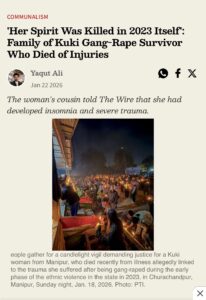
The Manipur case also highlights the intersection of digital media and gender-based violence. Digital Media doesn’t just reflect gendered violence, but it can also intensify it. Even in normal circumstances, whereas in conflict places where women are targeted through a patriarchal lens, it can further amplify harmful and exploitative content. The viral video brought widespread attention to the incident, but it also raised serious ethical concerns. The circulation of the footage exposed the victims to repeated trauma and public scrutiny.
Marwick and Boyd (2018) describe this as “privacy at the margins,” where individuals with less social power have less control over how their information is shared and used.
This creates a complex tension in which, on the one hand, visibility can promote accountability by ensuring that the video is visible and that the incident cannot be ignored. On the other hand, it also turned violence into a spectacle, raising questions about dignity and consent. In Manipur, the digital circulation of the video both exposed injustice and reproduced harm. This highlights the need for more nuanced approaches to content governance that recognise the ethical complexities of visibility in digital spaces and respect individuals’ rights and dignity.
Rethinking Responsibility: Beyond Individual Blame
Discussions of online harm often focus on individual users. While users do play a role in sharing content, this perspective is incomplete. Responsibility must be understood across multiple levels. Platforms design the systems that determine what content is visible
As Flew (2021) argues, they function as key actors in shaping public discourse. Their decisions influence how information flows and how users engage with it.
Governments are responsible for regulating these platforms. However, responses such as internet shutdowns demonstrate the limitations of current approaches. Users participate in content circulation, but their behaviour is shaped by platform design. This means that the responsibility for digital harm is not just individual; it is deeply structural with many stakeholders. The state has the responsibility to address the actions around it. Understanding this is essential for developing effective responses to digital harm.
Manipur in Global Context: A Repeating Pattern

The case of Manipur, India is not an isolated one. Similar patterns have been observed in Myanmar, Sri Lanka, and Ethiopia, where digital platforms have played a role in amplifying ethnic and religious tensions.
In Myanmar, Facebook was widely criticised for its role in the spread of hate speech against the Rohingya community. In Sri Lanka, misinformation circulated on social media contributed to anti-Muslim violence. In Ethiopia, digital platforms have been used to mobilise ethnic conflict. Across these cases, the same dynamics emerge:
- Weak moderation systems
- Algorithmic amplification of divisive content
- Fragile social and political contexts
The result is a pattern in which online dynamics contribute to offline harm and violence that erupts beyond control. This suggests that the issue is not confined to a specific region or platform. It reflects broader challenges in global platform governance where the world is getting polarised each day, violence is erupting in different parts of the world on identities, religion and ethnicities.
What Needs to Change
If Manipur is a warning, meaningful change requires structural reform.
Platform accountability
Platforms must take responsibility for the systems they design. This includes investing in localised moderation systems, improving the crisis response mechanisms, and increasing the transparency around algorithmic processes
Rights-based regulation
Governments must develop approaches that address harm without undermining fundamental rights. This means avoiding blanket internet shutdowns and Implementing targeted and proportionate interventions
Digital literacy
Users need tools to navigate digital environments critically. This includes identifying misinformation, understanding algorithmic influence, Engaging responsibly with content
Conclusion
Manipur challenges the idea that online and offline worlds are separate. They are not. Digital platforms shape how people see, understand, and respond to events. In moments of crisis, this influence becomes particularly significant, as it can escalate or de-escalate depending on the content fed to algorithms, which can amplify misinformation or disinformation across platforms. It also reveals a deeper issue that digital systems are not neutral infrastructures. They are active participants in shaping social realities, and if these systems continue to prioritise engagement over responsibility, similar crises will persist. And when hate goes viral, the consequences do not stay online, but they reshape real lives, communities, and realities.
References
Abi-Habib, M., & Raj, S. (2023, July 20). Video of sexual assault goes viral in India, renewing attention on ethnic conflict. The New York Times.
Al Jazeera. (2023, October 27). In India’s strife-torn Manipur, narrative battle is fought on social media.
Amnesty International Australia. (2023, September 29). Myanmar: Facebook’s systems promoted violence against Rohingya; Meta owes reparations.
BBC News. (2023, July 20). Manipur violence: India outrage after women paraded naked in video.
Crawford, K. (2021). The Atlas of AI: Power, politics, and the planetary costs of artificial intelligence. Yale University Press.
Flew, T. (2021). Regulating platforms. Polity Press.
Goggin, G., Vromen, A., Weatherall, K., Martin, F., Webb, A., Sunman, L., & Bailo, F. (2017). Digital rights in Australia. University of Sydney.
Just, N., & Latzer, M. (2017). Governance by algorithms: Reality construction by algorithmic selection on the Internet. Media, Culture & Society, 39(2), 238–258.
Marwick, A. E., & Boyd, D. (2018). Understanding privacy at the margins. International Journal of Communication, 12, 1157–1175.
Matamoros-Fernández, A. (2017). Platformed racism: The mediation and circulation of an Australian race-based controversy on Twitter, Facebook and YouTube. Information, Communication & Society, 20(6), 930–946.
Nissenbaum, H. (2018). Respecting context to protect privacy: Why meaning matters. Science and Engineering Ethics, 24(3), 831–852.
Pasquale, F. (2015). The black box society: The secret algorithms that control money and information. Harvard University Press.
Roberts, S. T. (2019). Behind the screen: Content moderation in the shadows of social media. Yale University Press.
Sinpeng, A., Martin, F. R., Gelber, K., & Shields, K. (2021). Facebook: Regulating hate speech in the Asia Pacific. University of Sydney.
The Hindu. (2023). Coverage on Manipur violence and internet shutdown.
The Hindu. (2024, January 10). Official crime data does not reflect women’s ordeal in Manipur 2023 conflict.
The Indian Express. (2023). Reports on misinformation and violence in Manipur.
The Wire. (2023, July 28). Manipur: Kuki woman gang-raped during ethnic violence dies.



Be the first to comment