When many people browse their social media, they often encounter a subtle situation. For example, in the comment sections discussing female scholars or working women, you may see remarks like, “She is so successful…there must be some other advantages behind it…” And in some discussions about regions, someone may say, “People from that place are just like this. There’s nothing surprising about it.” These comments do not contain obvious offensive words. However, after reading them, you will feel uncomfortable or even offended.
These expressions are quite common in the current online environment. Unlike direct insults or attacks, they often appear in a more ambiguous way, such as comments that sound joking, neutral evaluations and so on. When viewed on their own, these contents seem not to be harmful speech. However, once placed in a specific context, they can take on connotations of belittlement, exclusion or even hostility.
The following question then arises: When the harm is no longer expressed in obvious language but is hidden within the context, how should the platform identify and handle such content?
What counts as harm if no one is “insulting” anyone?
In existing research, hate speech is usually defined as language that portrays a particular group as inferior, undesirable or threatening, thereby providing justification for exclusion, discrimination or even hostility (Flew, 2021). The focus of this definition is not on how intense the tone is, but on whether the expression reinforces the negative understanding of a specific group.
In the online environment, the harm is often not completed at once. Many contents do not directly say the most offensive words, but gradually take effect through repeated evaluations or familiar stereotypes. If you look at a single sentence, it may not be that serious. But when similar expressions repeatedly target at the same group, it is building a fixed impression.
This is why, judging harm only by whether there are offensive words often misses a lot. Sinpeng et al. (2021) found in their study of hate speech governance on Facebook in the Asia-Pacific region that some content experienced as hateful by targeted groups was not removed because it did not fully fit the platform’s existing definitions. This indicates that content already perceived as harmful does not necessarily align with the typical imagination of hate speech.
In the Chinese context, this situation is also obvious. Guan and Chen (2025) pointed out that online hate speech not only includes direct attacks, but also stereotypical and hostile expressions targeting rural residents, foreigners, the LGBT community, etc. These contents continuously strengthen the boundary between “us” and “them”.

How platforms identify harmful content
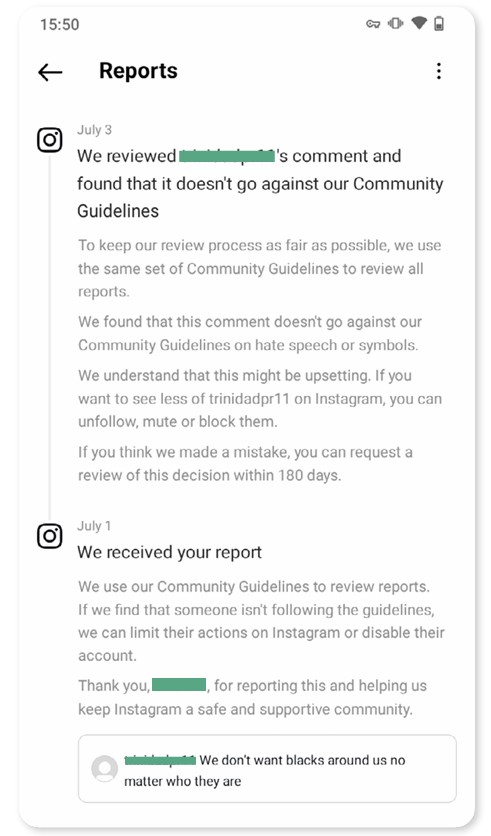
When dealing with harmful content, the platform primarily relies on a set of pre-defined moderation rules. A common approach is to categorize the content based on community standards or content policies, such as hate speech, harassment or threats. Only when a piece of content can be classified into one of these categories does the platform have a clear basis for handling it.
In terms of specific operations, moderation usually begins with filtering. Faced with the continuous growth of user-generated content, platforms must first identify content that may be problematic and then decide whether to take action. This process is typically accomplished through a combination of automated tools and human reviews. The platform can use keyword detection to conduct an initial round of filtering, but even with these technological means, a large amount of content still requires human moderation, especially after being reported by users (Roberts, 2019).
This process also affects what the platform is able to identify more easily. Comments involving insulting language and targeting specific groups are more likely to be flagged by the system. For example, expressions like “Everyone in that group is trash” have a clear target and are easily sent to the moderation process. On the contrary, if the expression is more indirect, such as “Such people have always been like this”, it is often ignored for lack of a clear label.
For platforms operating across different regions, they more rely on a relatively standardized set of rules to handle content of different languages and cultural contexts to ensure that moderation results remain consistent. However, research suggests that those standards can’t fully cover all users’ feelings and experiences with these contents (Sinpeng et al., 2021)
Harm without slurs in Chinese social media
In Chinese social media, some aggressive expressions take the form of labels, evaluations or even humorous remarks. Kate Zhu Wenqi is the case. As a mathematics PhD student at the University of Oxford, she was questioned by many netizens after gaining public attention: “she is too pretty to study mathematics…” and was even labelled as “mathematics socialite” (South China Morning Post, 2022). These comments shift the attention from academic ability to her appearance, making all her achievements seem like something that needs to be explained.

Source: South China Morning Post
Terms like “socialite” tend to evoke certain associations, such as appearance, access to resources. Through repeated use, these expressions gradually link certain people with specific characteristics. Research also shows that in the Chinese context, expressions of hatred or hostility often operate through stereotypes and othering (Guan & Chen, 2025).
From a platform moderation perspective, this type of content is often difficult to handle. Comments such as “too attractive to look like a mathematics student” are hard to classify under any defined category of violation.
Source: South China Morning Post
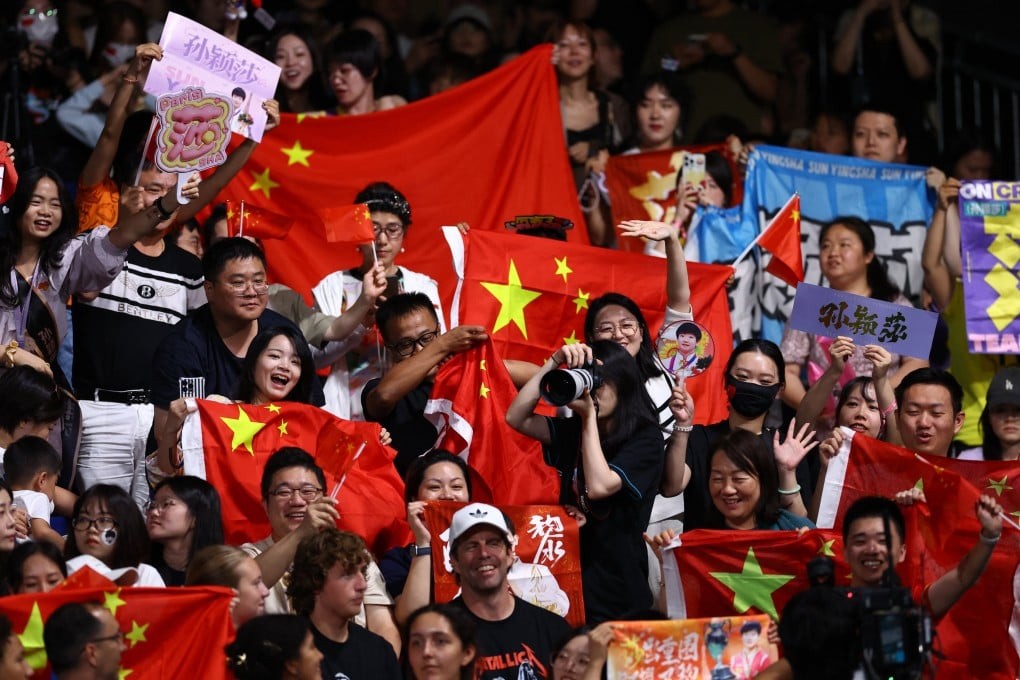
A similar situation can be observed in the case of Chen Meng. Chen Meng is a Chinese table tennis player who won the women’s singles championship at the 2024 Paris Olympics. However, after the game, there were numerous controversial comments regarding the result and Weibo subsequently suspended hundreds of accounts (South China Morning Post, 2024).
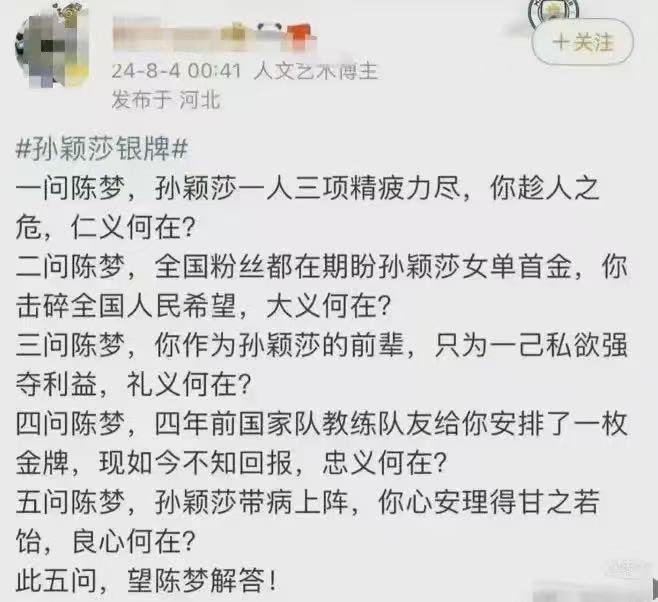
It was not a direct insult, but rather, through moralized language, it portrayed Chen Meng’s victory as “unfair”, thereby guiding others to interpret her achievement in a negative way.
Most of them were clearly in violation of the rules. But apart from these, there were also many comments like evaluations, such as repeated questioning of her performance or even morality. These evaluations gradually change the atmosphere of the discussion, making some negative interpretations more and more common.
What’s more troublesome is that such expressions are often shielded by being framed as “jokes”, “teasing” or “just comments”. Matamoros-Fernández (2017) mentioned that the harm on the internet is often disguised in forms such as humor, satire and irony and the rules of the platforms regarding such content are not that clear. Facebook, Twitter and YouTube all allow space for humor or social commentary, but what constitutes humor and what counts as harm is not clearly explained. As a result, expressions like “mathematics socialite” are more likely to remain in a grey area.
When Abuse Starts to Look Like Politics
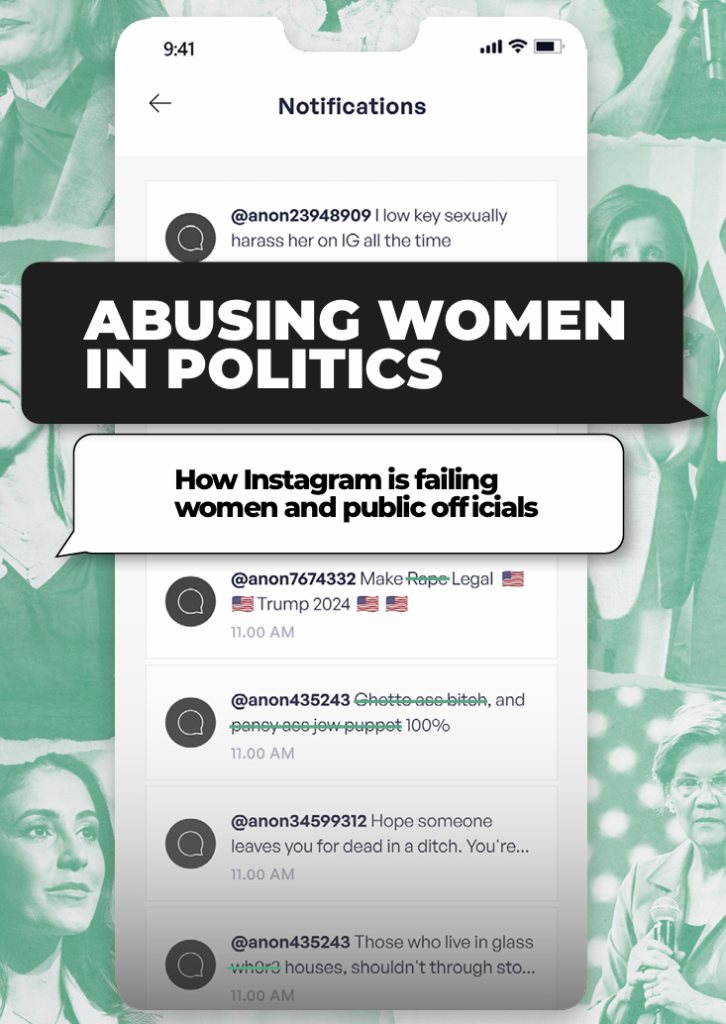
In 2024, the non-profit organization Center for Countering Digital Hate analyzed more than 500,000 comments on the Instagram accounts of ten female politicians, including Kamala Harris, Elizabeth Warren, Nancy Pelosi and Marjorie Taylor Greene. The researchers marked over 20,000 toxic comments and reported approximately 1,000 of the most severe ones. One week later, the platform still retained 93% of the harmful comments, including sexist and racist abuse, as well as death and rape threats (Reuters, 2024).
The reason why these contents can remain is also related to the platform’s underlying logic of circulation. Comment posts with stronger emotions and more opposing viewpoints are more easily receive interactions, and these interactions will further promote the spread of the content. In the political communication environment, this logic is consciously utilized to increase participation (Reuters, 2024). Some aggressive expressions are more likely to be seen, responded to and amplified in the ongoing interactions.
When placed in the comment section of female political figures, this situation becomes more complicated. It is already filled with opposition and provocation, and aggressive content is easily mixed with stance statements, emotional release. The same sentence might be regarded as harassment or threat in a general social setting, but once it enters this environment, it can be wrapped up in the shells of intense expression or political debate.
In the previous cases, harm is more dependent on the local cultural context and the meaning of the labels. Here, the problem is that the political context has changed the way the content is understood and processed. Sinpeng et al. (2021) mentioned that hate content relies on specific contexts to generate meaning. And platforms have difficulty using the same set of rules to distinguish whether these contents need to be dealt with as attacks or can be accepted as political expressions. The context here includes language, cultural background, as well as the political interaction. Even if it is hostile enough, some content may still remain in the political discussion area because it is more like opinions, debates or participation.
Rethinking Moderation in Context
The current issue is no longer about whether to remove the comments. If the platform still relies mainly on any keyword list, standardized categories, much harmful content will be overlooked. So, the platform needs more local policies and culture expertise, as well as continuous communication with the target group in order to accurately identify harm (Sinpeng et al., 2021).
What the platform really needs is not to add more abstract rules, but to start to focus on how the system operates. The idea of a duty of care proposed by Woods and Perrin is useful: the focus of supervision should cover the platform’s service design, business model, user tools, complaint handling and security resource allocation, because these aspects directly affect how harmful content flows and is handled (Woods & Perrin, 2021). In other words, the platform cannot come up with remedial measures after the content has gone wrong. Instead, it should be responsible for the communication environment it has created.
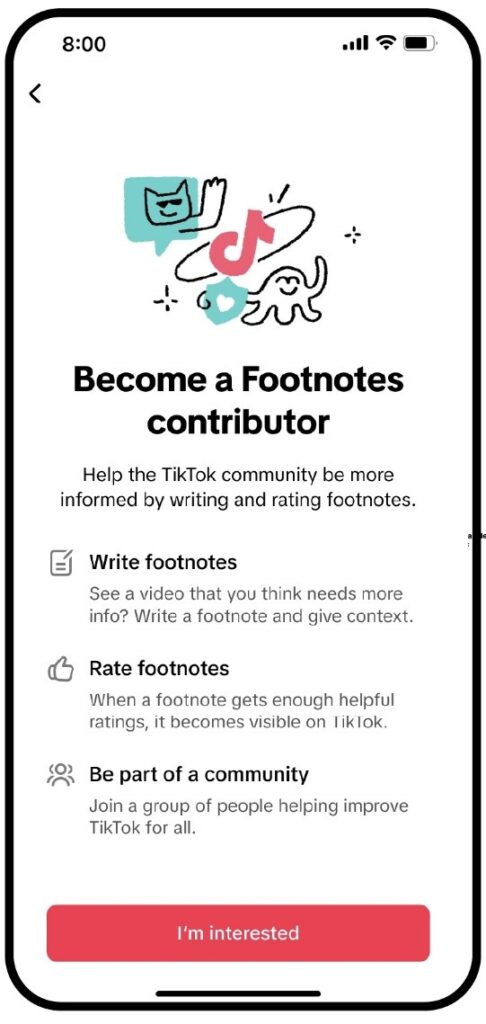
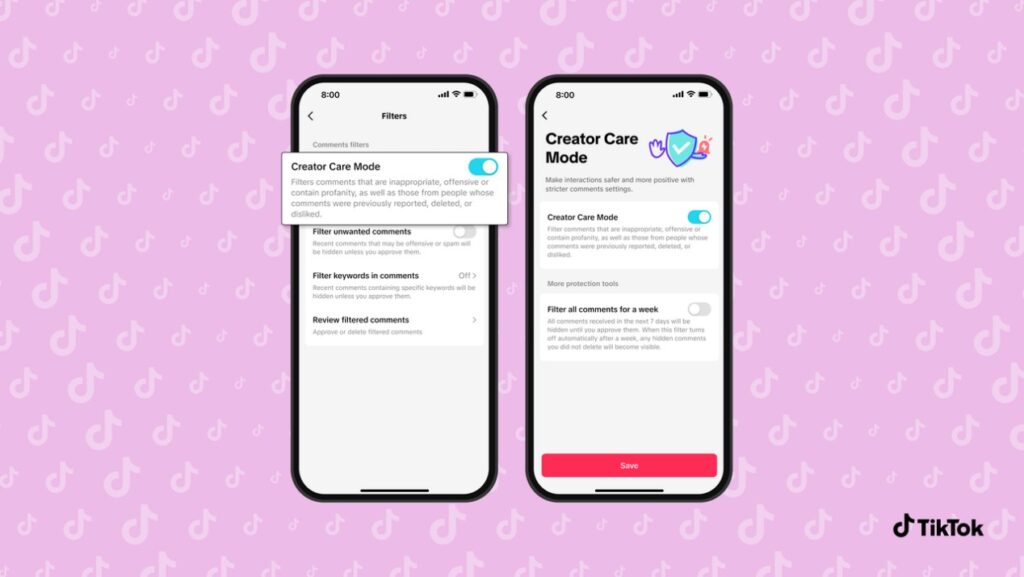
The improvements now being made by platforms are in the right direction, but not sufficient. For example, in TikTok’s recent updates, features such as Creator Care Mode, live-stream tools for bulk muting of words, phrases and emojis and the Footnotes function for providing background information for content (TikTok, 2025a, 2025b) have been added. However, these tools focus more on helping users protect themselves rather than truly addressing how the platform can more reliably distinguish context-based harm, attacks in political contexts and hostile expressions under the guise of humor or commentary.
Furthermore, the platform needs to be more concrete in terms of transparency and appeals mechanism. In Sinpeng et al.’s suggestions, several points are worth noting: make the content governance process clearer and easier to understand, make the punishment and appeal procedures public, explain what types of evidence are needed when the platform takes action, establish a continuous communication mechanism with affected groups (Sinpeng et al., 2021). The significance of doing this is to reduce the sense of powerlessness that users feel when they are harmed but do not know how to report or receive only vague responses after reporting.
Finally, there is still the most difficult problem to encounter: how to balance freedom of speech and harmful speech.
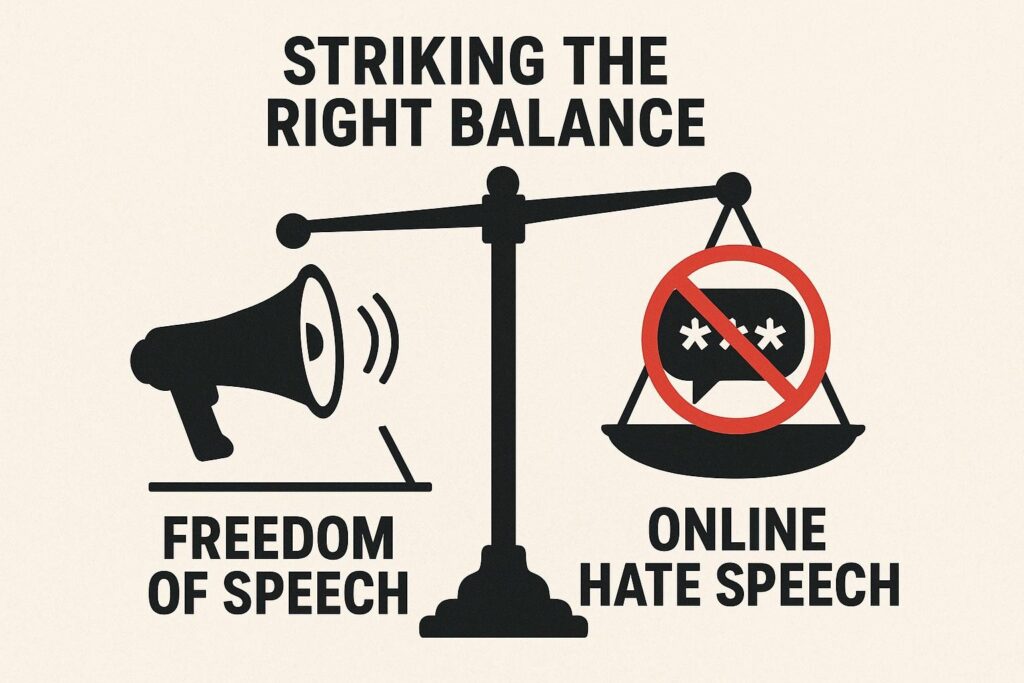
Balancing freedom of speech and online hate speech in digital environments.
Source: Lawvs
This question does not have a simple answer. If the platform does nothing, free expression must create a space where vulnerable groups suffer from continuous pressure. But if the rules are too strict, they may remove some appropriate criticism and political expression.
On one hand, there is the goal of promoting free expression. On the other, hate speech and online abuse badly need to be limited (Flew, 2021). It has long been one of the most difficult challenges in internet governance. A workable way is not to choose between complete openness and total restriction, but to recognize that the same expression can have very different effects in different contexts—and that governance needs to begin from that difference.
References:
Center for Countering Digital Hate. (2024). Instagram fails to protect women politicians from abuse. https://counterhate.com/research/abusing-women-in-politics/
Flew, T. (2021). Issues of concern. In Regulating platforms (pp. 91–96). Polity Press.
Guan, T., & Chen, X. (2025). Threat perception, otherness and hate speech in China’s cyberspace. Journal of Contemporary China, 1–16. https://doi.org/10.1080/10670564.2025.2475051
Inside Marketing. (n.d.). Definizione di hate speech [Image]. https://www.insidemarketing.it/glossario/definizione/hate-speech/
Lawvs. (n.d.). Freedom of speech and online hate speech: Striking the right balance [Image]. https://lawvs.com/articles/freedom-of-speech-and-online-hate-speech-striking-the-right-balance
Matamoros-Fernández, A. (2017). Platformed racism: The mediation and circulation of an Australian race-based controversy on Twitter, Facebook and YouTube. Information, Communication & Society, 20(6), 930–946. https://doi.org/10.1080/1369118X.2017.1293130
Reuters. (2024, August 14). Meta’s Instagram failed to curtail hate speech against women politicians, report says. https://www.reuters.com/technology/metas-instagram-failed-curtail-hate-speech-against-women-politicians-report-says-2024-08-14/
Roberts, S. T. (2019). Behind the screen: Content moderation in the shadows of social media. Yale University Press.
Sinpeng, A., Martin, F. R., Gelber, K., & Shields, K. (2021). Facebook: Regulating hate speech in the Asia Pacific. Department of Media and Communications, The University of Sydney. https://hdl.handle.net/2123/25116.3
South China Morning Post. (2022, December 21). What doesn’t kill you makes you stronger: Chinese woman accused of being too beautiful to be Oxford graduate faces online backlash. https://www.scmp.com/news/people-culture/trending-china/article/3204377/what-doesnt-kill-you-makes-you-stronger-chinese-woman-accused-being-too-beautiful-be-oxford-graduate
South China Morning Post. (2024, August 5). Chinese fans boo table tennis champion Chen Meng, sparking furious online reaction at home. https://www.scmp.com/sport/paris-olympics-2024/table-tennis/article/3273131/chinese-fans-boo-table-tennis-champion-chen-meng-sparking-furious-online-reaction-home
TikTok. (2025a, April 16). Testing a new feature to enhance content on TikTok. https://newsroom.tiktok.com/en-us/footnotes
TikTok. (2025b, July 30). TikTok announces a suite of product features. https://newsroom.tiktok.com/en-us/tiktok-announces-a-suite-product-features
Tukuppt. (n.d.). Hate speech infographic template [Image]. https://www.tukuppt.com/muban/oakoymrv.html
Woods, L. (2021). Obliging platforms to accept a duty of care. In M. Moore & D. Tambini (Eds.), Regulating big tech: Policy responses to digital dominance (pp. 93–109). Oxford University Press.



Be the first to comment