Have you ever experienced this: telling yourself to stop after watching another one, but after ten minutes, your fingers are still sliding. An hour later, it becomes difficult to recall where the time has gone. This is not like an active choice at all, but more like a subconscious instinctive action. Sliding the screen gradually no longer needs to think and becomes an effortless habit.

This kind of experience is very common. On platforms such as TikTok, Instagram Reels and Youtube, many users will waste a lot of time unconsciously. What begins as just a few minutes of watching can easily turn into several hours without realising it. This unstoppable state is not an exception, but an increasingly common phenomenon (Hunter & Morganstein, 2021). Many people attribute this to poor self-control or “Internet addiction”, but from the perspective of digital policy and governance, this explanation is too simple. It seems to be a matter of personal habit, but in fact it is deeply bound to the design logic of the platform (Ortiz et al., 2023). To understand this point, we should not only focus on individual behaviour, but also analyse the underlying system that shapes these behaviours, revealing how short-video algorithms increasingly move from serving users to manipulate their attention in order to drive platform profitability.
How platforms keep you scrolling?
In the current digital environment, artificial intelligence is not only “recommended content”, but also continues to model user behaviour through data-driven and automated decision-making systems (Hunter & Morganstein, 2021). The user’s click, stay time, sliding speed and interaction mode will be recorded and converted into data, thus building a computable and predictable behaviour model.
This process does not need to really understand the user himself, but captures the rules through massive behavioural data. Over time, the system can more accurately predict which content can better retain users. Even if you just stay on a video for one more second, such small actions will affect the subsequent content push (Hunter & Morganstein, 2021). Therefore, the recommendation mechanism has become the core of the platform. The short video platform will continue to optimise content distribution and maximise user usage time.
Furthermore, the interface design of infinite sliding eliminates the natural stop node. Users do not need to actively choose to continue, and the next video will appear automatically. And, the content itself is full of uncertainty, and the next article may be bland or particularly attractive (Ortiz et al., 2023). This uncertainty forms a reward model similar to “slot machine”. Every swipe is a new attempt, and the occasional high-quality content will strengthen the desire to continue to brush. Psychological research shows that this “variable reward” mechanism is more likely to make people dependent than fixed rewards (Ryan, 2012).
The key is that this design weakens the active decision-making needs of users. Users no longer deliberately choose to continue, but are pushed forward by the system (Liu et al., 2025). In the long run, people’s sense of control will continue to weaken, and even if they realise that it takes too long, it will be difficult to stop.
Why emotional content works so well?
The extreme optimisation of the platform’s attention is also reflected in the selection of content push. Short video platforms prefer content that can quickly trigger emotional reactions (Hunter & Morganstein, 2021) such as overnight stories, dramatic life twists, or highly exaggerated contradictions and conflicts.

Examples of short-form “instant-gratification” dramas on short-video platforms
This kind of content is simple in structure and extremely fast-paced, which can stimulate strong emotions in a few seconds. Users do not need to think deeply, but only need to make instinctive emotional responses. Whether it is excitement and satisfaction, or negative emotions such as anger and anxiety, it can be used to retain users (Hunter & Morganstein, 2021). Under this mechanism, the content is not randomly pushed, but filtered and sorted by algorithms. The content brushed by different users is different, but the operating logic behind it is exactly the same, that is, to maximise the participation of users through emotional stimulation (Hunter & Morganstein, 2021).
Those complex social realities have been broken down by the platform and simplified into a big white story that ordinary people can understand at a glance. The real social problems have also been changed into a short and dramatic fragment. Doing this does make it easier for everyone to understand and spread the content more widely, but the price is that the content is not deep and accurate enough, and many details are worn out. When we read these contents, most of them subconsciously follow our emotions, and rarely calm down to ponder and analyse rationally (Just & Latzer, 2017). After a long time, a feedback loop will be formed. Those content that can make people happy and sad and full of emotions, the platform will vigorously recommend and browse more and more; while those content that needs us to think about, more and more no one can browse, and the exposure is pitifully low. This not only changes what users watch, but also makes people more and more reluctant to think deeply (Phillips, 2010).
It is not just watching – it is buying
The transformation of user information processing not only affects the viewing choice, but also reshapes consumption decision-making. When users get used to responding quickly emotionally and rejecting deep thinking, the ability to carefully evaluate choices will decline (Phillips, 2010) and shopping decisions will become more hasty and lack rational thinking.
Take the common live shopping as an example, the anchor introduces the product while interacting in real time, and repeatedly emphasises the tight inventory, limited-time special price, and the upcoming off-shelf. The order messages of other users are constantly scrolling on the screen, creating a strong sense of urgency and an atmosphere of following the crowd. In this scenario, users do not browse products rationally, but are involved in a high-emotional and fast-paced environment and are guided to place orders immediately instead of comparing options and thinking about actual needs.
The boundary between entertainment and shopping is becoming more and more blurred, and watching videos can easily be transformed into consumption behaviour without planning. In the long run, the space for rational thinking has been continuously compressed, and consumption has become automated and arbitrary (Hunter & Morganstein, 2021; Just & Latzer, 2017).

Some real cases show that users will spend a lot of money in a short time and don’t even realise how much they have bought. The user’s choice seems to be autonomous, but in fact it is guided by the carefully designed environment, which has long gone beyond simple content recommendations and is an in-depth intervention in human decision-making.
From habit to control: a new form of governance
Over time, this influence is no longer limited to a single behaviour, and begins to reshape the long-term habits and decision-making patterns of users (Just & Latzer, 2017). Through continuous tracking and personalized recommendations, the consumption path becomes shorter and simpler. Users no longer carefully compare and choose, but rely on the platform push, and decision-making is getting faster and faster and more automated (Hunter & Morganstein, 2021). At the same time, people’s perception of value has also changed. Products are no longer judged by quality and function as the core criteria. Story packaging, atmosphere creation and emotional attraction have become more important, and consumption has also changed from demand-driven to experience-driven (Hunter & Morganstein, 2021).
This process can be regarded as a new governance model. Algorithms shape user behaviour by controlling information flow and attention (Just & Latzer, 2017). This kind of governance does not rely on coercion, but makes specific behaviours more likely to occur through the design environment. Users seem to be choosing independently, but in fact, the choice has already been planned by the platform in advance. Therefore, the short video platform is no longer just a service to users, but also a system to guide and control user behaviour. The so-called personalized service is actually a structured mechanism that serves the interests of the platform. When the algorithm becomes “addictive”, it provides convenience while also manipulating users (Meng, 2021).
Not everyone is affected equally
It is worth noting that this kind of impact is not the same for everyone. For example, many elderly users lack companionship in their daily lives and are relatively lonely, so they are particularly easily attracted to the content of playing emotional cards in the live broadcast room, and it is also straightforward to fall into online shopping and can not extricate themselves. The anchors rely on inciting emotions and creating a sense of urgency that if they do not buy it again, they will be gone, so that the consumption decisions of these elderly people completely follow their feelings, and they can not make rational judgements at all.
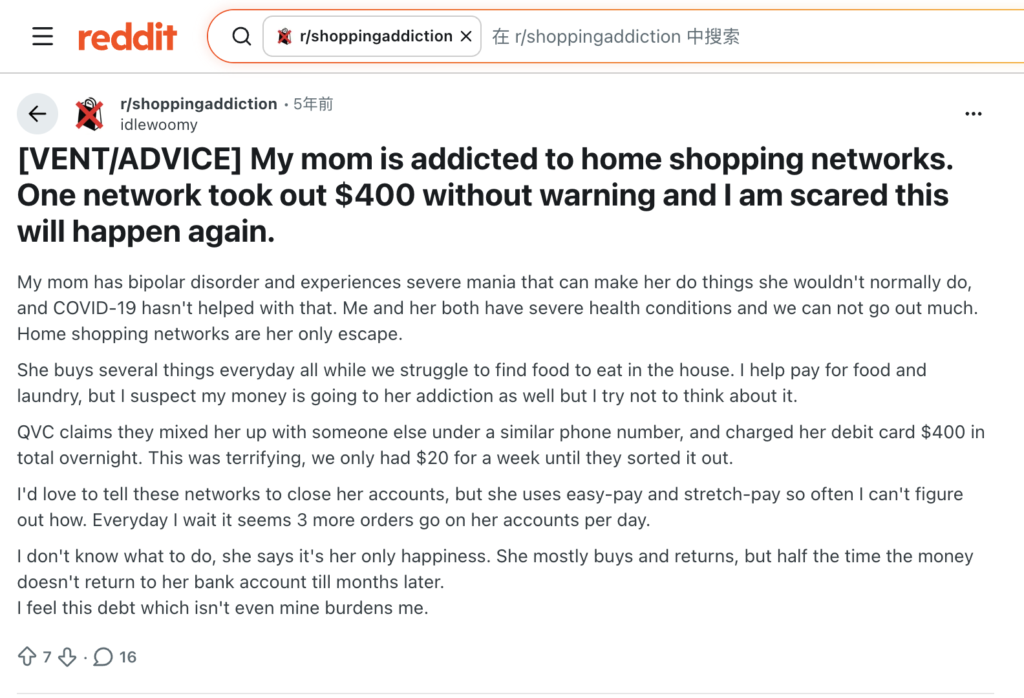
There is a very real example on Reddit: a netizen said that his mother was obsessed with shopping channels. Even if her family was not well-off, she still had to place orders almost every day. The content on the platform has become a way for her to relieve her emotions. Under the constant inducement, she repeated consumption again and again. Even if she has caused economic losses, it is still difficult to stop. This shows that emotionally fragile people are more likely to have compulsive consumption in the algorithmic environment (Liu et al., 2025).
More generally, users who are emotionally vulnerable or have lower levels of digital literacy are more likely to be affected (Wang et al., 2024). They often do not know how the recommendation mechanism works. They are more likely to believe in the content pushed by the platform, spend more time on the platform, and are more easily influenced by emotionalisation and commercial content (Wang et al., 2024). Algorithmic systems not only have different effects on different groups of people, but also exacerbate existing social inequality (Just & Latzer, 2017).
Why regulation is still struggling?
Most of the effects of this kind of algorithm are implicit. As Pasquale (2015) pointed out, the transparency of the algorithm system is extremely low, and users usually do not understand its operating logic, so it is difficult to question and resist. As a result, the platform gradually controls the attention and behaviour of users, and users lose complete control over their own decision-making (Crawford, 2021). This is not only a technical issue, but also about the distribution of power and interests.
In this regard, scholars and policymakers have put forward governance principles such as fairness, accountability and transparency (Papagiannidis et al., 2024), and also promote the development of explainable AI to reduce excessive interference in individual choice. However, these measures are not effective enough. In actual operation, the platform often puts user activity and profitability first, and user protection is left behind.
The more core problem is that as long as the platform business model still relies on maximising user participation and profits, there are structural obstacles to effective supervision (Papagiannidis et al., 2024). Even if ethical principles are recognised, they are often suppressed by business motives. The challenge lies not only in improving the regulatory rules, but also in reflecting on the bottom economic model that supports these platforms.
So who is this system really serving?
In such an environment, the algorithm is definitely not a neutral tool. It itself is wrapped in the logic of power rules and commercial interests, and will also influence the user’s behaviour choice by manipulating the flow of information (Pasquale, 2015).
Short video addiction has never been such a simple problem as lack of personal self-control, but the result of the data-driven system, automated operation mechanism, and the joint action of the platform’s right to speak. In this process, users are not only ordinary users of the platform, but have become targets to be shaped, guided and controlled. Our attention has also become a resource that the platform can accurately predict and realise.
The moment we unconsciously slide the screen, it seems to be a small habit developed inadvertently, but in fact, this is the result of the careful design of the whole system. In the end, the most important question is not why users can’t stop browsing, but why the platform should design the mechanism to make it difficult to stop, and whose interests is such a design ultimately serving.
References
Crawford, K. (2021). Atlas of AI: Power, politics, and the planetary costs of artificial intelligence. Yale University Press.
Hunter, M. T., & Morganstein, J. C. (2021). [Rev. of Irresistible: The Rise of Addictive Technology and the Business of Keeping Us Hooked: ALTER, ADAM. New York: Penguin Books, 2017. 368 pp. ISBN: 9780735222847]. Psychiatry (Washington, D.C.), 84(2), 204–206. https://doi.org/10.1080/00332747.2021.1925508
Just, N., & Latzer, M. (2017). Governance by algorithms: Reality construction by algorithmic selection on the Internet. Media, Culture & Society, 39(2), 238–258. https://doi.org/10.1177/0163443716643157
Liu, C., Wang, J., Li, H., Shangguan, Q., Jin, W., Zhu, W., Wang, P., Chen, X., & Wang, Q. (2025). Loss aversion and evidence accumulation in short-video addiction: A behavioral and neuroimaging investigation. NeuroImage (Orlando, Fla.), 313, Article 121250. https://doi.org/10.1016/j.neuroimage.2025.121250
Meng, J. (2021). Discursive contestations of algorithms: a case study of recommendation platforms in China. Chinese Journal of Communication, 14(3), 313–328. https://doi.org/10.1080/17544750.2021.1875491
Neil Patel. (2026, February 3). Live shopping is rewriting e-commerce [Video]. YouTube. https://www.youtube.com/shorts/7HZ88XcUgYI
Ortiz, J. A. F., De Los M. Santos Corrada, M., Lopez, E., Dones, V., & Lugo, V. F. (2023). Don’t make ads, make TikTok’s: media and brand engagement through Gen Z’s use of TikTok and its significance in purchase intent. The Journal of Brand Management, 30(6), 535–549. https://doi.org/10.1057/s41262-023-00330-z
Papagiannidis, E., Mikalef, P., & Conboy, K. (2025). Responsible artificial intelligence governance: A review and research framework. Journal of Strategic Information Systems, 34, 101885. https://doi.org/10.1016/j.jsis.2024.101885
Pasquale, F. (2015). The black box society: The secret algorithms that control money and information. Harvard University Press.
Phillips, A. L. (2010). [Rev. of THE SHALLOWS: What the Internet Is Doing to Our Brains.(The Shallows: What the Internet Is Doing to Our Brains)]. American Scientist, 98(5), 438.
Ryan, F. (2012). Cognitive therapy for addiction : motivation and change. Wiley. http://USYD.eblib.com.au/patron/FullRecord.aspx?p=1120610
Wang, D., Liu, X., Chen, K., Gu, C., Zhao, H., Zhang, Y., & Luo, Y. (2024). Risks and protection: A qualitative study on the factors for internet addiction among elderly residents in Southwest China communities. BMC Public Health, 24, 531. https://doi.org/10.1186/s12889-024-17980-6Picture References
https://www.flightpath.com/blog/2022/10/short-form-videos-explained-and-how-can-brands-use-them/
https://m.media-amazon.com/images/M/MV5BODI4OTg2MTAtYjA3ZS00MWM1LThkYjctNjUyMzk2OTIzY2NmXkEyXkFqcGc@.V1_FMjpg_UX1000.jpg
https://m.media-amazon.com/images/M/MV5BNmE5Nzc1ZTQtMGM1Ni00MzAzLWI0MTYtNTlmN2I5Y2Y4NjJhXkEyXkFqcGc@.V1_FMjpg_UX1000.jpg
https://m.media-amazon.com/images/M/MV5BYzVhNmQ4YTctYTY5Ni00Nzg5LThkNGEtZTFmMjRmYjg5ZGJmXkEyXkFqcGc@.V1_FMjpg_UX1000.jpg
https://m.media-amazon.com/images/M/MV5BZDg5Zjg5N2UtYWNlOS00YjMyLWE0MGQtNGFjODQ0NTc5M2E2XkEyXkFqcGc@.V1_FMjpg_UX1000.jpg
Be the first to comment