Understanding Hidden Hate Speech on Red Note Through the “Fei Bai Cheng Shi” Case
Introduction
With the development of digital media and online social platforms, more and more people have gained the opportunity to speak out and participate in various discussions. As a result, many users have come to hold the misconception that “I have freedom of speech, as long as I don’t break the law, I can say whatever I want, and I have the right to express my views.”
The problem, however, is that not all “views” and statements are merely ordinary expressions; often, people’s views are sharp, offensive, and even highly targeted and insulting. In Parekh’s article, he points out that hate speech differs from ordinary disagreement or dislike; such speech involves language that is clearly hostile toward a specific group or individual, and may consist of insulting or aggressive remarks targeting a particular gender group, race, sexual orientation, and so on (2012, p. 40).
In recent years, the Chinese internet has also become a space where netizens shape their personal identities and express their views. According to research by Guan and Chen, in a China undergoing cultural, economic, and ideological transformation, the collision of diverse ideologies and perspectives inevitably leads to disagreements. Hate narratives have also emerged as a defining feature of this period (2025, p. 1338). Among these platforms, Red Note—a Chinese social media platform known for its large female user base—has also seen a significant amount of hate speech directed at specific groups.
2.1 “Feibai”Case Study
On December 24, 2025, China’s wildly popular wuxia game Where Winds Meet released a revealing in-game outfit in its store to celebrate its first anniversary, sparking widespread discussion on the Red Note community. This discussion subsequently escalated into a heated online feud centered on gender-based hate speech, with many neutral social media users caught in the crossfire. During this process, a large number of derogatory terms were coined and used against ordinary female players who were not participating in the advocacy or had purchased the outfit.
However, the vast majority of hate speech in this case was composed of obscure, non-attributive word combinations. The blurred boundaries of what constitutes an insult and the high degree of context-dependence allowed these terms to evade platform moderation. Furthermore, algorithms designed to gauge the emotional intensity of user posts amplified their reach, causing them to spread continuously across the platform. This blog post will use the “Fei Bai Cheng Shi” case as a case study to analyze how this discussion evolved into hate attacks between groups, as well as how Red Note’s algorithmic mechanisms and moderation policies failed to detect hate speech, thereby gradually amplifying this gender-based hate speech incident.
2.2 The Fermentation Process
In “Where Winds Meet,” players can choose to start the game as either a male or female character. Since the character is portrayed as the adopted son or daughter of the distillery owner, they are commonly referred to as “Young Master.”
As the game progresses, more and more female players are drawn to the Young Master’s cheerful, passionate personality and gentle, steady nature, often referring to the character as their own son or daughter.


(Figure 1&2, Feibai player custume,https://www.yysls.cn/news/official/20251224/37780_1278303.html)
Figures 1 and 2 show the outfits that have sparked widespread controversy within the community, with the main debate centered on the female Young Master’s attire. From a design perspective, as a wuxia game set against a Chinese historical backdrop, this style of clothing does indeed clash with the game’s world-building. It is inherently implausible for a female Young Master to wear a short skirt and a crop top while fighting enemies, performing rolls, or executing lightness skills.
According to Guo’s (2023, p.1) study, female users account for as much as 88.8% of Red Note’s user base. In recent years, an increasing number of posts purporting to “support feminism and women’s freedom and independence,” along with the platform’s prevailing portrayal of “successful women,” have pushed young female users toward becoming “feminist advocates.”
However, as the advocacy group grew, many irrational voices emerged, More and more rights-advocating players began attacking ordinary female players who did not participate in the advocacy efforts. Finally, amid the chorus of calls to “take the game offline immediately,” many players joined the discussion, angrily asking, “If you take the game offline, what are we supposed to play?” ; “Can’t you advocate for your rights in a rational way without disrupting the gaming experience for ordinary players?”
As players with differing viewpoints joined the discussion, the issue gradually escalated within the community into a hate-filled verbal battle centered on the notion that “failing to advocate for this cause equates to not supporting feminism.”
3 The “Unchecked Spread” of Hate Speech
Why did this hate speech war continue to escalate within the community for over three months? This blog post attributes the cause primarily to two factors: users’ clever choice of words and the platform’s push notification mechanism.
3.1 “Covert” Hate Speech?
According to Parekh’s (2012, p. 40) definition, we identify hate speech based on three key criteria. First, such speech targets an identifiable group or individual possessing certain characteristics or an identity. Second, it goes beyond merely expressing disapproval or dislike, escalating to stronger forms of hostility, insult, or exclusion. Finally, hate speech rationalizes hostility toward the group, making acts of humiliation and the like “acceptable.”
In the “Feibai” case, hate speech focused on attacking female players who did not participate in the advocacy campaign—particularly those who continued to discuss the game’s plot on official accounts and purchased in-game outfits after the case occurred. They were labeled as a group “reaping the benefits of the feminist movement while doing nothing,” and a significant number of players who refuted this view faced even more intense attacks. These included, but were not limited to, abusive private messages and hate speech directed at them in the comments sections.
Directly offensive language and personal attacks are easily filtered out by platform moderators and user reports. In the “Feibai” case, however, the most dangerous and harmful content consisted largely of subtle expressions that, while not obviously in violation of platform rules, were nonetheless filled with malice.
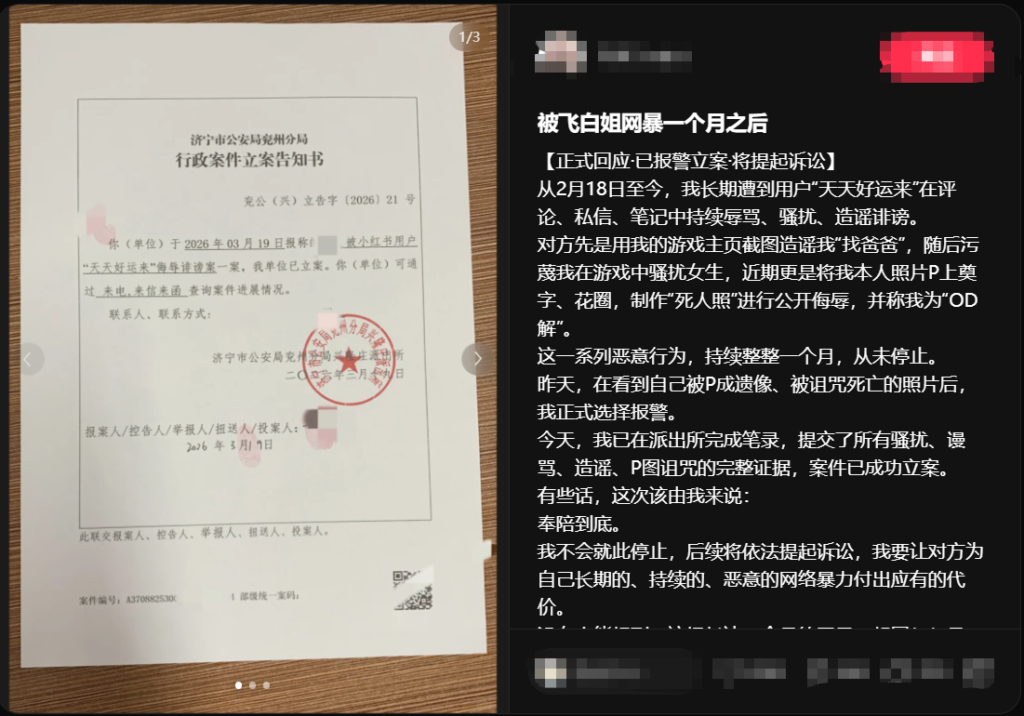
(Figure 3, A female user posted a photo of herself filing a lawsuit after she received a large number of prolonged private messages containing insults and false rumors following her posting of purchased fashion items in the community.http://xhslink.com/o/6XHqHrKb1n2)
As Sellars (2016, p. 14) noted, hate speech often manifests in very subtle ways. In the “Feibai” case, a large number of terms were recoded into hate speech that only members of the gaming community could understand. For example, in many posts within the “Where Winds Meet” community on Red Note users referred to women who did not participate in advocacy or boycott radical advocacy as “biaozi,” which is the Chinese pinyin for the word “bitch.” In addition, there were other insulting terms such as “barking” and “male-pleasing” (which actually imply comparing other users to dogs; or referring to women who objectify themselves, deliberately curry favor, and pander to men). These highly offensive terms on Red Note—a platform touted as “feminist”—managed to evade the platform’s moderation standards, skirting the red line of offensive language policies to appear on the platform, thereby further escalating the conflict.
Even more extreme cases have gone so far as to describe women who oppose radical advocacy—as well as those who do not advocate at all—as “enemy mounts” (where “enemy” refers to men).
Initially, many advocates believed that “as a woman, remaining neutral in this case amounts to siding with men,” and they labeled these users as a “man-pleasing” group, subsequently branding them as “enemy mounts.” Subsequently, these users who had posted hateful remarks issued clarifications: they argued that a mount is a support role in war that does not participate in the division of spoils, and that the behavior of women who do not advocate for their rights serves to reinforce men’s social status, hence the comparison to enemy mounts. However, the term “mount” inherently implies being “ridden,” dominated, and exploited, while “enemy” further marginalizes these women, casting them as objects of ridicule and exclusion. Consequently, this clearly objectifying and dehumanizing slur was widely rejected. The result was a new round of hate speech and verbal attacks within the community. Since the components of this term—“enemy” and “mount”—do not violate any community guidelines and fall within the scope of normal speech, users continue to be targeted.
All of this aligns with Parekh’s definition of hate speech. The rights advocacy group positions itself on the moral high ground to label a group as “hater women,” rationalizing insulting behavior and speech while elevating a clothing issue into a matter of gender conflict. But what is most tragic is that in this “gender conflict” hate-filled verbal battle, it is only women attacking other women. Huang et al. (2025, p. 2) mention this phenomenon on the Chinese internet in their article: Hate speech spreads in diverse ways in Chinese, with people using various methods to disguise their hateful remarks—whether through homophones, metaphors, pinyin, or word combinations. Social media platforms in many countries maintain dictionaries to screen for hate speech, whereas the Chinese internet lacks such databases, making it difficult for platforms to intervene and impose restrictions.
3.2 The Platform’s Content Recommendation Mechanism
In addition to users’ use of euphemisms and the limitations of Red Note’s own moderation system, the platform’s recommendation mechanism is also a factor in the escalating conflict over hate speech.
Red Note is a social media platform that relies heavily on algorithmic recommendations; what users see depends largely on a post’s performance metrics. The platform uses various factors to determine which posts have greater potential, prioritizing those with higher engagement metrics that are more likely to keep users engaged. Consequently, the platform does not present information neutrally but rather “allocates” visibility through algorithms, deciding what gets seen and amplified.
Zhao’s article presents the following perspective: on social media platforms, emotionally charged posts spread more easily, particularly those that are negative, pessimistic, and angry. On Weibo, another major Chinese social media platform, anger spreads more easily than low moods (2025, p. 6). Red Note is one of the few platforms in China that consistently maintains high traffic through text and images, which means that creating notes on the platform is simple, time-efficient, and allows for rapid publication. The combination of text and images allows users to grasp the core of the content and react immediately (p. 26). Coupled with Red Note’s high proportion of female users, this further ensures that posts “related to women’s rights and carrying angry emotions” are destined to generate high traffic. With the boost of high traffic, a large number of users flood in, and with that comes a natural shift and reversal in sentiment (p. 68)
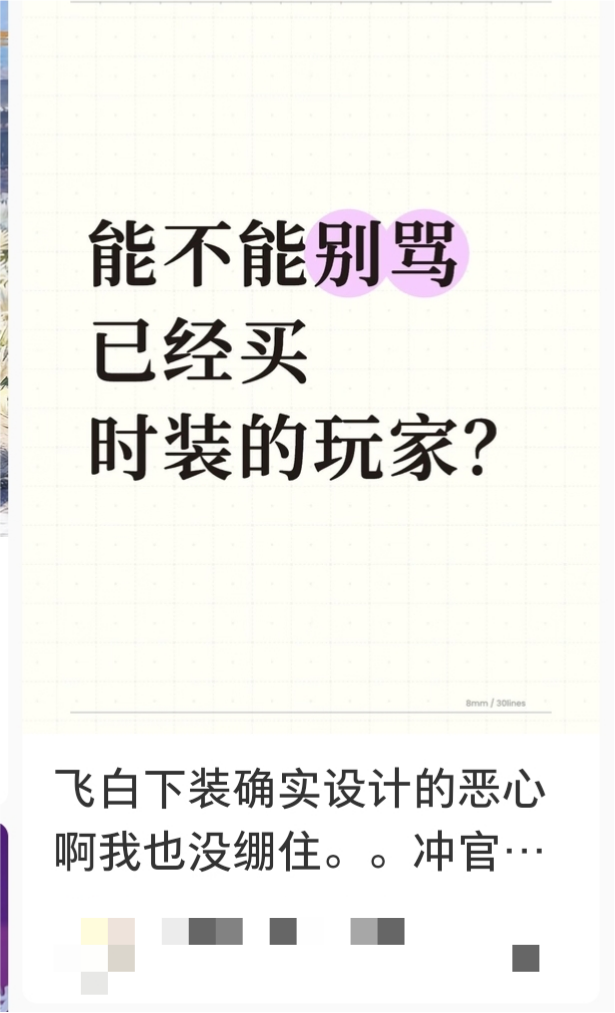
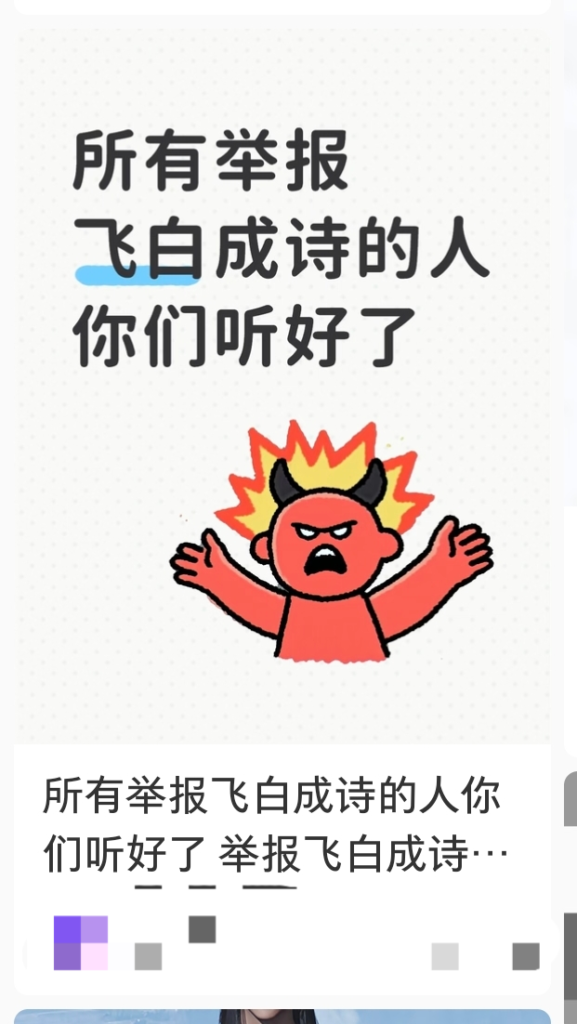
(Figure 4&5,Users’ opinions on the Fei Bai fashion collection posted on Red Note,http://xhslink.com/o/3yQj0SFgYID; http://xhslink.com/o/77fX7cG6K3G)
In the “Feibai” case, content laced with explicit anger and aggression attracted more user clicks than rational discussions about fashion design and aesthetics.
The text on the cover image reads, “Can we please stop insulting players who bought this outfit?” and “All players who reported the Feibai outfit, listen up!” These emotionally charged image captions easily draw users in, prompting them to immediately take a stance—either by choosing a side or launching a counterattack. The result is that supporters echo the sentiment, while opponents retaliate. Hate speech is generated and escalated in this process. Consequently, the hate speech hidden within these image posts naturally aligns with the platform’s algorithm, attracting user retention and stimulating engagement.
Another notable phenomenon in this case is that the groups participating in discussions—or even spreading hate speech—consist of highly active users, and many posts may actually be duplicate posts from the same user’s account. Many users are naturally inclined to share their daily lives and engage in trending discussions. Consequently, when they join a contentious discussion and consistently post hate speech, they can easily sustain the event’s momentum and gain greater visibility on the platform.
These points have also been substantiated in articles by Binny and others. In their study on anti-Semitic hate speech, they found that on the social media platform Gab, 0.67% of users participating in the discussion accounted for 26.8% of the total posts (2019, p. 175). Subsequently, by analyzing factors such as user profiles, they calculated an intriguing statistic: the network density of hate-spreading users was 16.74 times that of ordinary users. This indicates that within this group of like-minded users spreading hate speech, there exists a highly cohesive core. Among these users, radical views and emotions have formed a highly efficient closed-loop of dissemination (p. 176). Therefore, the reason hate speech continued to spread in the “Feibai” case was not only due to users’ veiled language and emotional outbursts, but also because it aligned with Red Note’s push algorithm logic. When highly active users banded together to amplify anger and hate speech, the platform’s non-intervention itself served as a driving force.
Reflection & Conclusion
When reviewing the “Feibai” case, we find that it differs from traditional social incidents that trigger hate speech; its content does not involve armed conflict or racial discrimination, and at its core, it is merely a dispute within the women’s community regarding feminist stances. It evolved from a morally and legally permissible exercise of free speech into a hate speech war involving personal insults, denigration, and even threats via private messages and phone calls(Jeffery, 2019, p.95).
n short, this hate speech war was the result of an interaction between users’ malicious remarks and the platform’s limitations. Users first deviated from rational analysis in the discussion, shifting instead to moral judgments targeting positions and identities. The discussion, which originally centered on the expression of female identity within the game, was simplified into a matter of choosing sides. Especially when sensitive topics like feminism were involved, many equated the rejection of a position with a rejection of personal values, thereby triggering the spread of hate speech. Meanwhile, the platform’s focus on capturing user engagement and emotional reactions further fueled the spread of hate speech, drawing an increasing number of ordinary users into the verbal altercation.
On the other hand, this conflict also reflects that some young women on Chinese social media still lack a mature understanding and practice of feminism. Social issues that should focus on structural equality have been turned into cultural symbols and tools for moral coercion. Many people, under the guise of “defending women’s rights,” insult and attack women who hold opposing views. Such hate speech not only fails to advance women’s rights but also causes women who were once steadfast in their convictions to retreat after being attacked, and may even lead them to develop a fear of discussing such topics in the future.
Reference List
Guan, T., & Chen, X. (2026). Threat Perception, Otherness and Hate Speech in China’s Cyberspace. Journal of Contemporary China, 35(158), 1337–1352. https://doi.org/10.1080/10670564.2025.2475051
Guo, W. J. (2023). Research on Female Image in Xiaohongshu APP from the Perspective of Social Gender (Master’s thesis). Hebei University, Baoding, China.
Huang, Q., Li, P., Wang, W., Zhang, X., Chen, S., Cheng, H., & Liu, Z. (2025). Knowledge-enhanced Chinese multimodal hate speech detection. Expert Systems with Applications, 129906.
Jeffrey W. Howard. 2019. Free Speech and Hate Speech. Annual Review Political Science. 22:93-109. https://doi.org/10.1146/annurev-polisci-051517-012343
Malmasi, S., & Zampieri, M. (2017). Detecting hate speech in social media. arXiv preprint arXiv:1712.06427.
Mathew, B., Dutt, R., Goyal, P., & Mukherjee, A. (2019, June). Spread of hate speech in online social media. In Proceedings of the 10th ACM conference on web science (pp. 173-182).
Sellars, A. (2016). Defining hate speech. Berkman Klein Center Research Publication, (2016-20), 16-48.
Zhao, Y. (2025). Research on the Emotional Dissemination Mechanism of Social Hot Events on Xiaohongshu (Master’s thesis). Henan University of Economics and Law, Zhengzhou, China.
Figure Reference List
为爱只做凌. (2025, December 24). 飞白下装确实设计的恶心啊我也没绷住 [Screenshot]. Xiaohongshu. https://xhslink.com/o/77fX7cG6K3G
喜欢下雨天. (2026, March 19). 被飞白姐网暴一个月之后【正式回应・已报警立案・将提起诉讼】 [Screenshot]. Xiaohongshu. https://xhslink.com/o/6XHqHrKb1n2
燕云十六声. (2025, December 23). 全新预告发布,周年直售外观上新速览! [Webpage]. Yan Yun Shi Liu Sheng Official. https://www.yysls.cn/news/official/20251224/37780_1278303.html
云吃吃. (2025, December 25). 所有举报飞白成诗的人你们听好了 [Screenshot]. Xiaohongshu. https://xhslink.com/o/3yQj0SFgYID
Why does the layout on this website look so weird?!!