The Australian government is combating the impact of online harm on young people by enacting restrictive legislation for teenagers (Online Safety Amendment (Social Media Minimum Age) Act 2024).This seems like a strong response to the harms of the internet. However, the law has encountered numerous obstacles since its early implementation. The ongoing violations of the law may mean that teenage internet use is not the real problem. The real issue may lie in the fact that these platforms are designed to maximize user attention and amplify inflammatory content.
The real risk stems not only from “accessing the platform” but also from the platform’s design itself. Simply imposing age restrictions to prevent some young people from registering accounts may not solve the deeper problems. While the government’s measures address the public’s genuine concerns, they also expose a broader governance dilemma: governments often prioritize controlling users rather than addressing the systemic issues that create the risks.
This report on Australia’s under-16 social media ban highlights how access restrictions can be difficult to enforce in practice.
Is bigger than whether children can access the platform that issues are.
It’s easy to understand why age restrictions have attracted government attention. The law has a simple mechanism and is easier to explain to the public. According to official guidelines, from December 10, 2025, social media platforms with age restrictions must take reasonable measures to prevent Australian users under the age of 16 from creating or maintaining accounts. (Online Safety (Age-Restricted Social Media Platforms) Rules 2025)
However, online harm isn’t just a matter of “access rights”—it depends on more than just the presence of harmful content. It also relates to how platforms sort, rate, recommend, repeatedly display, and moderate the content users see. In other words, the real issue isn’t just “whether children can access the platform,” but also “what kind of environment the platform creates once anyone is on it.”Platforms aren’t just neutral channels of communication. They also act as regulators, setting rules, organizing visibility, and shaping how speech spreads. Therefore, the issue isn’t just whether children can access social media, but how platforms manage risk, attention, and content exposure once users are on board. This is a more difficult and also more important problem.
An age threshold won’t redesign the recommendation system, change autoplay, remove interactive sorting mechanisms, or automatically improve moderation, reporting systems, or appeals processing. It simply sets a barrier to “entering the platform.”This might have some effect. But it’s not the same as truly addressing the underlying structure of harm. O’Donnell’s discussion of Australia’s minimum age law for social media is helpful because she points out that this system is far more complex than a simple “ban.” It actually involves: what harm it aims to address, which services it covers, what obligations the platform must assume, and what privacy costs it will incur in its implementation. (O’Donnell, 2025)
Therefore, even from a legal perspective, this is not just a story of “children being banned from social media.” It’s more about what risks a state believes it is regulating and whether it is using the right methods.
The real problem is not simply that young people are online. It is that platforms are designed to organise attention, amplify risk, and make harmful experiences harder to escape.
The restrictions a platform sets for children do not equate to making the platform safe.
The shortcomings of this policy are being exposed as some users below the legal age continue to circumvent platform restrictions and post on social media. In practice, while the state requires platforms to keep children out, much of the platform’s architecture remains largely unchanged. This does not equate to making the platform safer.
This is why Woods and Perrin’s concept of “duty of care” is so important. They argue that to make platform regulation more effective, the focus should be on preventing harmful consequences, treating the platform itself as a combination of software and business systems, rather than just focusing on individual pieces of content (Woods & Perrin, 2021). This means the key issue is no longer simply whether platforms can remove harmful content quickly enough. The real risk often lies not in a single post, but in the platform’s recommendation mechanisms, interactive design, amplification mechanisms, business incentives, and governance structure. In other words, the problem lies in how the system operates; even simple commercial advertisements, such as some commercial games on Instagram that contain extreme racial themes, seem to highlight the importance of governing social media platforms.
A platform doesn’t need to explicitly instruct children to do dangerous things to create a harmful environment. It only needs to continuously push emotionally charged, sensational, or stimulating content because such content performs better in the “attention economy.”
Massanari’s research on “toxic tech culture” suggests that online harm stems not only from content itself but also from the combined effects of platform design, governance rules, visibility mechanisms, and community culture. In other words, platforms are not passive intermediaries; they actively shape how speech is accessed and how harm circulates. (Massanari, 2017) This is not to say that age restrictions are meaningless, but rather that they focus too much on “who enters the platform” and not enough on “what kind of environment the platform is actually designed to create.”
It’s not just about bad users
When people talk about online harms, a common argument is that blaming these comments on a few bad users seems more reassuring. This explanation implies that the platform itself is largely neutral, and the problem only stems from those posting hateful, harassing, or disturbing content. But this argument is too simplistic. Of course, we need to acknowledge that some users do engage in harmful online behavior. But if we focus solely on bad users, the platform’s problems disappear from view.
This easily leads to the assumption that the problem will be solved simply by removing enough bad users. Why does harmful content continue to appear even when platforms claim to be addressing it? We should consider this from the perspectives of regulation, definitions, algorithms, platform affordances, amplification, culture, and enforcement.
The problem isn’t just bad users; it’s that platforms manipulate attention in ways that can reward strong emotions, repeated stimulation, and the spread of anger.
Sinpeng’s research on hate speech on Facebook remains highly valuable. While this study focuses more on hate speech in the Asia-Pacific region than on laws regarding access for minors, its broader implications are significant. The research shows that platform governance failures often stem not from a lack of rules, but from rules that are not specific enough to reflect real-world context, local knowledge, or users’ actual experiences of harm. (Sinpeng et al., 2021) Sinpeng also reveals how weak reporting mechanisms leave affected users feeling powerless and exhausted. Developing rules does not equate to building a system that effectively manages risk. This also applies to hate speech rules, content moderation policies, and laws protecting minors.
Case Study: eSafety Commissioner’s First Compliance Update Reveals Governance Gaps
Even with strict legal restrictions imposed by the Australian government, the problem goes beyond mere theoretical concerns when underage children actually access these platforms.
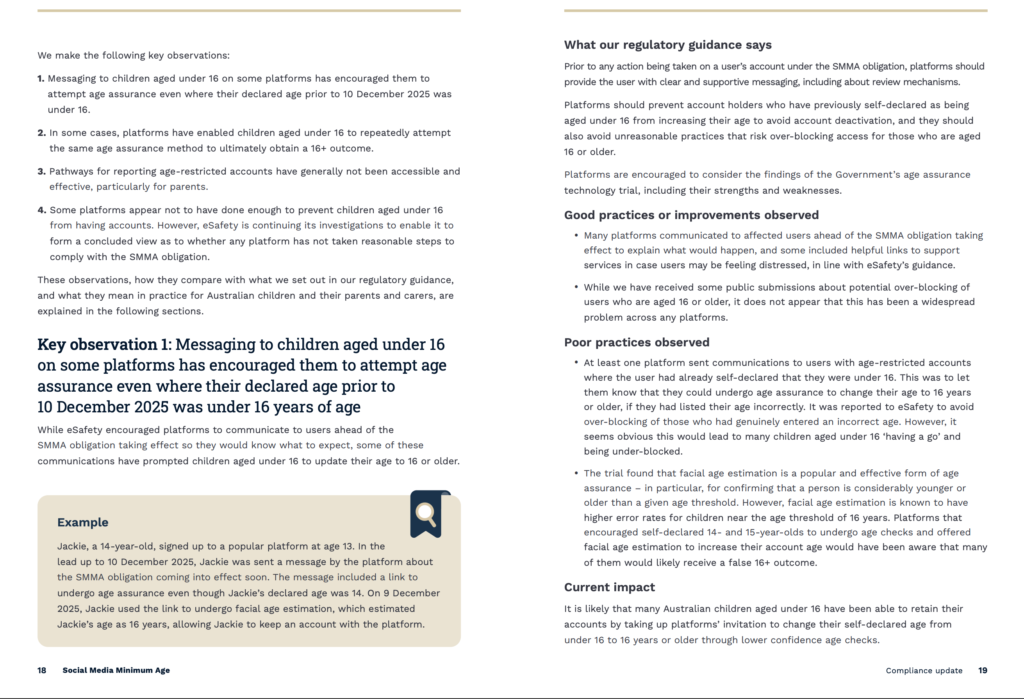
In its March 2026 compliance update, the Australian Cyber Security Agency (eSafety) stated that it had “deep concerns” about the compliance of Facebook, Instagram, Snapchat, TikTok, and YouTube. The report also noted that at least some enforcement actions could be decided by mid-2026. The report further mentioned that a new legislative rule has been registered to better target platforms with “addictive or other harmful design features.” (eSafety Commissioner, 2026; Social Media Minimum Age: Compliance update (March 2026)) This reveals regulatory loopholes. Some platforms still rely excessively on users filling in their birth dates, even encouraging those under 16 to attempt to circumvent legal registration. This means a 13-year-old could easily falsely claim to be 16 to register an account with no guarantee of further verification. While explicit legal enforcement does create barriers for platforms, the interpretation, implementation, and enforcement of the law still depend on the platforms themselves. And those companies that should be minimizing harm are instead pursuing growth, engagement, user retention, and scale.
This tension is not accidental. Platforms need to profit, and users need the protection they deserve; these are inherently conflicting, making it a structural problem.
If user engagement and emotional investment remain central to the business models of social media platforms, then truly robust security measures are likely to conflict with the companies’ business incentives. Flew’s discussion of “regulatory limitations” is helpful here. Laws can set formal obligations, but that doesn’t mean platforms will enforce them in a way that overcomes their own business incentives, technical systems, or existing moderation practices. This is why this case is so valuable. The real difficulty in regulation lies not in writing the law, but in getting platforms to enforce it in a way that may clash with their own profit logic.
This policy may sound tougher in public discourse than in reality—a law on account access sounds decisive. But once it enters the enforcement phase, deeper issues emerge: verification, interpretation, compliance burdens, design circumvention, business incentives, and unequal enforcement. Therefore, the issue here is not just technical, but also a policy design problem.
This case illustrates what online harm entails
Discussions about online harms to teenagers are often too narrowly framed. Even eSafety itself points to a deeper issue: its goal is to protect young people from design features that encourage excessive screen time and expose them to content that may harm their health and well-being. (eSafety youth page)
The perspectives of Blake, Sourander, Kato, and Scott are helpful here because they balance the argument. They’re not saying social media harms are false, but rather reminding us that the relationship between adolescent mental health and social media shouldn’t be presented as a simplistic, direct causal chain. Policy should be based on evidence, not just what sounds politically appealing. (PubMed) This isn’t to say social media is harmless, nor is it to say age restrictions are meaningless. They’re making a more cautious, mature judgment: the harm is real. But policy responses can still be too crude. This is a better way to conduct public argumentation.
This isn’t spreading panic; it’s more like analysis. We can’t simply choose between “absolute freedom of speech” and “banning all harmful content.” It encourages you to think about what online harms actually are, why they persist, how moderation works, and what forms of governance might truly address these issues. This is precisely why this case is so relevant. It transforms abstract issues in the online and social spheres into a real, ongoing policy case.
It’s time to find a new direction—shifting the focus from age restrictions to strengthening platform regulation.
More robust platform regulation is crucial for the healthy development of Australian minors and a more welcoming online environment.
Keeping young users out of platforms does not automatically change the systems that shape what they see, how often they see it, or how harmful experiences accumulate over time.
The flaw in age restrictions lies in their focus on “who can access” rather than “what kind of environment they enter.” It primarily equates security with “access.” Many online harms don’t begin the moment a user registers on a platform. The right to ban minors from social media doesn’t automatically change the systems that shape the content they see, the frequency of their access, and how harmful experiences accumulate over time.
Online harms often develop gradually after a user joins the platform. When recommendation systems, ranking systems, the constant flow of information, and weak reporting mechanisms begin to collectively influence the content a user sees and the frequency of their access, platforms cannot simply react after harm has occurred. Platforms should proactively mitigate foreseeable risks through service design and operation.
This shifts the focus from “whether specific content should be removed” to “whether the platform’s structure itself is more prone to harmful consequences.” More attention should be paid to how the platform’s recommendation system guides vulnerable users to harmful content and what preventative measures the platform has implemented beforehand. When users seek help, has the platform strengthened the feedback of its reporting and appeal systems? Cyber harm is not solely caused by individual mistakes. It can also be rooted in systems that reward user attention, repeatedly push inflammatory content, and make it difficult for users to escape harmful experiences. Platforms may remove some dangerous content, but the overall environment remains the same. Therefore, measuring security cannot simply look at “who is allowed to access the platform,” but must also look at “what measures the platform takes to prevent harm after a user accesses it.”
Conclusion: Getting to the Root of the Problem
Australia’s social media laws targeting users under 16 are hailed as a landmark move in addressing online harm. They may delay some young users’ access to online platforms and force platforms to prioritize child safety.
Broadly speaking, the implementation of this law has revealed a disturbing fact through the rebellious actions of young people. The most intractable issue in digital governance is not whether children should be protected. The real challenge lies in whether governments are truly willing to invest in building a positive and healthy community culture for social media platforms.
Australia’s official cybersecurity and online harm governance agency provides food for thought. Online harm stems not only from harmful users or content but also from flawed systems. As long as policies don’t address this issue, they will continue to expose children to online harm. But if we delve into the real core problem—proper regulation and reform of platforms—then perhaps online harm can truly be kept away from our children.
References
Blake, J. A., Sourander, A., Kato, A., & Scott, J. G. (2025). Will restricting the age of access to social media reduce mental illness in Australian youth? Australian & New Zealand Journal of Psychiatry, 59(3), 202–208. https://doi.org/10.1177/00048674241308692
Woods, L., & Perrin, W. (2021). Obliging platforms to accept a duty of care. In M. Moore & D. Tambini (Eds.), Regulating big tech: Policy responses to digital dominance (pp. 93–109). Oxford University Press. https://academic.oup.com/book/39213/chapter/338717347





Be the first to comment