The Problem of Public Consent
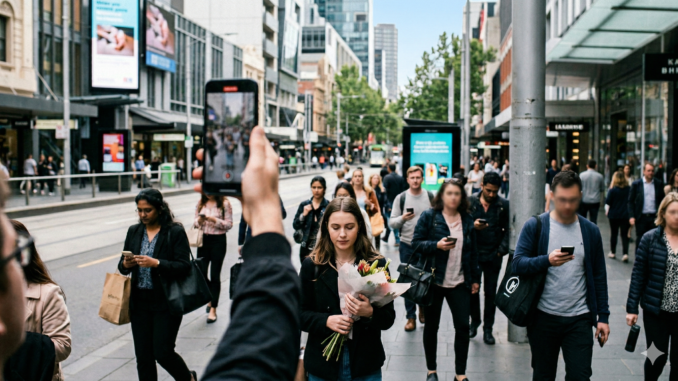
You no longer need to be a celebrity to become popular. With the advancement of technology and the continuous development of social media platforms and electronic devices, every public appearance of ordinary people brings new risks. This means that you may be filmed by someone else’s smartphone or other electronic device and unknowingly become material on their social media accounts.
This phenomenon has raised new concerns, making many people extremely sensitive to the footage around them. We instinctively look around and observe everything around us. Whether it’s shopping, fitness, or strolling down the streets, it’s hard to enjoy the scenery or focus on our activities, for fear that we might inadvertently become the material for strangers’ vlogs or promotional videos. Some people even exacerbate their appearance anxiety because of this phenomenon, repeatedly reviewing their appearance and clothing in public.
Social media creators don’t perceive such behavior as causing distress to others. They simply share their daily lives anytime, anywhere, considering it perfectly normal to film and share content online in public spaces. However, those caught on camera experience extreme discomfort. Why does the unauthorized filming of ordinary people’s daily moments and their subsequent use on social media cause such distress? Does this constitute an invasion of privacy or other digital rights?
In fact, just because people are seen in public on a small scale doesn’t mean they agree to be filmed, uploaded, and shared online. There is a clear line between being present in public places and consent to online content. When creators translate brief appearances of strangers into online content without authorization, the problem is no longer limited to personal discomfort, which violates our privacy and the right to determine how our image and daily life are used online.
Why does the public not mean permission
When someone complains that being photographed by strangers is uncomfortable, those creators always justify themselves by saying that filming public content does not violate privacy regulations, and if the person being photographed does not want to, they can avoid the camera themselves. However, this quibble is not in fact valid. Avoiding being photographed in public spaces is not the responsibility of ordinary people who are being photographed. Appearing in public spaces should not be seen as automatic permission to be uploaded to the digital world, nor should freedom be a shield against such offensive behavior.

According to an Australian Broadcasting Corporation News report, in 2022, a woman named Mary in Melbourne accepted flowers from strangers in a shopping mall, and this ordinary daily life was filmed, re-edited and uploaded to social media platforms. The video later went viral on TikTok and had over 57 million views.
While the video creator’s team argued that consent was “theoretically” not required to be filmed in public, Mary said she was disturbed by the fact that she did not consent to being filmed and uploaded, and expressed her pain in an interview, believing she was “dehumanized” and used as “clickbait”.
This distress can be understood by the concept of “situational integrity” proposed by Helen Niesenbaum. Nissenbaum believes that the source of privacy anxiety is neither control nor secrecy, but appropriateness; in other words, the privacy issue is not just “whether the secret has been exposed” or “whether there is a loss of control”, but whether the flow of information is in line with the original situation. This problem is disturbing, often due to “inappropriate flow of information.”
Simply put: when you are in a café and feel uneasy and anxious about a camera that strangers can shoot and influence, it is because your image does not stop at the scene where it should stay, that is, the café, but can be forcibly transmitted to a place it shouldn’t be at any time, such as social media, and infinitely expand the scope of being watched.
The point here is not simply that Maree was visible. The crux of the problem is not just Mary’s appearance. The root cause of the invasion of privacy is that a short moment is abstracted from the original environment and fixed by the original environment, which is widely seen by online audiences.
We can clearly understand the three elements of this theory and how they are broken with this example:
Participant: Mary. She tacitly agreed to be seen by the person in the scene at the time, rather than being seen by the 57 million strangers and being promoted by the algorithm to more strangers.
Type of information: A simple moment is permanently transformed into a digital video.
Principle of communication: The default rule of “instantaneous visibility” was unilaterally changed to “global widespread dissemination”.
At the end of the day, even if you’re in the PR space, you can’t control what others look at you, that doesn’t mean your daily life is free material for other people’s accounts.
What Is Actually at Stake? The Loss of Digital Self-Determination
If Nissenbaum’s theory helps explain how privacy is violated, the next question is what this damage looks like in practice.
This problem is not just a temporary discomfort, it is more about the loss of our digital autonomy. In other words, this issue reflects our loss of the right to decide when, where, and how our images, behaviors, and daily lives are part of the web. Digital rights are not just abstract concepts, far from our daily lives. According to the Australian Digital Rights Report, digital rights should include the rights and “reasonable expectations” that ordinary users should have on digital platforms. However, as passers-by are being photographed, these expectations have been ignored by the photographer and the person who uses the filming as the content of the social media account.
The same report also suggested that 27% of respondents had experienced personal content being posted without consent. These videos usually don’t involve intimate footage, but just capture ordinary moments, such as tired faces on the train, awkward moments in the store, or people being exercised in the background of gym videos. However, this does not mean that these videos do not have an impact on the people being filmed. Once the video is intercepted, edited, subtitled, or does not conform to the context of the video. Once they are shown to strangers, this can affect the reputation and evaluation of the person being photographed on the Internet and even affect their real life.
This is why the problem is not just one creator filming a stranger. Once an image is uploaded, it moves into a larger platform system that involves visibility, dissemination, and data usage. According to the Australian Digital Rights Report, most respondents feel that their online privacy is not in control, although many have tried to do something to protect their privacy. The report also found that 78% of respondents expressed curiosity about how social media companies handle their personal data, while 57% expressed concern about companies violating their privacy. This data shows that people are more concerned about what happens when the filmed material is uploaded, that is, who will see it, how widely it will be disseminated, and how the platform will use it and save it.
In this sense, the video taken by the bystander also reveals a kind of power imbalance. Subjects often face the risk of embarrassment, harassment, or misrepresentation, while others gain attention, interaction, or commercial value from this content. When harm occurs, people should not be called to be more cautious in public. The report pointed out that most people strongly support the platform to increase content moderation and provide a convenient complaint and reporting mechanism. Convenience is important to the public, and it means whether the general public has an effective way to address exposure they don’t want to have after the image is posted as content.
Why This Is Hard to Govern: Private Platforms, Public Harms
If bystander videos cause such obvious harm, why are they so incredibly hard to stop?
The answer is that the harm unfolds in stages. The first act, one person filming another in a café, might not clearly break a local law. In the initial stages, such as one person filming another person in a café, this behavior may not be a clear violation of local laws. The real damage happens later, when that clip is uploaded, recommended by an algorithm, remixed, and served to millions of strangers.
By that point, the issue is no longer about a rude stranger with a phone. It is a structural platform problem.
The platform’s so-called “neutral” position
In the face of criticism, social media companies often argue that they are “neutral”. But as media scholar Terry Floe points out in his book “Regulating Platforms,” this is just a sophistry.
The platform is not neutral. Content review and push is one of their core content. They organize, store, and actively push social media posts to increase user engagement and the profits they can make. Behind the popularity and widespread dissemination of a video of a passerby, there is a certain amount of effort and participation on their part. It spreads because the platform is explicitly designed to make that circulation fast, easy, and rewarding for the creator.
Private Rules for Public Spaces
This leads to a huge contradiction, which is illustrated in Australia’s Digital Rights Report. Today, digital platforms take on part of the responsibility of public utilities, in other words, they are to some extent modern squares. However, their operating systems are not transparent and are governed by the private enterprise system.
The standards of speech, data collection, or content management on these platforms are not accessible to ordinary users. Even if users do not understand or agree to these rules, or even participate in their development, they are still forced to follow them.
The Nightmare of Taking It Down
This governance blank creates a dangerous “perception gap”. Many people believe that if they deal with videos that are harmful or do not have their consent to upload them through complaints or other platform management methods, the platform will respond quickly and the video can be easily removed. But the reality is not like that, the complaint process on platforms like TikTok or Meta is actually cumbersome, slow and very processed.
The average user has high expectations for the platform’s behavior, but this expectation is very different from the platform’s perception of its own responsibility. By the time onlookers realize that their figures have been uploaded without consent and made into disseminated content, the video has long been copied and widely disseminated. It’s almost impossible for them to find a real solution to this problem.
Ultimately, the problem of governance is not just the lack of rules, but also because these rules are more about protecting corporate profits, and they are often private and unfair. But the harm to ordinary people is open and difficult to truly eliminate.
What Needs to Change
Privacy and digital rights issues caused by videos of passers-by often go unnoticed. But this blog believes that they are very serious problems. The biggest problem is not that people are filmed in public, but that the daily lives of living people are captured, uploaded, edited, and disseminated beyond their original environment without their knowledge. Not only do people lose their privacy, but they also have no control over how their image, behavior, and daily life are used by others.
Creators’ personal ethics are crucial in protecting their digital rights, and they should be more cautious before photographing strangers. But the creator’s personal ethics alone are not enough to completely solve this problem.
As consumers, we need to stop promoting this behavior. When we find that the protagonist of the video is not the creator himself, but a stranger, and the creator has not indicated that he has permission to upload, all we can do is not stay, do not like, and do not share. Refusal to participate is an effective way to stop such behavior.
At the same time, platforms should better design their systems. Platforms like TikTok, Instagram, and Meta should prioritize developing and applying privacy-preserving features. For example, they can provide creators with some simple background blur tools to help them better protect strangers in the video background before publishing videos. In addition, they should establish a sound post-release review mechanism and stop paying attention to videos that infringe on the rights of others. Once someone complains about such problems, the platform should deal with them on time.
Reference list
Chwasta, M. (2022, July 13). Melbourne woman featured in viral TikTok video without consent says she feels ‘dehumanised’. ABC News. https://www.abc.net.au/news/2022-07-14/tiktok-video-maree-melbourne-flowers/101228418
Flew, T. (2021). Regulating platforms. Polity Press.
Goggin, G., Vromen, A., Weatherall, K., Martin, F., Webb, A., Sunman, L., & Bailo, F. (2017). Digital rights in Australia. University of Sydney. http://hdl.handle.net/2123/17587
Nissenbaum, H. (2018). Respecting context to protect privacy: Why meaning matters. Science and Engineering Ethics, 24, 831–852. https://doi.org/10.1007/s11948-015-9674-9



Be the first to comment