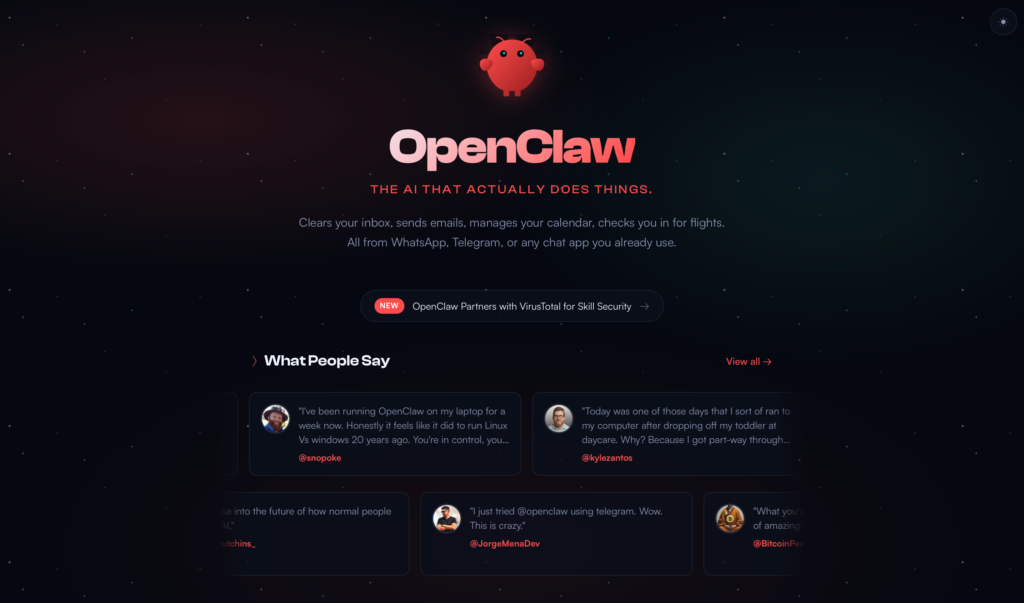
In the past, most of us regarded AI assistants as a tool to answer questions. You enter an instruction and it will give you a reply. It can summarise articles, explain concepts, and draft emails, but it will also make mistakes. But even if it makes a mistake, many times the loss is only at the text level. And the emergence of OpenClaw shows that today’s AI may be transforming.OpenClaw describes itself as an “the AI that actually does things”. It can clean up mailboxes, send emails, manage calendars, and complete tasks through the applications that people are already using.
This means that AI has changed from a “consultant” to an “executor”.
At first glance, this seems to be the most natural next step. Modern digital life is originally cut between mailboxes, calendars, files, reminders and chat platforms. A tool that can connect these systems and reduce repetitive labour is certainly efficient and attractive. But this convenience has also changed the nature of the AI problem. If early AI mainly affects what we see, then AI like OpenClaw may begin to affect how things actually happen.
Once AI begins to act across platforms, the most important question is no longer just the quality of the answer, but access, errors, control and dependence.
Why OpenClaw Matters
OpenClaw is worth discussing not only because it is a new product, but also because it represents that what AI is expected to do has changed. It is no longer just a chatbot, but an agentic AI that not only generates content, but also performs tasks.
Just and Latzer pointed out that algorithms are not neutral intermediaries. They organise relevance, shape visibility, and influence people’s actions in the digital environment (Just & Latzer, 2017). And this is even more important when AI not only generates content but also begins to do things for users.
In The Atlas of AI, Crawford believes that AI is not purely technological intelligence suspended above society, but a social-technical system composed of extraction, infrastructure, labour and power (Crawford, 2021). We say OpenClaw is “smart” or “useful”, but these words also make us ignore its prerequisites – the reason why it looks awesome is that it can connect accounts, messages, platforms and workflows.
In other words, its power comes not only from “intelligence”, but also from “connection”.
For this reason, OpenClaw should not be regarded as just a product. It is actually sending a signal: AI is changing from “speaking” to “doing”. And this is where the risk is more difficult to ignore.
Convenience Comes with Deeper Access
The first hidden cost of OpenClaw is actually very direct.
If an agentic AI assistant wants to be really useful, it can’t just stay on the surface. It must enter more parts of the user’s digital life, such as mailboxes, calendars, files and chat records. And this is not an additional item for this kind of AI, but a part of the product commitment. This means that convenience and access are tied together. Users not only get task help, but also make their digital environment more visible, and even hand over some operating capabilities to the system.
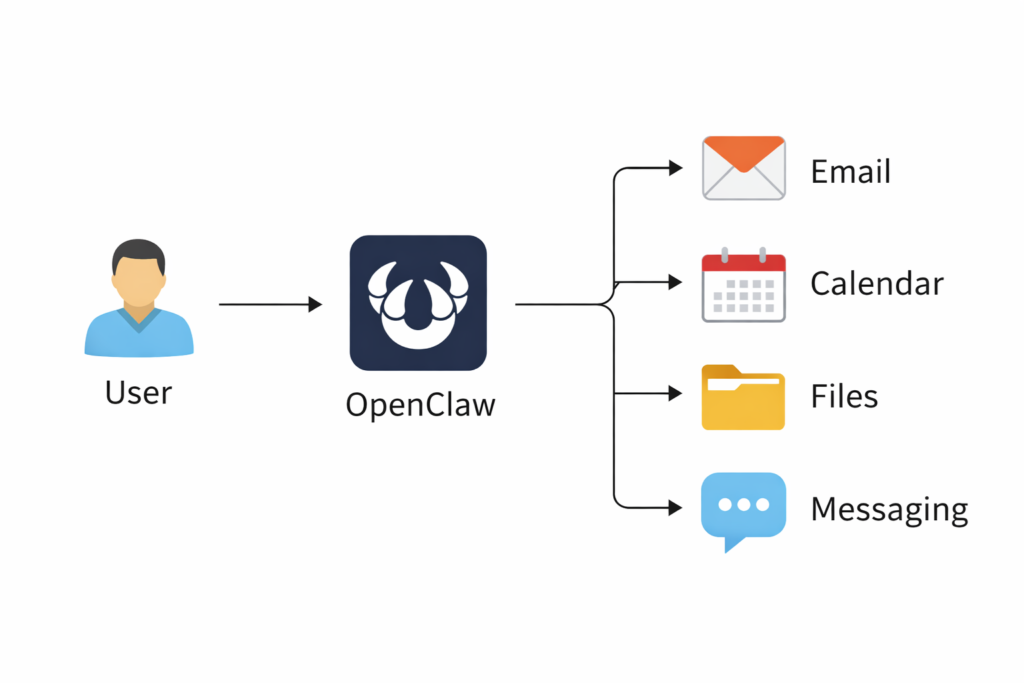
Therefore, in the context of agentic AI, the privacy risk is not only what the system knows, but what it can reach, what it can connect, and what it can do after gaining access.
Microsoft’s article on how to run OpenClaw safely suggests using independent identities for agents, minimising permissions, using short-term tokens, and setting controlled authorisation for high-privileged access, because such systems will handle untrustworthy inputs and may hold continuous permissions. That is to say, it is no longer a security model of an ordinary chat interface, but a software actor with authorisation.
Chen and Cheung’s research on WeChat users found that people often express their true concerns about privacy while continuing to use platforms that will expose privacy. Their judgements are often a cost-benefit logic: when convenience, social value or practical utility are high enough, users will tolerate a higher degree of exposure than verbally (Chen & Cheung, 2018). The same is true for OpenClaw. Users may not be unaware of the risks, and the huge convenience will make these risks seem acceptable.
This is also why agentic AI is more worthy of critical discussion. The reason why OpenClaw is attractive is that it makes many things more trouble-free.
But the problem is also here: the more trouble-free it is, the more difficult it is for users to realise what data they let it see, what permissions they have given it, and how much control they originally controlled for this convenience.
When AI Gets It Wrong, It Can Do Real Damage
Traditional chatbots make mistakes. They may fabricate facts, misunderstand questions, or give bad suggestions, but mistakes only stay at the information level.
Agentic AI has changed this because it will push mistakes to the action level. Once the system begins to draft, send, arrange, classify and process on behalf of users, the error is no longer just a wrong sentence, but may become a wrong action.
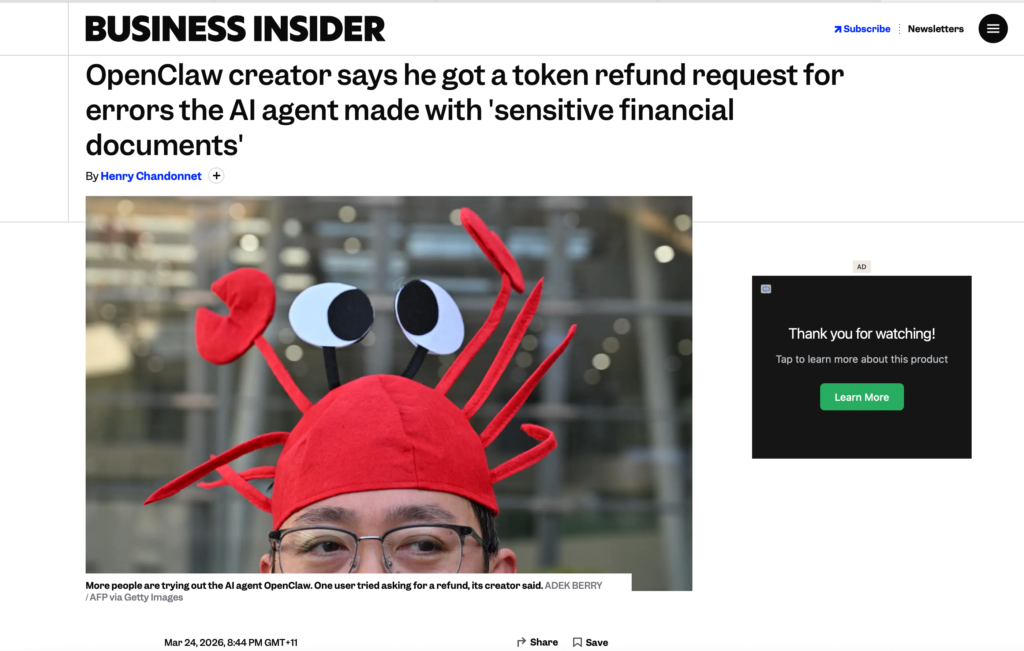
Business Insider has a very representative report that a user asked OpenClaw to process sensitive financial documents. As a result, the system had incorrect numbers, fabricated data, internal contradictions and miscalculations. It was said that it took several hours to manually correct them.
This case is particularly representative, because users originally wanted to save time and reduce trouble with the help of OpenClaw, but they had to spend a lot of time manually correcting. In this way, the meaning of “convenience” has changed. If an agentic AI brings wrong numbers and contradictory content into the sensitive workflow, users will no longer just read the wrong content, but clean up the mess for the wrong actions.
This is why agentic AI cannot be measured with exactly the same standards as ordinary chatbots.
For an ordinary chatbot, the wrong answer can usually be ignored, rewritten, or quickly replaced. But for a system that enters the real process, the cost of failure will increase significantly. Errors are no longer just inaccurate information, but may also mean extra labour, time delays, process chaos, and affecting the judgement before the error was discovered. This difference is very important, especially in financial or administrative tasks.
Just and Latzer believe that as the algorithm system acquires more delegated action, the issues of accountability, predictability and controllability will become more acute (Just & Latzer, 2017). OpenClaw is exactly in line with this description. The real question has changed from “the answer is accurate” to “by the time humans find errors, what step has the system taken?“. In the traditional chatbot scenario, we can ignore the bad output, while in the action scenario, the output may have affected documents, tasks, scheduling, and even decision-making itself.
That’s why the transition from chatbot to actor is so important. The deeper AI goes into the real workflow, the more practical its failure is, not just textual.
The More We Rely on It, the Less We Check
The third risk is more hidden, but perhaps more important than obvious system errors, that is, human supervision will be less and less.
The main selling point of tools like OpenClaw is to help people save time and reduce repeated checks. Of course, this sounds reasonable. After all, if every step needs to be confirmed manually, it will not be so efficient. But the problem is that those seemingly troublesome steps are not always bad things. Sometimes, it is these steps that make people stop, take a look and think again. Once “the more trouble you save, the better” becomes a default pursuit, human confirmation and inspection may slowly decrease.
Beer pointed out in the discussion on automation culture that automation is increasingly taking over the screening, organisation and judgement processes that were originally completed more directly and visibly by people (Beer, 2023). The problem is not only efficiency, but also the changes in the conditions of people’s participation in judgement. For agentic AI, this means that users may gradually no longer be active decision-makers, but become supervisors who only come out when there are obvious mistakes.
This change may occur very slowly. At first, we may carefully check every step of the system, but the real attraction of the tool is precisely in checking less and less. Compared with a dramatic failure, the danger is more likely to come fromthe normalisation of habits, such as “I thought it had been dealt with”.
Therefore, in addition to automating tasks, agentic AI may also automate attention. This may be one of its most important cultural effects. It will slowly change our daily habits, ways of doing things and ways of thinking.
This Changes What AI Is For
What has really changed here is not only what AI can do, but also the relationship between people and AI.
With the emergence of tools like OpenClaw, users no longer regard AI as just an object to provide advice or information, but begin to regard it as a system that can undertake some daily digital affairs.
This change is important because it changes the position of AI in daily life. A system that provides advice, the final action is still clearly in the hands of people, while a system that is allowed to send, classify, manage or trigger tasks begins to take on a more proactive role. In this sense, OpenClaw not only adds more functions, but also promotes a different relationship between users and AI.
It reflects a change from “getting advice” to “entrusting action”.
Users no longer just ask AI what to do, but increasingly let it do things directly for themselves. Once this change occurs, the problem gradually changes from whether the system is useful or not to how much daily digital life people are willing to hand over to it for the sake of convenience.
So What Should We Do About Agentic AI?
Systems like OpenClaw are entering our daily digital life, so the first thing we need to do is to change the way we look at them. We can no longer regard agentic AI as ordinary chatbots. Chatbots mainly give advice, while agentic AI can access accounts, connect services, and perform real operations. This means that we should be more cautious when facing it, not more relaxed.
For ordinary users, a good starting point is to ask a few simple but important questions before using it: what can it access? What can it send, modify or trigger? What will happen if it does something wrong? These questions sound fundamental, but they are important because “convenience” can easily make us ignore how much control we have handed over.
We also need to restrain ourselves from the habit of gradually trusting a system when there is no problem most of the time. This may be one of the biggest risks of agentic AI. The more useful it seems, the easier it is for us to take it lightly and stop checking it. But for tools that can act for us, it is not always safe enough to be right most of the time. As long as it can send emails, manage schedules, and process documents, even if it’s just a small mistake, it may bring the impact out of the screen.
This means that we need to be more careful about which tasks can be given to it and what can’t. Especially things involving sensitive information, money, formal communication, or things that are difficult to recover once a mistake occurs, should not be easily left to AI completely. Not everything that can be automated should be automated. Sometimes, it is a safer practice to retain people’s participation.
The most important thing is that we should not mistake “useful” for “harmless”. A system can help us save time while quietly changing our relationship with privacy, attention and judgement.
Therefore, the real question for us is not just how powerful the agentic AI looks, but whether we are still paying serious attention to what it has done when it acts in our name.
References
Beer, D. (2023). Automated culture. Polity.
Chen, Z. T., & Cheung, M. (2018). Privacy perception and protection on Chinese social media: A case study of WeChat. Ethics and Information Technology, 20(4), 279–289.
Crawford, K. (2021). The Atlas of AI: Power, politics, and the planetary costs of artificial intelligence. Yale University Press.
Just, N., & Latzer, M. (2017). Governance by algorithms: Reality construction by algorithmic selection on the Internet. Media, Culture & Society, 39(2), 238–258.
OpenClaw. (n.d.). OpenClaw. Retrieved April 9, 2026, from https://openclaw.ai/
Steinberger, P. (2026, March 30). OpenClaw creator says user asked for a token refund over errors in sensitive financial documents. Business Insider. https://www.businessinsider.com/openclaw-creator-user-asked-token-refund-errors-financial-documents-2026-3
Microsoft Security. (2026, February 19). Running OpenClaw safely: Identity isolation, runtime risk, and secure agent design. Microsoft. https://www.microsoft.com/en-us/security/blog/2026/02/19/running-openclaw-safely-identity-isolation-runtime-risk/


Be the first to comment