
The original purpose of age verification is to protect teenagers and children. However, in practice, due to the third-party data collection and the emergence of more risky ways to bypass verification, age verification has become a new trap regarding the leakage of user privacy.
You must have seen some checkbox prompts like this before: “Please confirm that you are over 18.” In fact, whether you are truly 18 years old or not, you can simply tick the box and then gain access to the website.
This situation usually occurs when users want to access some restricted content involving violence, pornography or bloodshed. It is meant to discourage children and teenagers from entering these spaces and to reduce potential harm.
However, this is more like a door with a broken lock. To open it, all you need to do is take the lock off and push the door open without getting any punishment. Thus, this verification approach almost entirely relies on the user’s self-discipline.
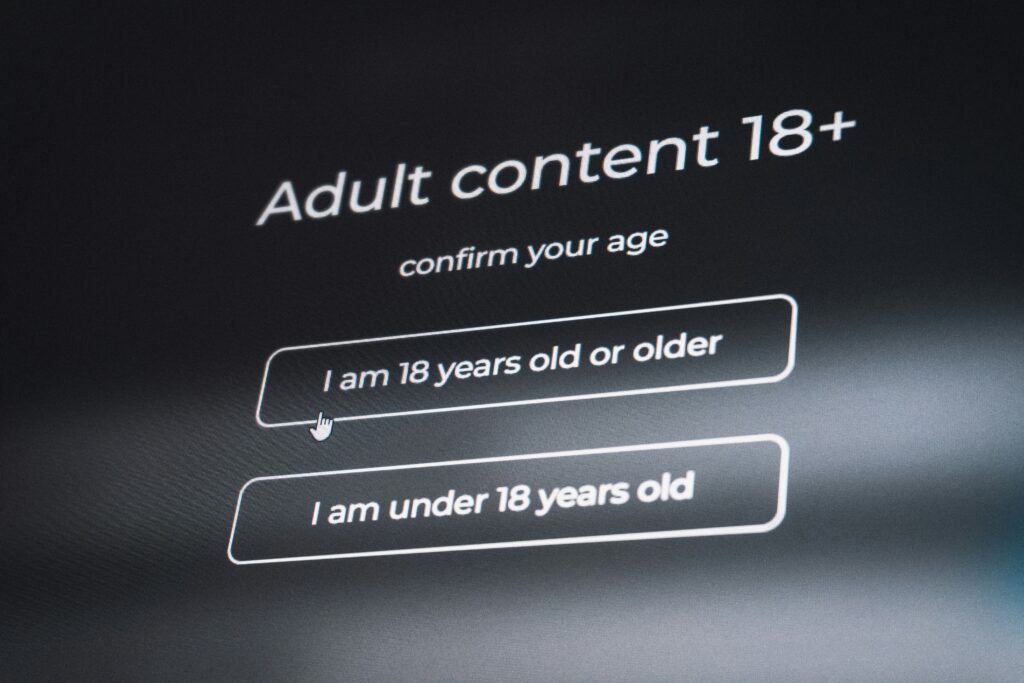
However, recently, if you are within Australia, you will find that this simple and superficial verification method has been upgraded. When you try to access pornographic websites or social media platforms that allow adult content, you are now required to go through an age verification process, which will require you to upload a selfie or ID to confirm your age or identity.
Similar measures were earlier introduced in the UK, where age verification relies on biometric technologies (Blake, 2019). In this way, people worry about their sensitive information they upload will be exposed.
Many people worry that this type of verification may harm their privacy. Because of this, some users try to avoid it by using other platforms or VPNs. However, these methods can increase the risk of data leaks. Although age verification is often presented as optional, users do not have many choices. They either share their personal data or use less secure ways to access content.
Therefore, age verification can be seen as a trap. It may seem like a way to protect children, but it actually reduces online anonymity. This makes personal information easier to collect and misuse, putting the privacy of users at greater risk.
Why Is Age Verification So Difficult?

Age verification usually means that platform use technical means to check users’ real age, instead of relying on simple self-declarations.
Common methods at present include (Woodley et al., 2025):
- Uploading identity documents (such as passports or driver’s licenses)
- Facial recognition technology (determining age through selfies)
- relying on third-party digital identity verification services
These age verifications methods may seem simple, but they involve technical challenges and may raise privacy and security concerns.
For instance, some platforms ask users to upload selfies and use biometric technology to confirm if they are old enough. However, the accuracy of facial recognition is not always reliable. This may lead to some adults being wrongly locked, while some minors accidentally obtaining access rights.
Furthermore, this kind of biometric technology can also be easy to bypass. As Goray (2025) points out, facial recognition systems only check if a face looks old enough, rather than confirming the real age of the person. This means that children could use someone else’s photo to pass the check or even buy adult accounts that have already been verified to access restricted content.
In addition, the selfies users upload is collected during the process. This creates a risk of data leaks and may threaten personal privacy.
Besides, any system that requires users to upload ID documents must face security issues of information storage and transmission. Once this information is collected, platforms often need to keep it for a long time.
However, users do not know how their data will be used or if it could be exposed. This creates serious privacy and security concerns. As a result, privacy concerns about age verification may push users to less regulated parts of the internet.
For example, some people may use VPNs to access regions without age checks, or switch to other free platforms to avoid verification. These actions can lead users to less secure environments, such as unregulated websites or untrusted apps, increasing the risk to their privacy and security.
Case Study of Australia’s Pornography Age-verification
Now, let’s go back to the moment when Australia’s internet changed.
On 9 March 2026, the second tranche of Age-Restricted Material Codes based on Australia’s Online Safety Act came into effect. In response to these new rules, many adult websites started blocking Australian users (Taylor, 2026b).
This regulation puts a real lock on the door. In simple terms, when unlogged Australian users visit Pornhub, the world’s largest porn website, they only see content that is safe for the workplace.
At the same time, these rules also apply to social media platforms that host adult content. For example, when using X, you may find that much of this content is blurred. To view it, you need to verify your age by uploading a selfie or an ID. Under this rules, accessing adult content is no longer simple.
In fact, the first set of industry codes was introduced as early as December 2025. These rules mainly focused on search engines, hosting services, and internet providers (Taylor, 2026a). The second phase expands this scope to include social media platforms and adult websites.
In addition, to make sure this “lock” works, enforcement measures have been introduced. Specifically, Companies that do not follow the rules may face fines of up to $49.5 million.
However, this seemingly secure age verification has raised widespread concerns about privacy and data security. This is because these systems are often run by third-party services, which creates a new link between your identity and the platforms you use.
In other words, even if your data is handled properly, it may still be shared across different platforms and services. Although these measures are presented as ways to protect children from harmful content, they also create new privacy risks.
As a result, users have started to change their behaviour to avoid privacy risks or get around age checks. For example, VPN downloads have increased quickly in a short time.
According to news reports (Taylor, 2026b), free virtual private network apps such as Proton VPN and NordVPN saw a surge in downloads. This pushed them into the top 20 apps on the iPhone download charts. A similar trend was seen when the United Kingdom introduced similar rules.
In fact, this shift may push users toward less compliant websites and into deeper privacy traps. On the one hand, users may turn to less secure VPN services or unregulated sites, which can increase the risk of data breaches and malware.
On the other hand, these actions also weaken the protection that platform regulations are trying to establish. We should realize that users do not bypass these systems simply to avoid checks. They do so to reduce how much personal data they have to share, and to lower the risk of data leaks.
Therefore, the Australian case reveals a clear contradiction: A policy designed to protect users may actually push them into deeper risks and increase privacy concerns. This raises doubts about how effective it really is, and also highlights the need to think more carefully about how to balance privacy and regulation.
Why Is Protecting Children Just an Excuse?

In recent years, governments and tech companies have actively promoted age verification as a way to protect children from harmful content. However, as discussed earlier, it can also create new ways for platforms and institutions to collect and monitor user data.
In the context of the internet, gaining access is essentially a trade-off of personal data. This means users usually need to share their data to use online services.
For instance, to pass age checks, users must provide personal data to confirm who they are. This information is then collected by platforms or third parties, and it may be stored for a long time.
In today’s data-driven environment, user information carries significant commercial value. Platforms often use unclear terms to make users handing over their personal data without fully understanding it (Suzor, 2019). This data is then used to build user profiles for targeted advertising or even sold to third parties (Flew, 2021). As a result, sharing personal information has become a basic condition for accessing many online services.
This phenomenon is closely linked to the privacy paradox. As Francis and Francis (2017) explain, this is when people worry about privacy but still choose to share their personal information. Age verification can be seen as an extension of this. It creates more opportunities for platforms and governments to monitor user data, while also quietly expanding their regulatory scope.
Therefore, some argue that the disadvantages of age verification outweigh the benefits. As Blake (2019) points out, this form of verification can affect freedom of expression and personal privacy, but still fails to protect children effectively.
In addition, when users try to get around these checks, they may face even greater risks. This shows the main challenges that age verification is facing today.
Finding a Balance Between Age Verification and Privacy Protection
In discussions around age verification, one question cannot be avoided: how can we balance protecting children with safeguarding user privacy?
The key to this challenge is not more identity checks, but less and more secure data collection. As Australia’s eSafety stated, service providers have the responsibility to balance data privacy with data usability in age verification systems (Taylor, 2026a).
Achieving this balance requires joint efforts from multiple sides.
From an individual perspective, users first need to develop stronger privacy awareness. This begins with taking privacy policies seriously. When age verification is required, users should carefully read not only the platform’s privacy policy but also the terms of any third-party verification provider. This can prevent the leakage of personal information without full knowledge.
In addition, users should avoid using untrustworthy bypass tools or non-compliant websites. Although these methods may help people avoid age verification, they are much harder to regulate. This can increase the risk of privacy breaches.
Besides, social media platforms should also take responsibility. For example, they should provide clearer and more user-friendly privacy policies. These rules should explain how data is collected, why it is used, and how long it is stored during the age verification process. This can improve transparency in data handling and help reduce privacy risks.
At the government level, the role is even more crucial. On the one hand, lawmakers need to clearly set data protection standards for age verification. They should also define strict limits on how personal data can be collected and used. This helps ensure that these technologies protect privacy, rather than becoming tools for surveillance.
On the other hand, enforcement agencies should take stronger action against non-compliant websites and applications. By enforcing these policies more strictly, they can better protect citizens’ digital rights.
The core issue facing age verification is privacy and data security. We should work together across different sectors to find a balance. While children are protected, users are not pushed into deeper privacy traps.
In conclusion, finding a balance between protecting minors and maintaining privacy is key to the long-term success of age verification policies. We should be clear that reducing privacy risks matters more than using more complex forms of identity checks.
To achieve this, governments, platforms, and users all need to work together. Only in this way can age verification truly protect children while respecting privacy, instead of becoming a reason for greater privacy risks.
References
Blake, P. (2019). Age verification for online porn: More harm than good? Porn Studies, 6(2), 228–237. https://doi.org/10.1080/23268743.2018.1555054
Flew, T. (2021). Regulating platforms. Polity Press.
Francis, L. P., and Francis, J. G. (2017). Privacy: What Everyone Needs to Know. Oxford: Oxford University Press.
Goray, C. (2025). Balancing consumer needs, privacy rights and company practices in online advertising, media sharing, and age assurance [Doctoral dissertation, University of Michigan]. https://deepblue.lib.umich.edu/items/f52c58e5-196c-401f-b419-4d9032aaf2f1
Suzor, N. P. (2019). Who makes the rules? In Lawless: The secret rules that govern our lives (pp. 10–24). Cambridge University Press.
Taylor, J. (2026a, March 8). Australians will have to verify their age to watch pornography from Monday. Here’s what you need to know. The Guardian. https://www.theguardian.com/australia-news/2025/sep/13/australians-will-verify-age-photo-id-facial-recognition-to-watch-pornography-from-december
Taylor, J. (2026b, March 9). VPN apps rocket up download charts in Australia as porn websites begin blocking users. The Guardian. https://www.theguardian.com/australia-news/2026/mar/09/vpn-downloads-australia-porn-sites-blocking-users
Woodley, G., See, H. W., O’neill, B., Green, L., Staksrud, E., & Haskell‐Dowland, P. (2025). Australian Teen Voices on Age Verification and Age Assurance Measures. Policy & Internet, 17(4), e70019.


Be the first to comment