Why does online hatred occur?
The video shows that online communication often quickly evolves from ordinary topics to conflict, anger, and even hatred in a short time. Entertainment content, which was originally light, often quickly becomes confrontational and easier to arouse people’s strong emotions. Many people blame this phenomenon on users themselves, believing that people have become more radical and extreme.

The problem may not only lie in the users, but also in the platform system itself. Social media does not neutrally display content. On the contrary, they will actively shape the information we see, the way we interact, and the exposure of the content. This article points out that online hatred is not simply caused by personal behavior or algorithms, but it is the result of the joint effect of platform design, participation-based incentive mechanisms, and content governance failure. These factors are superimposed on each other to create an environment conducive to the spread and persistence of online hatred.
Break the platform neutrality
In fact, many people assume that social media is a “neutral intermediary” and is only responsible for presenting user-produced content. Therefore, the responsibility for the dissemination of harmful content is mainly attributed to individual users. But this view ignores the key role of the platform in shaping online interaction. As Flew (2021) said, the platform is not only an information dissemination channel but also an important participant that actively shapes the network communication environment through design rules, algorithmic mechanisms, and governance methods. The algorithm determines the priority display, recommendation, or flow limitation of the content. The visibility of online content is not formed naturally, but deliberately screened and constructed. Therefore, “platform neutrality” conceals the power of the platform, allowing our analysis to stay at the individual level and ignore more critical system factors.
After determining that the platform is not neutral, how does the problem affect the content environment when it turns to the platform system? The platform mechanism plays a key role in content dissemination. The core goal of social media is usually to maximize user participation, and content that can trigger strong emotions is often more likely to get user discussion. Therefore, harmful and divisive content is more likely to be seen. It is not that the platform intends to promote it, but that such content is consistent with the operating logic of the platform. At the same time, functions such as liking, sharing, commenting, and recommending algorithms will also make the content spread rapidly. There is nothing wrong with these functions in themselves, but they will give offensive and controversial content a natural advantage in the dissemination. In the long run, such mechanisms have been continuously strengthened, eventually forming a network environment where harmful content is more conspicuous, more lasting, and more difficult to avoid.
This process is not only a technical problem, but also related to platform governance and community culture. As Masanari’s (2017) research on Reddit shows, bad network culture is not caused by individual users but is directly related to platform design and governance structure. It is these structures that allow bad behavior to appear and persist. Similarly, the concept of “platform racism” proposed by Matamoros Fernandez (2017) means that the underlying mechanism of digital platforms has promoted the dissemination of racist content to a certain extent. This does not mean that the platform intentionally spreads hate speech, but that its system objectively and unintentionally creates an environment conducive to the dissemination of harmful content and attracting attention.
Therefore, blaming the problem entirely on individual users is an excessive simplification of this phenomenon. The essence of online hatred is the result of the interaction of platform design, user behavior, and broader social factors.
Who is more likely to get hurt?

If the platform system deeply affects the dissemination mode and scope of dissemination of harmful content, then there will be vulnerable groups. Existing relevant research has clearly shown that network hazards are not evenly distributed among all people, but they will more seriously affect groups in a relatively vulnerable position in real society. Taking Australia’s network environment as an example, the online experience of Aboriginal users is a very representative case.
The research of Carlson and Fraser (2018) clearly points out that Aboriginal groups frequently encounter racial discrimination, malicious harassment, and social exclusion in cyberspace. Such harmful incidents are not occasional individual phenomena, but long-term and recurring persistent problems. The relevant data updated later also further confirms this trend, clearly showing that the probability of aborigines encountering hate speech and attacks on the Internet is significantly higher than that of ordinary people in society.
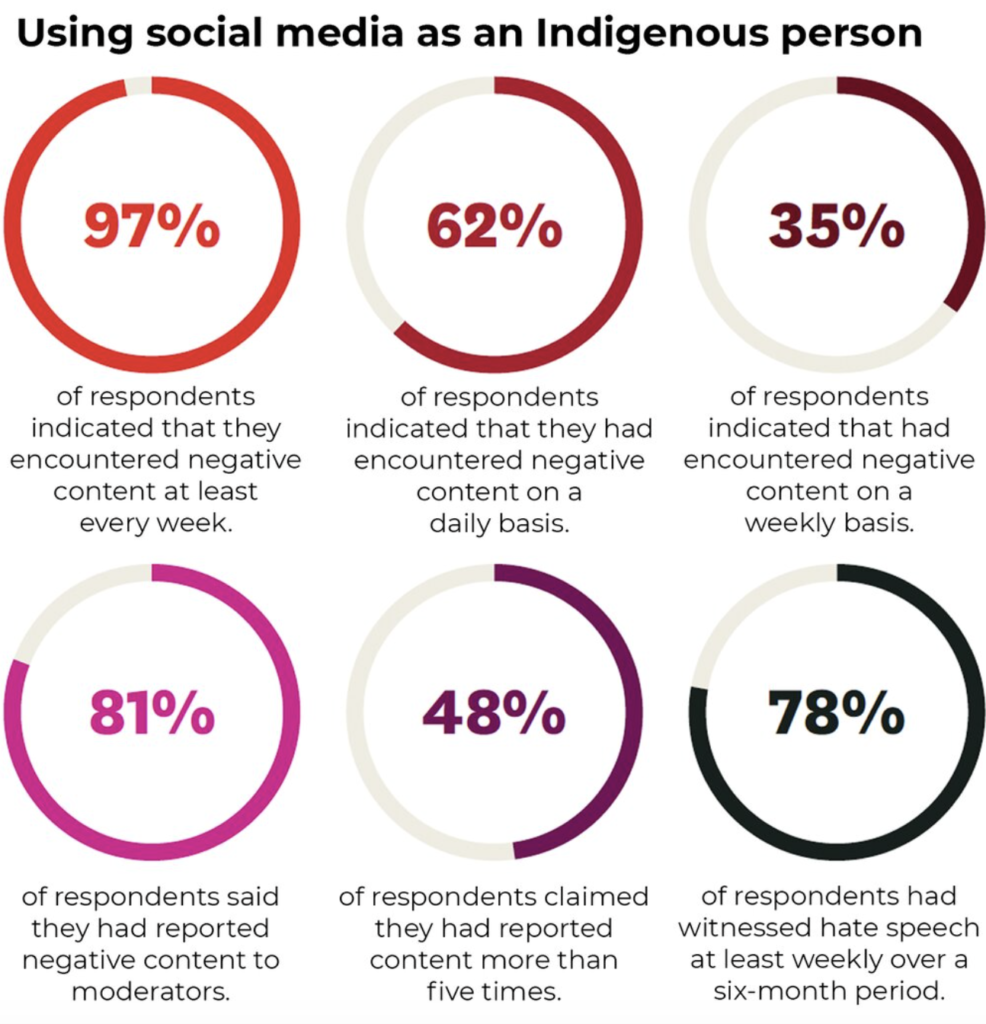
The relevant pictures also visually show the specific manifestations of such network hazards in the daily process of surfing the Internet. Many Aboriginal users frankly said that they frequently receive racially discriminatory insults, personal threats, and hostile comments. Such negative interactions are no longer accidental events, but gradually evolve into the “normality” they take for granted in their online life. This reality fully shows that online hatred not only exists widely on the platform, but also continues to penetrate and integrate into people’s daily digital life experience. The platform’s anonymous mechanism, the function of rapid content dissemination, and the lack of protective measures not only further increase the exposure of harmful content but also weaken the ability of victim users to effectively fight back and protect themselves. Because of this, negative online interactions against aborigines are not only becoming more and more frequent but also more difficult to avoid and resist.
Regarding this phenomenon, we can understand it with the help of the “platform racism” mentioned above (Matamoros-Fernandez, 2017). The concept points out that the digital platform does not passively carry racist content, but its underlying system, which will actively promote the spread and fermentation of such harmful content to a certain extent. From this point of view, hate content does not simply exist on the platform, but is constantly shaped and strengthened in a series of operations of the platform. In such an environment, Aboriginal users not only have to face the harm of online hatred itself, but also must bear the additional psychological pressure and time and energy costs to deal with. This also reflects that the shortcomings at the platform governance level will make this group not only more likely to be exposed to harmful content, but also more difficult to get rid of the hostile and harmful network environment.
Limitations of governance
When we look at online hatred, the limitations of platform governance will be exposed. Although social media platforms constantly emphasize their efforts in content review, claim to have built a perfect content control system, and invested a lot of manpower and technical resources to carry out audit work, in actual operation, there are still obvious and difficult loopholes in these measures, which cannot fundamentally curb the network. The growth and spread of harmful content.
First, there is a lag in the content review itself. As Sarah T. Roberts (2019) pointed out, most of the content review of the platform belongs to the post-intervention mode, usually starting the processing process after the harmful content is released and has caused adverse effects. This means that even if the relevant illegal content is eventually deleted by the platform, the negative impact cannot be reversed or undone. In such a fast-spreading digital environment, the delay of post-audit greatly weakens the effectiveness of the platform protection mechanism, and it is difficult to achieve timely protection for vulnerable user groups.
Secondly, there are obvious differences in the implementation of content review in different regions and situations. A special study on Facebook’s platform governance in the Asia-Pacific region clearly shows that the platform’s control policy for hate speech will be constrained by multiple factors in the actual implementation process (Sinpeng, A.). This inconsistent implementation method will directly create many loopholes in the platform content protection mechanism, and these loopholes will make those vulnerable marginal groups who are already more susceptible to online hatred fall into a more lack of security, further exacerbating the uneven impact of network harm.

The deeper problem is that there is an unavoidable structural contradiction between the platform business model and effective governance. The core of the commercial operation of social media platforms has always been to maximize user participation and extend user usage time, to obtain traffic, advertising revenue, and commercial value. Observing the law of network content dissemination, the content that is easiest to attract users to click, comment, forward, and quickly increase participation is often the most controversial content that can provoke extreme emotions, incite antagonism, and even potentially harmful content itself. Therefore, the platform has always faced an inherent contradiction that cannot be reconciled: on the one hand, it needs to rely on high-emotion and controversial content to obtain traffic and commercial benefits, and on the other hand, it needs to fulfill its governance responsibilities and prevent the large-scale spread of such harmful content. The conflict between commercial interests and public responsibility has always been difficult to balance.
This series of problems is enough to show that the limitations of platform governance are not only simple technical loopholes and insufficient audit processes, but also structural problems arising from the operation logic of the platform. If the platform still relies on the business model with user participation as the core, it does not change the operation logic of traffic first and revenue priority, and only relies on post-post-content review and modification control measures to fundamentally reduce the spread of online hatred; it cannot achieve the expected effect at all.
How to remedy it?
Therefore, if the platform really wants to solve the problem of online hatred, it must jump out of a single content audit framework, abandon the excessive dependence on the platform’s self-governance, and establish a more comprehensive and systematic accountability mechanism and governance method. Woods and Palin put forward the principle of “obligation to pay attention”. They believe that the platform should take the responsibility to actively prevent the occurrence of hazards, instead of responding passively after the damage has appeared and spreads (Woods and Perrin, 2021). This proposal shifts the governance focus of the platform from auditing the content one by one to adjusting its own system in a more macroscopic way.
However, it is a difficult task for platform governance to change from “post-remediation” to “prevention”. Although there are many calls for strengthening content censorship or external supervision in society now, if the platform still takes user participation and traffic revenue as its core operational goals, online hate speech will still occur. Therefore, platform governance should not only be a superficial problem, but also improve the underlying structure and logic of its own system; the problem of online hatred cannot be solved at the root cause.
Conclusion
Through the discussion of this article, it is understood that the breeding and proliferation of harmful content on the Internet is never the result of simple spontaneous user interaction or objective operation of technology, but the result of the interaction and joint inducing design at the bottom of the platform, the incentive mechanism with user participation as the core, and the limitations of the platform’s own governance. The impact of online hatred requires the platform to change its positioning as a “neutral intermediary” and improve the underlying system and logic within itself to build a more responsible and fairer digital world.
Reference List:
- Carlson, B., & Frazer, R. (2018). Social media mob: being Indigenous online. Macquarie University.
- Flew, T. (2021). Regulating Platforms. S.L.: Polity Press, pp.91–96.
- Kennedy, T. (2021). 97% of Indigenous people report seeing negative social media content weekly. [online] Phys.org. Available at: https://phys.org/news/2021-06-indigenous-people-negative-social-media.
- Massanari, A. (2017). #Gamergate and The Fappening: How Reddit’s algorithm, governance, and culture support toxic technocultures. New Media & Society, [online] 19(3), pp.329–346. doi:https://doi.org/10.1177/1461444815608807.
- Matamoros-Fernández, A. (2017). Platformed racism: the mediation and circulation of an Australian race-based controversy on Twitter, Facebook and YouTube. Information, Communication & Society, 20(6), pp.930–946. doi:https://doi.org/10.1080/1369118x.2017.1293130.
- Philosophy, W. (2026). PHILOSOPHY – EMERGING TECHNOLOGIES 3: Should Online Platforms Censor Hate Speech? [online] Youtu.be. Available at: https://youtu.be/3L-ii4BMoSQ?si=fuF_ubn0fzdFwdk4 [Accessed 18 Apr. 2026].
- Roberts, S.T. (2019). Behind the screen: Content moderation in the shadows of social media. Yale University Press.
- Sinpeng, A., Martin, F.R., Gelber, K. and Shields, K. (2021). Facebook: Regulating Hate Speech in the Asia Pacific. ses.library.usyd.edu.au. [online] doi:https://doi.org/10.25910/j09v-sq57.
- Woods, L. and Perrin, W. (2021). Obliging Platforms to Accept a Duty of Care. Oxford University Press eBooks, [online] pp.93–109. doi:https://doi.org/10.1093/oso/9780197616093.003.0006.
Be the first to comment