
Think about the last time you downloaded a new app. Whether it was as music listening app, a messaging platform, or a quick game to pass the time on the bus, you were almost certainly met with a wall of tiny text and a brightly colored bold button that said: “I Agree”.
If you’re like the vast majority of the population, you didn’t read the text. You clicked. And right at that moment, you didn’t just sign a basic software contract; you stepped into a carefully engineered trap.
This isn’t just about users being “lazy” with their digital settings. It is a fundamental crisis of digital rights and human autonomy. The “I Agree” button is not an accident of design; it is the culmination of “dark patterns”—user interface choices deliberately designed to manipulate us into making decisions that are not in our best interest. We are cognitively overloaded. Research suggests that if an average internet user actually took the time to read every privacy policy they encountered in a single year, it would take roughly 76 working days just to get through the text (Madrigal, 2012).
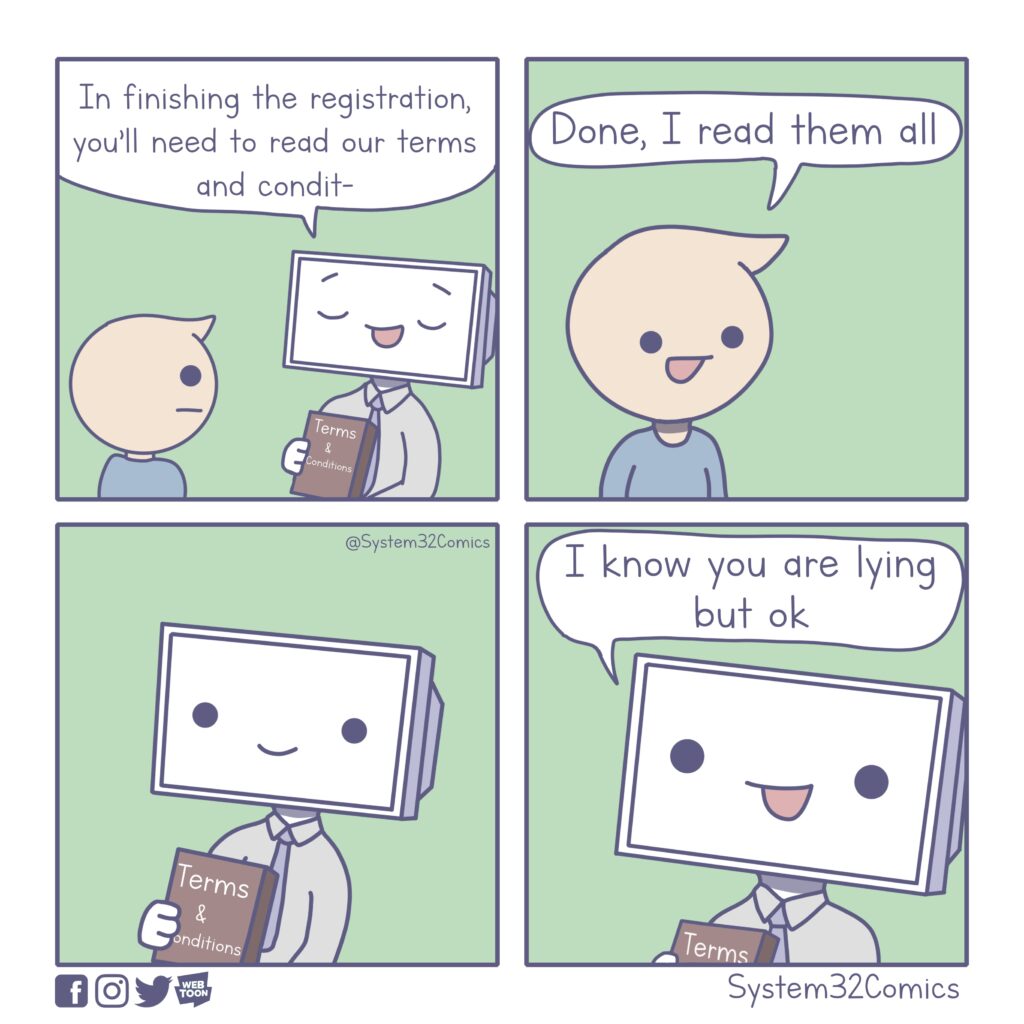
By presenting these terms at the exact moment of peak utility (when you just want to listen to a song or submit an assignment) platforms leverage our present bias. We value the immediate reward of the app over the abstract, future risk of a data breach. In this environment, “consent” is not a meaningful legal act; it is a forced compliance ritual. In 2026, the “I Agree” button represents the exact moment we hand over our personal autonomy to private companies, bypassing democratic laws entirely.

The Secret Rules of the Game: “Lawless” Governance
To understand the severity of this trap, we have to look at how power operates online. According to Nicolas Suzor (2019), major tech platforms aren’t just businesses anymore; they operate as private governments. They write their own constitutions—the “Terms of Service”—that dictate what you can say, who can see your data, and how your life is tracked. These rules are almost always written in dense, legalistic jargon designed to protect the company’s legal interests, not the user’s rights.
In traditional democratic systems, laws are subject to public debate, judicial review, and the separation of powers. In the digital frontier, the developer is the legislator, the judge, and the executioner. We don’t vote on these rules, yet they govern our digital lives more aggressively than the laws of our own countries.
The true nature of the trap is that digital participation is no longer optional. To work, study, or socialize today, you must submit to these private laws. For a professional or a student, being “de-platformed” or losing access to digital communication tools isn’t just an inconvenience—it can sever your livelihood and social connections. This power imbalance is exactly why the “I Agree” button is a trap; it is a non-negotiable surrender to a regime that we did not elect and cannot easily hold accountable.
Why does it feel so violating when we find out an app is quietly tracking our location or “leaking” our data?
It’s not necessarily because we have deep, dark secrets. According to Helen Nissenbaum (2018), it’s because the app has shattered our “contextual integrity”.
Nissenbaum (2015) argues that privacy is actually about the appropriate flow of information. Think about it in the physical world: you expect the sensitive information you share with your doctor to stay within the “medical context.” You would be horrified if your doctor sold that conversation to your employer or a marketing firm.
The “I Agree” trap works by tricking us into a model that ignores these natural boundaries and appropriateness. Once you click that button, your data automatically flows from a private context into a commercial one—sold to data brokers or fed into AI profiling models—without you ever truly understanding the shift. Thus, the context collapses, and with it, your privacy.
Case Study: The 2026 Educational App Crisis
The danger of this trap becomes heartbreakingly clear when it involves our most vulnerable citizens: children. A major UNSW-led audit released in April 2026 analyzed nearly 200 school-endorsed educational apps in Australia. What they found was a systemic failure of digital governance and a massive breach of institutional trust.
While many parents and teachers assume that a “Kids” label or a government recommendation implies safety, the UNSW audit found the exact opposite to be true. In fact, 76% of apps targeted at children showed “policy distortions”—where the app’s actual behavior contradicted its privacy promises. This technical reality makes a mockery of the “I Agree” button.
Key Findings by Researchers …
Instant Harvest
89.3% of the audited apps began transmitting sensitive data to advertising networks the moment they were opened.
Data was stolen before the child even tapped “play.
Literacy Gap
97% of the privacy policies required university-level literacy to comprehend.
For a busy parent or a teacher, “informed consent” is a literal impossibility.
Hidden Dangers
Almost 80% of apps containing “hard-coded secrets” that leave networks vulnerable to anyone who decompiled the application.
Apps branded specifically for “Preschool” were actually found to be less safe than we thought.
The audit didn’t just find “tracking”; it found the use of persistent identifiers. Unlike a temporary cookie, these are unique codes tied to the hardware of a child’s tablet that cannot be easily reset.
The audit highlighted the role of Software Development Kits (SDKs). Most educational app developers do not build their own analytics tools; they “plug in” ready-made kits from giants like Google (Firebase) or Facebook (Meta SDK). These kits are the silent observers in the classroom. Even if a developer has good intentions, these third-party SDKs are designed to harvest “idle telemetry”—the collection of data while a system, vehicle, or application is in a non-active or standby state.
This creates a transparency paradox. The school believes they have vetted the app, and the developer believes they are providing a tool, but the underlying infrastructure is hard-coded for surveillance. This means that even if the data isn’t being sold, it is being left in a “unlocked house” where any malicious actor who decompiles the app can get access to the school’s digital kingdom.
“We matched the privacy policy with the dynamic analysis – when the app is running, whether it is collecting the data and whether it is mentioned in the privacy policy or not… Only one in four were matching. Some of the policies appear to have been generated using AI tools.”
—Dr Rahat Masood, Senior Lecturer, UNSW (2026)
This case study proves that the “I Agree” trap is a governance black hole where schools and governments have effectively delegated their duty of care to the very platforms harvesting the data.
Digital Rights at the Margins: The Cost of Saying “No”
“Data-hungry algorithmic systems are introduced into every part of society, gobbling up data about people and their practices to feed decision-making systems in sectors as varied as criminal justice, advertising, transportation, and news delivery. The privilege to “opt out” of these data-oriented systems is increasingly unattainable.”
—Marwick & boyd (2018)
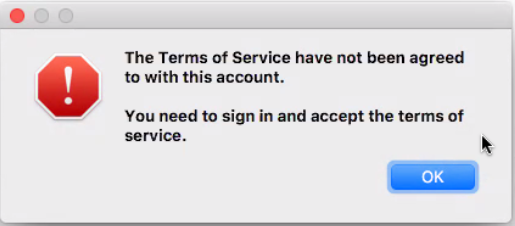
We often talk about the “I Agree” button as if it offered a genuine choice. But what actually happens if you say no? In 2026, refusing a Terms of Service agreement doesn’t just mean skipping a new game; it means total exclusion from modern life.
This “consent” trap hits marginalized communities the hardest. Vulnerable groups are routinely forced to trade their privacy for access to essential services. When critical infrastructure, like education, banking, and social services, is controlled by private platforms, the “I Agree” button ceases to be a contract. It becomes an ultimatum.
Consider the educational app crisis. If a student refuses to surrender their data to a mandatory school app, they might fail their assignments. For those who lack the financial or social power to seek private alternatives, the trap is absolute. You either submit your personal data to a private digital government, or you accept being entirely erased from the system.
As suggested by Marwick & Boyd (2018), this can be more dangerous and intrusive than one might think. For a privileged individual, a data leak might just result in annoying, highly targeted Instagram ads. But for those at the margins—such as LGBTQ+ communities, immigrants or victims of domestic violence—a breach of privacy can lead to physical danger, state surveillance, or systemic discrimination. When we are forced to click “I Agree,” we are agreeing to a system of automated surveillance that inevitably hits the most vulnerable people the hardest.
Reclaiming Our Rights: Opening the Black Box
The solution to the “I Agree” trap is not simply “better digital education” for users. We cannot expect every citizen to become a cybersecurity lawyer just to safely download a homework application. We need a massive structural shift toward Algorithmic Accountability. But what does that actually mean?
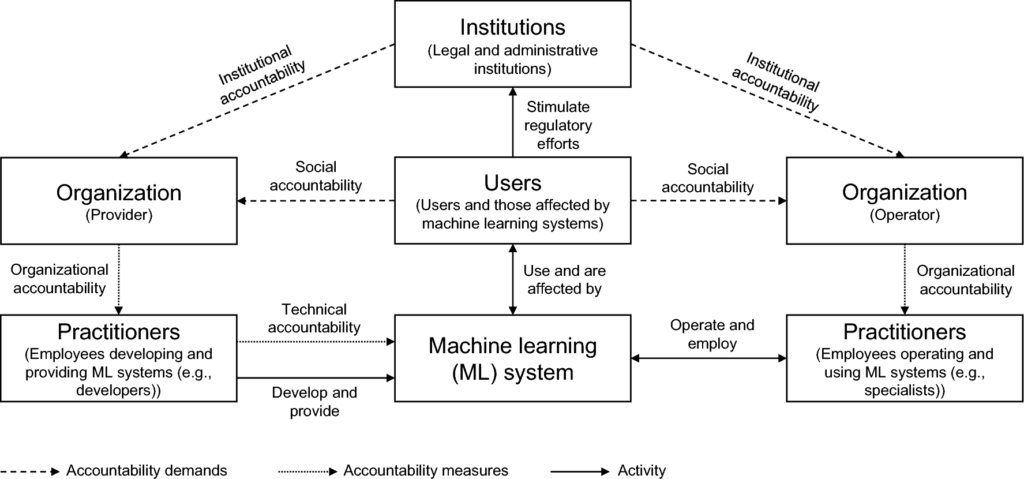
Algorithmic accountability types and stakeholders in Algorithmic Accountability – Horneber and Laumer (2023)
At its core, algorithmic accountability is the principle that tech companies must be legally responsible for the real-world impact of their code (Horneber & Laumer, 2023). Right now, the “I Agree” button places the entire burden of safety on you. If an app silently harvests your child’s data, the platform points to the 50-page contract you clicked and says, “You agreed to this”.
Algorithmic accountability flips this dynamic. It demands that the “black box” of app development is forced open for independent audits. It means regulators must proactively test apps to ensure they aren’t running hidden trackers or “idle telemetry,” rather than waiting for a catastrophic data breach to make headlines. If an app is deployed in a public institution like a school, its data-sharing behavior must be publicly verified.
Ultimately, we need to replace this broken consent trap with a mandatory duty of care. It should be strictly illegal for a platform to collect data that falls outside of its core context—regardless of what a user accidentally agreed to in the Terms of Service. It’s time we stopped treating the “I Agree” button as a legal shield for tech giants, and started demanding digital infrastructure that is safe by design.
Take Action: Reclaiming Your Context
We are waiting on the law to catch up, but you can take immediate steps to push back against the trap today by:
Auditing Your Permissions
Take 5 minutes to go into your phone settings and meticulously check which apps have unnecessary access to your location, microphone, or camera.
If a game wants your GPS coordinates, turn it off.
Demanding Simplicity
Support legislative pushes and civil society tools that advocate for the simplification of Terms of Service.
For instance, the UNSW researchers are currently developing a visual “traffic light” system for parents to quickly assess app data tracking without reading legal text.
Stopping Delegating Trust
Don’t assume an app is safe just because it has a “Kids” label or is recommended by a reliable institution.
Always check the eSafety Commissioner‘s latest guidelines before taking action.
Digital rights are the human rights of the 21st century. It’s time we stopped treating the “I Agree” button as a door we simply have to walk through, and started seeing it for what it is: a broken system that demands a new social contract.
References
Australian children’s data at risk through approved school apps. (2026). UNSW Sites. https://www.unsw.edu.au/newsroom/news/2026/04/australian-children-data-at-risk-through-approved-school-apps
Horneber, D., & Laumer, S. (2023). Algorithmic Accountability. Business & Information Systems Engineering, 65. https://doi.org/10.1007/s12599-023-00817-8
Madrigal, A. C. (2012, March). Reading the Privacy Policies You Encounter in a Year Would Take 76 Work Days. The Atlantic; The Atlantic. https://www.theatlantic.com/technology/archive/2012/03/reading-the-privacy-policies-you-encounter-in-a-year-would-take-76-work-days/253851/
Marwick, A. E., & Boyd, D. (2018). Understanding Privacy at the Margins: Introduction. International journal of communication [Online], 1157+. https://link.gale.com/apps/doc/A561120196/AONE?u=usyd&sid=bookmark-AONE&xid=3df64beb
Nissenbaum, H. (2015). Respecting Context to Protect Privacy: Why Meaning Matters. Science and Engineering Ethics, 24(3), 831–852. https://doi.org/10.1007/s11948-015-9674-9
Suzor, N. P. (2019). Who Makes the Rules? In Lawless: The Secret Rules That Govern our Digital Lives (pp. 10–24). Cambridge University Press. https://doi.org/10.1017/9781108666428



Be the first to comment