
On October 14, 2019, a 25-year-old woman was found dead in her home in Seongnam, South Korea. Her name was Choi Jin-ri — known to the world by her stage name, Sulli. She was a singer and actress. For years, she had been called a “female pervert,” told she “needs to get tested for drugs,” and buried under such relentless abuse that she had spoken openly about developing social phobia and depression as a result. Less than three months after her death, her close friend and fellow K-pop artist Goo Hara — who had endured her own storm of online harassment — was also found dead.
Two lives. Lost within months of each other.
And if the comments directed at them had been taken seriously and properly managed at the time, things might have turned out very differently.
This blog is about the violence and harm that the internet can cause. But more than that, it asks a harder question: why do the platforms and apps where all of this happens keep getting away with it? Because there is an uncomfortable truth that we need to sit with: online hate does not just happen on platforms. In many ways, it happens because of them.
The World Behind the Stage: Understanding the K-pop Machine

To understand what happened to Sulli, you first need to understand the world she lived in. K-pop is not just a music genre — it is a carefully engineered cultural industry. Performers are often signed as children, trained for years under strict contracts, and then launched into a public life that demands near-total conformity to a carefully managed image. Fans are not passive consumers; they are intensely invested communities who feel a strong sense of ownership over their idols’ public personas — and sometimes their private lives too.
The moment an idol steps out of line — dating publicly, speaking out politically, or simply wearing what they want — the backlash from certain corners of that fanbase can be swift, organized, and merciless. Sulli became one of the most targeted figures in this kind of hostility. She spoke openly about mental health, advocated for women’s rights and abortion access — still deeply contested topics in South Korea — and she had spoken openly about not liking to wear a bra. Each time triggering a fresh wave of attacks.
In June 2019, just months before her death, Sulli became a co-host on a JTBC variety show called The Night of Hate Comments (악플의 밤) — a programmed where celebrities sat on camera, read out malicious comments directed at them, and responded in real time. The fact that a show like this could exist tells you everything about how normalized online abuse had become in South Korea. And the fact that the show was cancelled the week after Sulli died is a hard truth for all of us: we talked about the problem for long enough, and still failed to protect her.
“Female Pervert”: What the Comments Actually Said

Take a close look at that screenshot. These are not anonymous threats buried in some dark corner of the internet — these are comments on a mainstream Korean entertainment platform, each with a visible like count sitting right underneath. “Female pervert” — 13 likes. “She needs to get tested for drugs” — 9 likes. “I don’t even think the mental institutes can help her” — 9 likes.
Those numbers are not just numbers. Media researcher Matamoros-Fernández (2017) argues that platform features like likes and shares give harmful content a kind of legitimacy — sending a signal to both the algorithm and other users that this content is worth paying attention to. She found that platforms do not simply “host” harmful content passively — they actively participate in its spread: “sharing and liking practices contributed to amplify overt and covert speech across platforms” (p. 938).
Every like on a comment calling Sulli a “female pervert” was a signal telling the platform to push that content in front of more people.
This is the heart of what Matamoros-Fernández (2017) calls “platformed racism” — a concept originally developed to describe race-based harassment, but one whose logic applies just as directly to the gendered violence Sulli experienced. The point is simple: this kind of harm is not a “bad users” problem. It is the product of platform design, algorithmic logic, and business models built around maximizing engagement — no matter what form that engagement takes.
She Only Wanted to Share Good News: The Story of Zheng Linghua

If you think what happened to Sulli is a problem unique to the Korean internet, consider what happened in China.
In July 2022, Zheng Linghua, a music student from Hangzhou, received an offer of admission to a graduate programme at East China Normal University. To celebrate, she went to the hospital where her grandfather was being treated and let him open the envelope himself. She had pink hair. She took a photo and posted it on Weibo.
Within days, marketing accounts had stolen the image and used it as advertising material. Strangers began flooding her account with abuse. Her pink hair, her appearance, her actions — all of it became a reason to attack. Some users reframed the photo as an “old man-young woman romance.” Others simply hurled insults. She dyed her hair back to black, but the harassment did not stop.
She tried to fight back — documenting her experience, taking legal action, refusing to give up even as her mental health continued to deteriorate. But the law could barely help her: at the time, a single comment needed 5,000 views or 500 reposts to constitute criminal defamation — meaning thousands of attacks that were each “not serious enough” on their own fell entirely outside the reach of accountability (CCTV News, 2024).

On January 23, 2023, Zheng Linghua died. She was 23 years old. She left behind a suicide note in which the first reason she cited for her death was the cyberbullying she had endured. One of the people who had attacked her, when contacted by a journalist afterward, said: “I only left a comment. Normal people can adjust. You just don’t look at it” (CCTV News, 2024).
From a graduation photo full of smiles to a hospital diary that stopped on Day 9: ONLY SIX MONTHS.
The Platform Is Not a Bystander — It Is a Participant

At this point, you might be tempted to conclude that the problem is simply “people being cruel on the internet.” But that framing lets platforms off the hook far too easily.
Think about what both cases have in common. In Sulli’s case, years of sustained, gendered abuse played out across Instagram, Naver, and Korean entertainment portals — platforms that collected engagement data on every hateful comment, every like, every outraged reaction, and used it to determine what content to surface next. In Zheng’s case, a stolen image was amplified across Weibo by marketing accounts whose entire purpose was to generate clicks, while the platform’s content moderation systems remained largely absent.
Matamoros-Fernández (2017) shows us precisely how this works in practice. In her analysis of the online harassment of Indigenous Australian football player Adam Goodes, she found that platforms’ recommendation algorithms actively generated more racist content once users began engaging with it: “By liking and watching racist content… the platforms’ recommendation algorithms generated similar content about controversial humour” (p. 939).
The algorithm does not ask whether content is fair, accurate, or harmful. It asks whether people are clicking on it. And outrage — including the kind directed at Sulli for not wearing a bra, or at Zheng for having pink hair — clicks exceptionally well.
This problem is made worse by the fact that users learn to exploit platform features to their advantage. Matamoros-Fernández (2017) documents how attackers used Twitter’s “sensitive media” filter to hide their harassment while still allowing the content to keep circulating. In South Korea and China, the same pattern plays out: gendered insults get repackaged as “fan opinions” or “just a joke,” and coordinated mass-reporting campaigns are used to get victims banned rather than perpetrators — the platform’s own safety tools turned against the very people they were meant to protect.
Platforms are not simply failing to manage this problem. In many ways, their design is the problem.
“It’s Sometimes Safer to Stay Silent”: What Victims Actually Go Through
Talking about platform mechanics can make online harm feel abstract — like a policy debate, not a human story. But the consequences for real people are anything but abstract.
Research by Carlson and Frazer (2018) offers a framework for understanding what sustained online harassment does to a person. Their participants described not isolated incidents but a “multi-layered terrain” of hostile interactions, leaving many feeling “more, rather than less, alone online” (p. 1) — and over time, many adopted what the researchers call “selective identification”: deliberately hiding aspects of their identity to avoid further attack (Carlson & Frazer, 2018, p. 10).
The parallel with Sulli and Zheng is direct and painful. Sulli was punished for refusing to perform the version of femininity the public expected — every time she wore what she wanted or said what she thought, a new wave of attacks followed. She joined a show about hate comments, perhaps hoping that visibility would create accountability. It did not save her. Zheng tried fighting back through legal channels, documented her experience, dyed her hair black, and eventually closed her account — doing exactly what Carlson and Frazer (2018) describe as retreat: pulling back, adjusting, trying to make herself a smaller target. It still was not enough.
Carlson and Frazer’s (2018) research makes clear that this kind of harm is not “hurt feelings.” It is cumulative identity-level damage — a person’s ability to exist publicly as themselves, steadily eroded with no clear endpoint. And this harm falls disproportionately on those who are already most vulnerable: the people who are targeted precisely because of who they are (Carlson & Frazer, 2018). Neither of them had done anything wrong. Both paid for it with everything.
Why Reporting It Does Nothing: The Moderation Problem
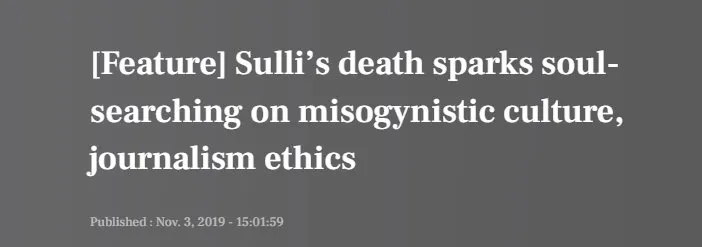
After Sulli’s death, Korea’s second-largest portal Daum closed its entertainment comment sections — an implicit acknowledgment that its own platform had created the conditions for her harassment. Bills were submitted to parliament. The public response was enormous.
But those comments had been there for years. The reports had been filed. Why did it take two deaths for anyone to act?
A 2021 study by Sinpeng, Martin, Gelber, and Shields, examining how Facebook regulates hate speech across the Asia Pacific, provides a sobering structural answer. Their core finding is that platforms’ content moderation systems are fundamentally ill-equipped to handle hate speech as it actually occurs in practice — especially when it is subtle, cumulative, or gendered.
The researchers distinguish between two types of harm that hate speech can cause. Causal harms are the direct consequences of specific hateful acts — someone reads an abusive comment and is hurt by it. Constitutive harms are more insidious: they are the harm caused simply by the existence of certain kinds of speech — content that degrades, subordinates, and marks certain people as legitimate targets of hostility, regardless of whether any individual comment crosses a legal threshold (Sinpeng et al., 2021, p. 6).
Together, they constituted a sustained campaign of dehumanisation. And platform moderation systems are almost entirely designed to catch the former, while remaining blind to the latter.
Sinpeng et al. (2021) also document a phenomenon they call “reporting fatigue” — a state where users who repeatedly report harmful content and receive no meaningful response eventually stop reporting altogether, because they no longer believe it will make any difference (p. 7).
Every person who reported a hateful comment directed at Sulli and received an automated “this does not violate our community standards” response was experiencing this. The platform’s moderation system did not just fail to help — it actively discouraged people from trying.
Perhaps most significantly for these cases, Sinpeng et al. (2021) find that platform moderation is systematically less effective against gender-based hate speech than against racial or ethnic hate — reflecting both the difficulty of algorithmically identifying gendered insults and a broader pattern of treating gender-based harm as less serious (p. 3).
This is not a coincidence. It is a structural bias embedded in the way platforms define and enforce their own rules — one that left Sulli and Zheng without meaningful protection.
They Made the World Listen — Even After They Were Gone
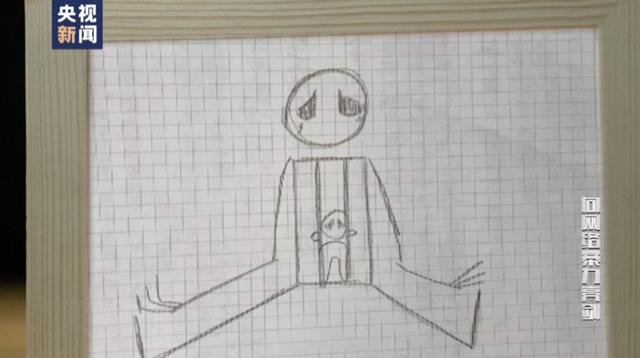
Look at that drawing one more time. A child, trapped inside a cage. Between the graduation photo and this image: six months.
The three layers of analysis in this blog — platform amplification, victim harm, and moderation failure — are not three separate problems. They are interlocking parts of the same system, and this system produced these outcomes not by accident, but by design.
Matamoros-Fernández (2017) shows us that platforms amplify harmful content because engagement is profit, and conflict drives engagement. Carlson and Frazer (2018) show us who pays the price: those forced to choose between existing publicly and staying safe, carrying cumulative harm that no single report can fully capture. Sinpeng et al. (2021) show us why the safety nets fail — because platforms define “hate speech” too narrowly, because gender-based harm is systematically underweighted, and because the experience of being repeatedly ignored ultimately destroys people’s will to keep trying.
The problem is a system — one in which platforms have every commercial incentive to maximize engagement and almost none to minimize harm. And the people most likely to be hurt are the least likely to receive meaningful protection.
Following Zheng Linghua’s death, China revised its laws — the requirement that a comment reach 5,000 views before constituting a criminal offence was amended, and new guidelines on cyberbullying governance were issued (CCTV News, 2024).
The question is not whether we can fix this. It is whether we are willing to demand that platforms fix it before the next tragedy — not after.
References
Carlson, B., & Kennedy, T. (2021). Us Mob Online: The Perils of Identifying as Indigenous on Social Media. Genealogy (Basel), 5(2), 52. https://doi.org/10.3390/genealogy5020052
CCTV News. (2024). “努力想要活下去”的她,最终留下一封遗书走了……时政新闻_中国反邪教网. Chinafxj.cn. https://www.chinafxj.cn/n43/c921221/content.html
Matamoros-Fernández, A. (2017). Platformed racism: the mediation and circulation of an Australian race-based controversy on Twitter, Facebook and YouTube. Information, Communication & Society, 20(6), 930–946. https://doi.org/10.1080/1369118x.2017.1293130
Ock Hyun-ju. (2019, November 3). [Feature] Sulli’s death sparks soul-searching on misogynistic culture, journalism ethics – The Korea Herald. The Korea Herald. https://www.koreaherald.com/article/2143792
Sinpeng, A., Martin, F., Gelber, K., & Shields, K. (2021). Facebook: Regulating hate speech in the Asia Pacific. Department of Media and Communications, University of Sydney; School of Political Science and International Studies, University of Queensland.
UPI. (2019, November 7). Suicide of K-pop star Sulli puts spotlight on cyberbullying – UPI.com. UPI. https://www.upi.com/Top_News/World-News/2019/11/07/Suicide-of-K-pop-star-Sulli-puts-spotlight-on-cyberbullying/4371573147309/#google_vignette
Be the first to comment