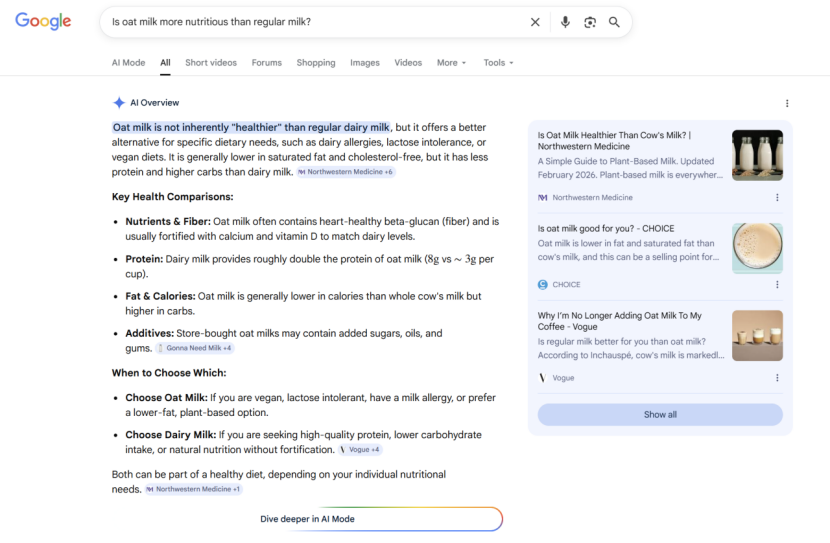
Imagine this scene: You wake up in the morning and are about to have a cup of milk, so you open Google and search “Is oat milk more nutritious than regular milk?”. Before you even open any websites, Google has already given you a AI-generated answer on the top of the page. It seems efficient, but in such a seemingly ordinary moment, you are no longer merely “searching” the internet. Instead, the internet has already “explained” things for you.
From search engines to answer engines
A few years ago, searching for information using Google meant that you had to put in a bit of effort yourself. You needed to enter the question, specify the search keywords, compare different websites, and then try to determine which answer was more reliable. Even so, the algorithm has already determined which content will be presented first, but users still need to browse various sources on their own and make their own judgments (Just & Latzer, 2017).
With the rise of large-scale language models and generative artificial intelligence, this search experience began to change. Instead of providing a list of relevant pages, artificial intelligence now gives an information summary immediately based on the query, making search engines more akin to “answer engines” (Gupta & Bansal, 2025).
The AI Overview launched by Google is a clear example of this transformation, which is similar to the knowledge panel. When users search for keywords, they will first see a summary on the top of the page that includes key information and links, which can help them find the content they want more quickly and easily (Google Search Help, n.d.).
With the Internet facilitating an unprecedented abundance of cultural content, it is easy to understand why this approach sounds so appealing. Most people do not want to search back and forth across different websites or read too much in order to answer a simple question, nor do they want to consider the larger community they belong to and the perspectives of those unknown others who constitute that community (Andrejevic, 2019). In this sense, AI Overview seems to be a reasonable response to information overload.
In the context of the attention economy, users’ attention is a limited resource. This has led to the formation of a zero-click search environment, where people can obtain answers without visiting other websites, allowing their attention to be focused on a single comprehensive response (Gupta & Bansal, 2025). In the field of AI overview, this helps people achieve cognitive focus and enhance interaction with the platform (Gupta & Bansal, 2025).
More than convenience: AI Overview as algorithmic governance
However, convenience is not the entire answer. Kate Crawford (2021) provided helpful insights on the “Clever Hans Effect” in this context, as it demonstrated why artificial intelligence may seem intelligent, but in reality it is derived from patterns that are based on large-scale, hidden human labor and data.
When AI Overview provides an answer, it conceals the complex reality of how the information is produced and selected. Then people may fall into “observer-expectancy effects”, believing that artificial intelligence has objective reasoning ability, while it merely reflects clear and formalized processes and data (Crawford, 2021).
Automated algorithmic selection governs a wide range of individual actions, including what can be found on the internet, what is seen, what is produced, what is considered relevant, and what is expected (Just & Latzer, 2017). In other words, algorithmic selection is not just about finding information, but also helps define what is the most important part of the information through the automatic assignment of relevance to the information (Just & Latzer, 2017).
This is why AI Overview should be understood as a governance mechanism, a tool for exercising rights, and an increasingly autonomous actor – with the power to promote political and economic interests at the individual and collective levels (Just & Latzer, 2017).
Filter bubbles, judgment, and the shaping of public knowledge

The key point of AI Overview lies in the fact that it not only changes the speed at which people obtain information, but also alters the way they initially form judgments about the information (Andrejevic, 2019). When the platform places a ready-made answer directly at the top of the page, people have less reason to browse multiple sources and pay attention to the differences between various statements to form an independent judgment (Andrejevic, 2019). This can lead to the situation where when people go to Google with urgent questions, they are more likely to accept the first answer that appears, even though there may be biases and incorrect information (O’Brien & Swenson, 2024).
Natascha Just and Michael Latzer (2017) further supported this view, arguing that the existing fragmentation and personalization trends among users are caused by the surge in media channels resulting from liberalization, privatization, and digitization. They argued that algorithmic systems are increasingly influencing the visible content, relevance, and expected content in digital life, and this influence often comes at the expense of transparency and user control (Just & Latzer, 2017).
Furthermore, the form of algorithmic personalization may lead to “filter bubbles”. Eli Pariser (2011, p.12) pointed out that a filter bubble “fundamentally alters the way we encounter ideas and information”. Platforms personalize and organize the information environment based on users’ past behaviors, interests, and predicted preferences, thereby creating a more pre-defined and narrower information world (Pariser, 2011).
Thus, what is truly worrying is that the public sphere will become a fragmented world sorted and manipulated by algorithms, which may lead people to only obtain information that confirms their viewpoints or communicate with like-minded individuals, and potentially have negative consequences for democratic societies (Pariser, 2011; Just & Latzer, 2017).
If this sounds a bit abstract, the concept of “black-box society” proposed by Frank Pasquale can make it more specific. The Internet has an unprecedented understanding of people’s daily lives, but people cannot know how these data are evaluated, or how these evaluations affect our rankings, sorting, and ratings (Pasquale, 2015).
The more people rely on search engines to find what they want, the greater the power of exclusion and ranking imposed by it, and the more it can ensure what content becomes permanent and what content is isolated (Pasquale, 2015).
AI Overview is in line with this black-box logic. The user sees only a polished result, and no other steps involved in producing it are visible to him, including how much weight to give sources, what material to discard, and what preset factors have affected the end result. It looks easy enough, but the entire process that goes into creating this answer is not transparent (Pasquale, 2015).
Kate Crawford (2021) has pushed this critique further, arguing that artificial intelligence entails many intersecting power systems, meaning there is no one black box to open. According to Crawford (2021), artificial intelligence constitutes a register of power, always constructed on top of wider structures of labor, infrastructure, capital, and politics. Artificial intelligence needs massive amounts of capital investments and helps optimize the world in the process, thus, artificial intelligence is ultimately designed to serve the existing dominant interests and must be addressed as a political, economic, cultural, and scientific force (Crawford, 2021).
Thus, the mere description of AI Overview as an assistive technology that enables users to save their time fails to address the important question about what this technology optimizes and for whom. Indeed, as Crawford (2021) stated, the issue here is not only increased accessibility of information but also more powerful control over its access and commercialization performed by the platform.
Case analysis: European publishers push back against Google’s AI Overview
The complaints from independent European publishers specifically highlighted this issue of power. In July 2025, the Independent Publishers Alliance filed a lawsuit with the European Commission, arguing that Google’s AI Overview used publisher content to generate featured summaries and harm their original content (Foo, 2025). Publishers did not have an absolute right to withdraw, as once they refused the use of their content by artificial intelligence, their visibility in regular search results may also decline (Foo, 2025).
This conflict did not end there. In December 2025, the EU initiated an antitrust investigation into Google’s use of content from online publishers and the content uploaded to online video-sharing platform YouTube for artificial intelligence purposes (Indhold, 2025). According to a Reuters investigation, EU antitrust chief Teresa Ribera stated that a healthy information ecosystem relies on publishers having the resources to produce high-quality content, and this should not be controlled by gatekeepers (Foo & Rasmussen, 2025).
In February 2026, the European Publishers Council filed a new complaint against AI Overview and AI Mode (Foo, 2026). These events are significant because they illustrate that the issue is not just about technical accuracy or product design, but also a platform economy struggle about who creates value and who can take it away.
In a research carried out by Gillian Bolsover and Philip Howard (2019), it was revealed that the adverse effects that social media has on democratic politics arise from “computational propaganda”, thus, the use of automation technology should not be considered politically neutral or harmless. They found that even though people consciously intended to seek diverse information, what eventually entered was a discourse space that had been pre-set by automated means and was dominated by a small group of stakeholders (Bolsover & Howard, 2019).
Although this article mainly discusses automated bots, AI Overview can be regarded as an expansion of its core logic – computational propaganda. The broader lesson still holds true: once an automated system begins to determine what is prioritized for visibility, it acquires significant political significance.
In addition, according to Tarun Gupta and Supriya Bansal (2025), as time progresses, the advancement of artificial intelligence will only contribute towards creating monopolies and not towards leveling the playing field for accessing information. In case where all information channels being controlled through such technologies, the area of digital advertisements is gradually developing into an industry that is highly concentrated, which will perhaps in the future be dominated solely by particular artificial intelligence service providers (Gupta & Bansel, 2025).
What the future of search should protect?
Overall, AI Overview from Google proves that governance of artificial intelligence technologies not only relies on accuracy of the facts provided but also includes who curates relevance, manages visibility, and directs how people comprehend information. Given the role of algorithms in creating social realities while remaining obscure and under the control of economic actors, AI Overview becomes part of the contestation of the politics-economics-culture nexus (Just & Latzer, 2017).
However, transparency is not sufficient to tackle the problems faced by the AI Overview in Google. As Pasquale (2015) put it, the most pressing risk of black-box technologies does not stem from “secrecy”, but rather from “opacity”. While some information can be made available, the technology itself can be too complex or complicated to be understood by the average person.
That is why it is equally crucial to ensure contestability and accountability. According to Just and Latzer (2017), algorithmic systems have a profound effect on shaping social order because they create relevance and behavior patterns, the outcomes of such systems will determine what the users see and how they act. It is important to consider another point made by Crawford, who emphasized that any AI system is always a part of a more extensive framework related to power and labor relations, it cannot be regulated only technically (Crawford, 2021).
As a result, what is required, besides greater visibility, is an accountability framework, involving more explanation, better exit routes, and governance measures which would hold accountable the dominant platforms that control their construction of knowledge online. In the future, AI Overview must be able to create a more balanced information system, as well as be more accountable and responsible to those who produce the knowledge which informs its system.
Reference list
Andrejevic, M. (2019). Automated Media (1st ed.). Routledge. https://doi.org/10.4324/9780429242595
Bolsover, G., & Howard, P. (2019). Chinese computational propaganda: automation, algorithms and the manipulation of information about Chinese politics on Twitter and Weibo. Information, Communication & Society, 22(14), 2063–2080. https://doi.org/10.1080/1369118X.2018.1476576
Crawford, K. (2021). The Atlas of AI: Power, Politics, and the Planetary Costs of Artificial Intelligence (1st ed.). Yale University Press. https://doi.org/10.2307/j.ctv1ghv45t
Foo, Y. C. (2025, July 4). Exclusive: Google’s AI Overviews hit by EU antitrust complaint from independent publishers. Reuters. https://www.reuters.com/legal/litigation/googles-ai-overviews-hit-by-eu-antitrust-complaint-independent-publishers-2025-07-04/
Foo, Y. C. (2026, February 10). Google hit by European publishers’ complaint to EU over AI summaries. Reuters. https://www.reuters.com/world/european-publishers-council-files-eu-antitrust-complaint-about-googles-ai-2026-02-10/
Foo, Y. C., & Rasmussen, L. (2025, December 9). Google faces EU antitrust investigation over AI Overviews, YouTube. Reuters. https://www.reuters.com/sustainability/boards-policy-regulation/eu-launches-antitrust-probe-into-googles-use-online-content-ai-purposes-2025-12-09/
Google Search Help. (n.d.). Find information in faster & easier ways with AI Overviews in Google Search. https://support.google.com/websearch/answer/14901683?hl=en&utm_source
Google. (n.d.). Is oat milk more nutritious than regular milk? [Figure 1]. https://www.google.com/search?q=Is+oat+milk+more+nutritious+than+regular+milk
Gupta, T., & Bansal, S. (2025). Search Engine Evolution with Generative AI: Rethinking SearchBased Advertising Strategies in the Era of AI-Overviews and Answer Engines. Journal of Marketing & Supply Chain Management, 1–9. https://doi.org/10.47363/jmscm/2025(4)176
IMG visuals icons. (n.d.). Filter bubbles concept icon. Journalism challenge idea thin line illustration. Isolating users from differing viewpoints. Propaganda and manipulation. [Figure 2]. https://stock.adobe.com/au/images/filter-bubbles-concept-icon-journalism-challenge-idea-thin-line-illustration-isolating-users-from-differing-viewpoints-propaganda-and-manipulation-vector-isolated-outline-rgb-color-drawing/403480524
Indhold, S. (2025). Commission opens investigation into possible anticompetitive conduct by Google in the use of online content for AI purposes. European Commission. Retrieved December 9, 2025 from https://ec.europa.eu/commission/presscorner/detail/da/ip_25_2964
Just, N., & Latzer, M. (2017). Governance by algorithms: reality construction by algorithmic selection on the Internet. Media, Culture & Society, 39(2), 238–258. https://doi.org/10.1177/0163443716643157
O’Brien, M., & Swenson, A. (2024, May 25). Cats on the moon? Google’s AI tool is producing misleading responses that have experts worried. AP News. https://apnews.com/article/google-ai-overviews-96e763ea2a6203978f581ca9c10f1b07
Pariser, E. (2011). The filter bubble: what the Internet is hiding from you. Penguin Press.
Pasquale, F. (2015). The black box society : the secret algorithms that control money and information. Harvard University Press. http://www.jstor.org/stable/10.2307/j.ctt13x0hch

Be the first to comment