Before reading this blog, please turn on your YouTube channel. Have you noticed that you can always find videos you want to watch?
Now, try searching for content that interests you and watching a video. After watching, did you notice that you were guided into a content stream that was almost entirely tailored to you, both convenient and fast? Have you ever wondered why? Watch the video below to find out.
Have you ever wondered if this is a form of behavior control?
YouTube’s algorithm has only one goal: to recommend videos that will keep viewers glued to their screens(Glover, R. 2024).Behind this feature is a powerful system driven by artificial intelligence, algorithms, and massive amounts of data.This system not only recommends videos but also actively influences what we see, what we think, and even our online behavior.
In this blog post, I will delve into how YouTube’s recommendation algorithm works, its governance mechanisms, its reliance on deep learning and effective filtering, and how AI predicts trends(How YouTube Recommendation Works 2025). I will illustrate these concepts with practical examples and offer insights into whether this raises concerns about power, bias, and accountability.
Key Concepts
Before moving on to a specific discussion of YouTube, I want to clarify a few key concepts
Artificial Intelligence + Datafication
AI systems heavily rely on data. Everyday behaviors—clicks, likes, dwell time, and viewing duration—are all transformed into analyzable data.
Scholars call this shift part of the “Big Data Revolution,” meaning users are no longer merely audiences but also sources of continuous data extraction.
Algorithms (Just & Latzer)
Algorithms operate using what Just and Latzer call “algorithmic selection”—a process that judges the relevance of information based on user data and behavioral signals. In other words, the content you see is not randomly generated but calculated.
Automation
These systems delegate decision-making power to algorithmic systems rather than humans.
Governance
Algorithmic governance—algorithms not only collect and analyze data but also shape social behavior and decision-making.
Recommendation System
YouTube’s recommendation system is more than just “finding videos you want to watch.” It’s backed by a complex suite of technologies. Every click, like, or even just a few extra seconds of viewing is recorded and becomes part of the data.
This data is fed into the system for continuous testing, allowing it to more accurately predict what you’ll want to watch next.
The following are the key elements of YouTube’s algorithm:
Content Characteristics

For example, I’ve been watching videos of people catching big fish lately, and now when I open my homepage, YouTube is clearly pushing videos of other people’s catches, efficient fishing tips, and even promotional information from fishing tackle vendors.
It also links videos that users frequently watch together. If a user clicks “Caught a 2m shark today” after watching content related to recommended fishing locations, you’re likely to see videos like “A day of unlocking giants on the central coast” in the recommendation list.
It relies on metadata in the title, tags, and description.
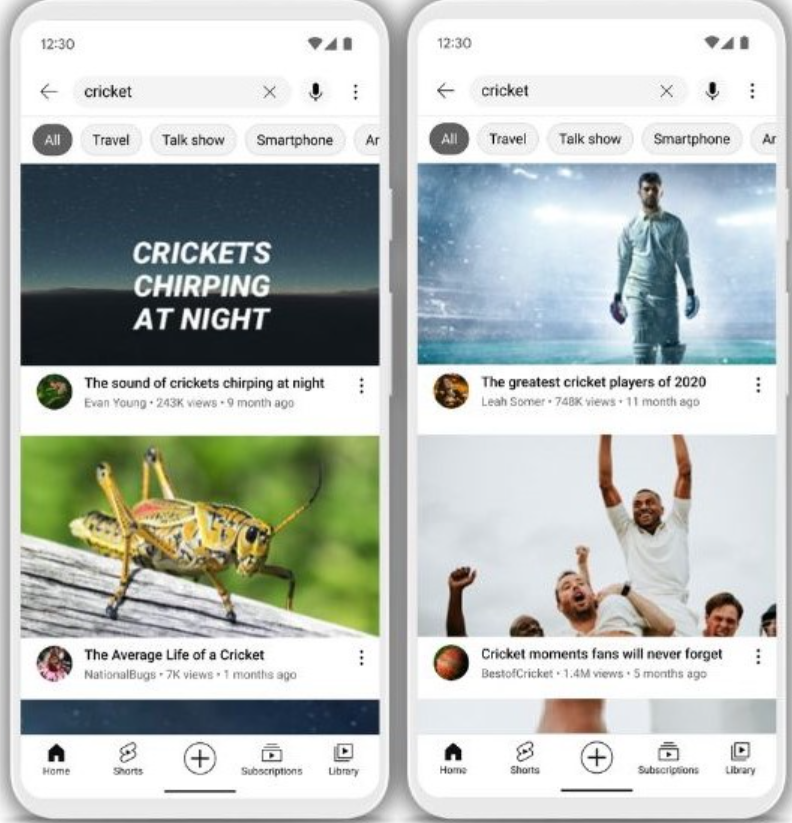
YouTube search results
Searching seems to simply tell YouTube what you want to watch, but the search results vary slightly from person to person.
Search for “line” and see what happens.

As you can see on my search page, “line” is a fhishing line. In this case, YouTube’s algorithm will adjust your viewing behavior.
Let’s look at how different people searching for the same thing yield completely different results.
How?
The problem is, the system’s goal isn’t to make you see more, but to make you watch longer.
From this perspective, YouTube’s recommendation system perfectly demonstrates how AI-driven platforms work: it transforms user data into a stepping stone, gradually influencing the content you see through algorithms, even affecting your interests and behaviors.
More importantly, this influence is often subtle and difficult to perceive. You won’t realize why you keep scrolling, and you’ll hardly know where these recommendations come from. Behind the scenes, all of this serves a very clear goal—to increase user engagement and thus generate more advertising revenue(How YouTube Recommendation Works 2025).
Behavior Shaping
Just & Latzer stated, “As the algorithmic system learns from repeated user interactions, YouTube not only responds to user behavior but also begins to shape it.” The more data the algorithm learns about you based on the data you provide, the greater its influence on your life.
Besides pushing more content tailored to your tastes, YouTube’s collected and stored data is also used to create personalized ads with highly accurate targeting. For example, I rarely buy fishing gear offline anymore; YouTube pushes ads to advertisers cheaply and conveniently.
Of course, this type of algorithm also has problems. For example, some hateful and inflammatory content gets more clicks and shares. Therefore, some people find themselves receiving various extremist, violent, and hateful content (算法 — 日常和人生十字路口陪伴你的“无形之手” 2020).
You’re not just choosing videos—the system is guiding your choices.
Information Cocoons
Have you noticed that your YouTube channel seems to know you better and better?
This is no coincidence—it’s what we commonly call an “information cocoon.”
Initially, this makes us happy. The more of a certain type of content you watch, the more related videos YouTube shows you.
But here’s the problem.
As you continue watching, your information flow becomes increasingly personalized—meaning it becomes less diverse. Over time, this affects your way of thinking. Not because you’re forced to choose, but because you’re not exposed to anything else.
While people within the same “information cocoon” may begin to identify more with each other, different groups create increasing disparities, exacerbating concerns about opinion polarization(Chen, S., Qiu, H., & He, W. 2025).
So, in a sense, YouTube is subtly shaping the world you see.
Bias
Noble (2018) shows how algorithmic systems can reproduce social inequalities and biases, particularly around race and gender.
Research on YouTube’s recommendation system has also revealed its potential biases. A large-scale study using 100,000 simulated user accounts found that YouTube’s algorithm does indeed tend to reinforce users’ existing political views. Right-leaning users, in particular, are more likely to receive recommendations that align with (and sometimes even reinforce) their views (Iyer, P. 2023).

This suggests that YouTube’s algorithm may amplify extreme or misleading content, thereby exacerbating ideological biases.
Black Box
Pasquale (2015) describes algorithmic systems as “black boxes,” whose decision-making processes are opaque and difficult to question.
A Mozilla study analyzing data from over 37,000 users found that 71% of “regrettable” videos—including misinformation and harmful content—were recommended by YouTube itself (Investigating YouTube’s algorithmic black box. 2021).
In many cases, users were directed to watch content that even violated platform guidelines, but the reasons behind these recommendations remain unknown.
YouTube’s algorithm can cause harmful consequences, but its accountability mechanisms are very limited.
Power
Crawford argues that artificial intelligence is not merely a technology, but a form of power shaped by economic and political interests.
YouTube’s recommendation A.I. is designed to maximize the time users spend online. Fiction often outperforms reality(Chaslot, G. 2017).
We’ve all heard of conspiracy theories and fake news circulating online. How does YouTube’s algorithm influence their spread?
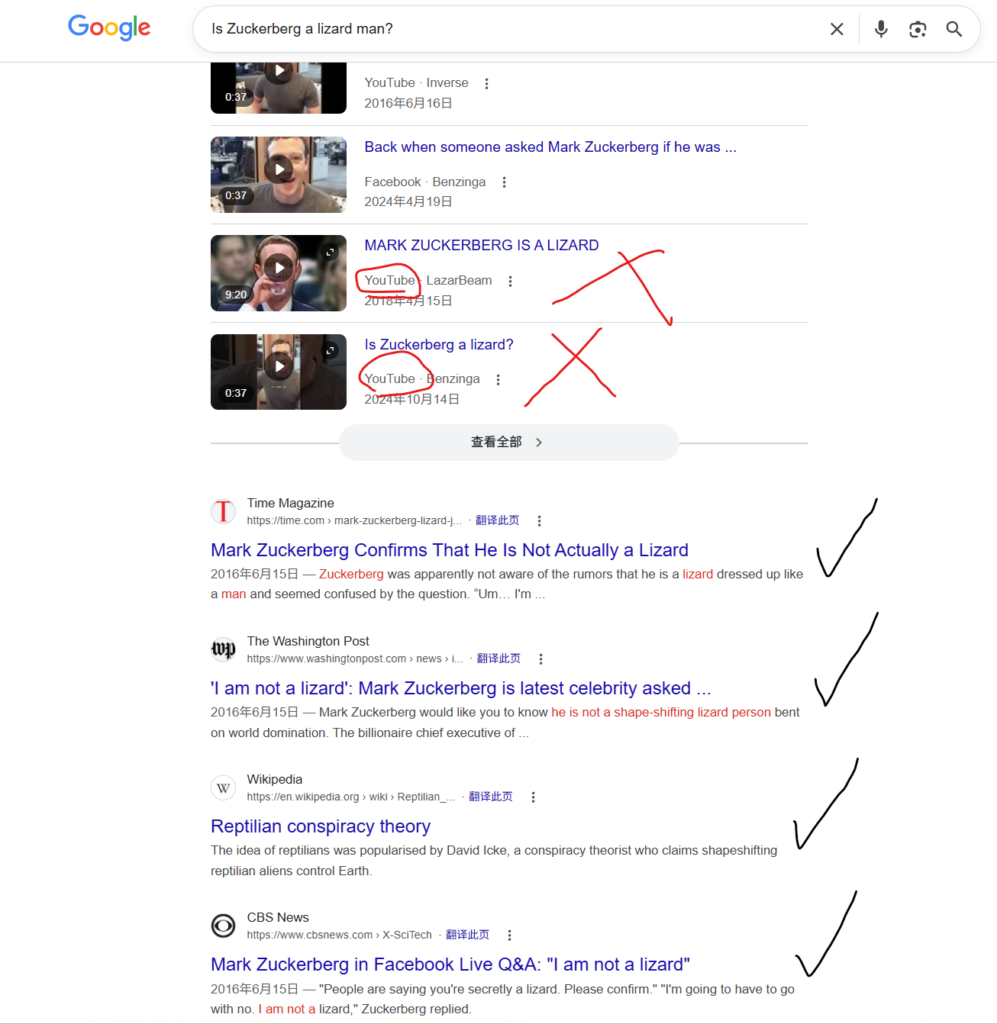
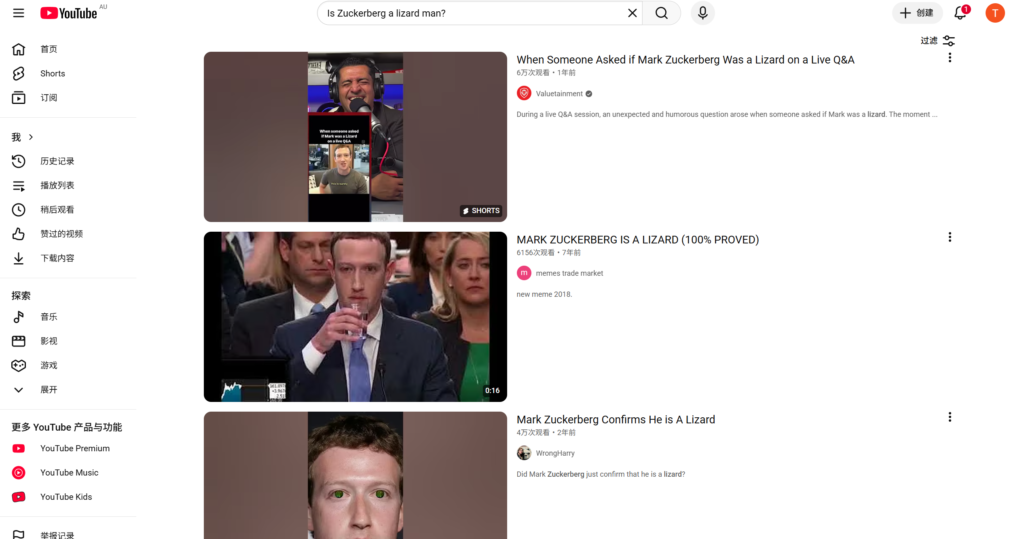
To test this hypothesis, I will search for 2 objective facts and compare the results of Google and YouTube search queries.
The following query results are sufficient to illustrate the point:
1.Is Zuckerberg a lizard man?
2.American president
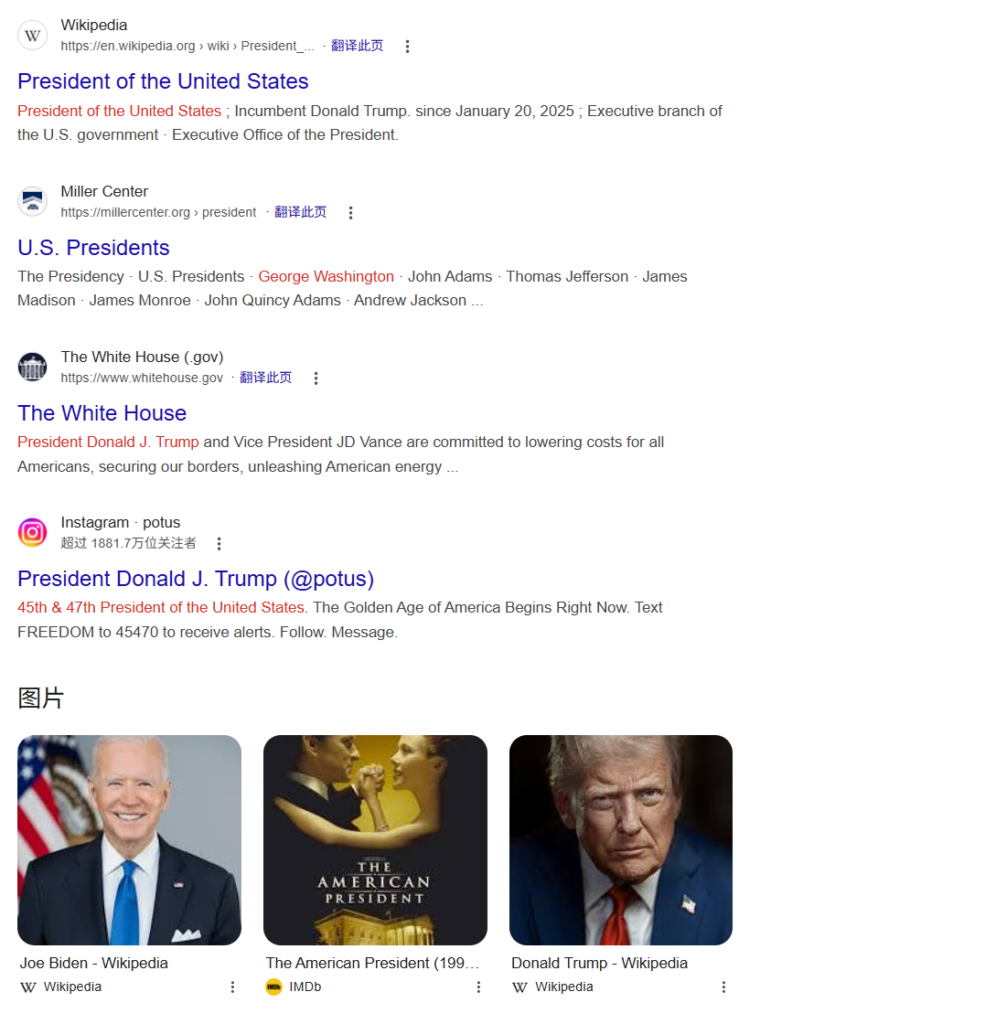
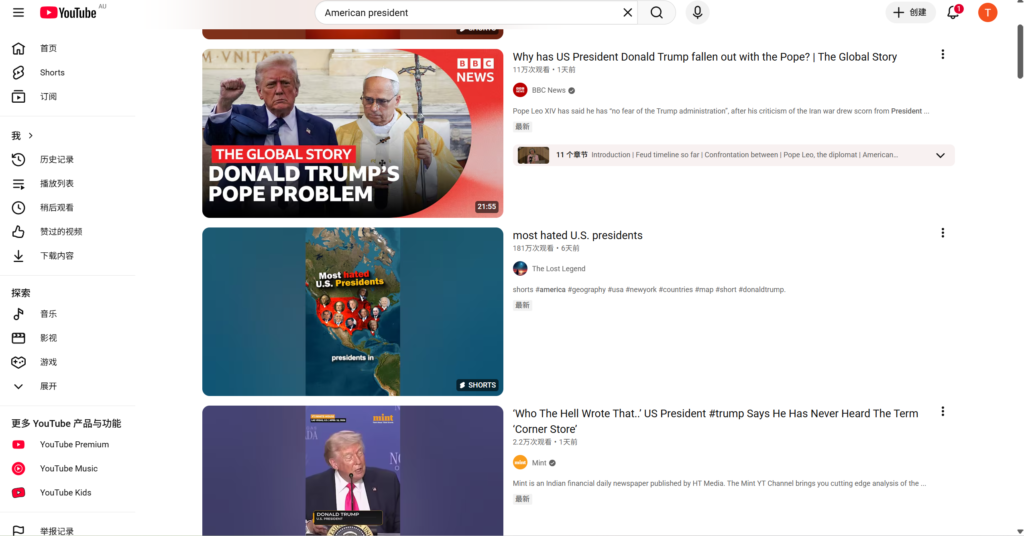
It’s quite obvious that YouTube tends to favor sensational headlines.
YouTube’s recommendation mechanism differs from search. Search results are typically based on relevance, meaning you can find content you actually want to see. However, YouTube’s recommendation system aims to extend viewing time, so it prioritizes watch duration.
This is why even videos with many negative reviews (including conspiracy theories) are still widely recommended. Once they perform well, more creators will produce similar content.
Ultimately, a large number of similar videos makes these viewpoints seem more credible than reality.
Currently, YouTube’s algorithm prioritizes maximizing user engagement and profit, rather than truth or fairness…
Governance
So… what can we actually do?
The problem is that YouTube’s algorithm is like a vast ocean; we don’t really understand its depths, why certain videos are pushed to us, or who is responsible when problems arise.
This is why people protest in various ways.
You may have seen creators post videos complaining about being disqualified from monetization, unfairly punished, or recommended content they don’t like. Essentially, this is users trying to understand the system and questioning it when something feels wrong (Just, N., & Latzer, M. 2016).
Sometimes, this does work. If enough people discuss the issue, YouTube might respond or make some changes, but usually only to creators with large followings.
This confirms Crawford’s point: “In the broader power structure, AI systems are embedded in an economic system that prioritizes exploitation and control.” Even with a voice, the platform still holds most of the power.
Ultimately, the current direction of governance is no longer just government governance; platforms are also gradually getting involved. Platforms like YouTube manage through algorithms, thus shaping the content users see.
Base on that,Let’s watch this Video below
Interestingly, even videos explaining how YouTube’s algorithm works are posted on YouTube.
This reveals an important fact: even if we try to change the system, we are still within the platform.
This raises a crucial question: when questioning remains confined to the same algorithm, can we truly challenge the system itself?
No one can answer that.
Additional discussion
This isn’t just a problem of recommended content; there are deeper reasons behind it.
The existence of harmful or hateful content online is not accidental. It often follows the same pattern: algorithms push attractive content, and creators cater to the algorithm’s pushes. Ultimately, it all revolves around the profits of the YouTube platform and creators.
This is why you sometimes see extreme content go viral—because it consistently attracts viewers.
Therefore, simply deleting videos won’t solve this problem; the system itself needs improvement.These three points below are indispensable (媛张, & 云峰何. 2025).
- Improve algorithm technical standards (effectively filter low-quality content)
- Increase algorithm transparency (abandon the black box and make it easier to understand)
- Optimize the algorithm recommendation mechanism (recommendations should not be based solely on clicks and viewing time)
But we must ask ourselves, when the interests of platforms and creators are at stake, do we have the ability and the right to change it?
Conclusion
Ultimately, YouTube’s recommendation system doesn’t just help us find videos we want to watch; it shapes our preferences and even our behavior.
While you might sometimes feel confident in your ability to control your viewing habits, in reality, algorithms often guide you into the environment they create.
This doesn’t mean the algorithm is a “demon that changes you,” so perhaps the real issue isn’t just some unreasonable recommendations,
but rather exploring who has the right to question and change these systems.
AI Appendix
The article outline was generated using AI, and some paragraphs were structurally modified. No other content was generated using AI.
References
- Flew, Terry (2021) Regulating Platforms. Cambridge: Polity, pp. 79-86.
- Crawford, Kate (2021) The Atlas of AI: Power, Politics, and the Planetary Costs of Artificial Intelligence. New Haven, CT: Yale University Press, pp. 1-21.
- Pasquale, Frank (2015). ‘The Need to Know’, in The Black Box Society: the secret algorithms that control money and information. Cambridge: Harvard University Press, pp.1-18.
- Just, Natascha & Latzer, Michael (2019) ‘Governance by algorithms: reality construction by algorithmic selection on the Internet’, Media, Culture & Society 39(2), pp. 238-258.
- Glover, R. (2024). How the YouTube Algorithm Works in 2023 (+14 Tips for More Views). WordStream. https://www.wordstream.com/blog/ws/2023/09/15/youtube-algorithm
- How YouTube Recommendation Works: A Deep Dive into AI, Deep Learning, and Collaborative Filtering. (2025, March 21). Data Science. https://ingrade.io/how-youtube-recommendation-works-a-deep-dive-into-ai-deep-learning-and-collaborative-filtering/
- https://www.facebook.com/bbcworldservice. (2020, August 19). 算法 — 日常和人生十字路口陪伴你的“无形之手” – BBC News 中文. BBC News 中文. https://www.bbc.com/zhongwen/simp/science-53820546
- Chen, S., Qiu, H., & He, W. (2025). The information cocoon paradox: fostering unity or fueling divergence? Humanities and Social Sciences Communications, 12(1). https://doi.org/10.1057/s41599-025-05169-0
- Investigating YouTube’s algorithmic black box. (2021, July 13). Digital Content Next. https://digitalcontentnext.org/blog/2021/07/13/investigating-youtubes-algorithmic-black-box/
- Iyer, P. (2023, December 7). New Study Suggests Right-Wing Bias in YouTube Recommendation Algorithm | TechPolicy.Press. Tech Policy Press. https://www.techpolicy.press/new-study-suggests-rightwing-bias-in-youtube-recommendation-algorithm/
- Chaslot, G. (2017, April 3). How YouTube’s A.I. boosts alternative facts. Medium. https://guillaumechaslot.medium.com/how-youtubes-a-i-boosts-alternative-facts-3cc276f47cf7
- Just, N., & Latzer, M. (2016). Governance by algorithms: reality construction by algorithmic selection on the Internet. Media, Culture & Society, 39(2), 238–258.
- 媛张, & 云峰何. (2025, May). 互联网短视频内容的生产、逻辑及治理. 中国新闻培训网. https://www.xwpx.com/article/2025/0509/article_72042.html


Be the first to comment